
Pulp Fiction, 1927 · page 94 of 107
Amazing Stories, August 1927 — page 94: what you’re looking at
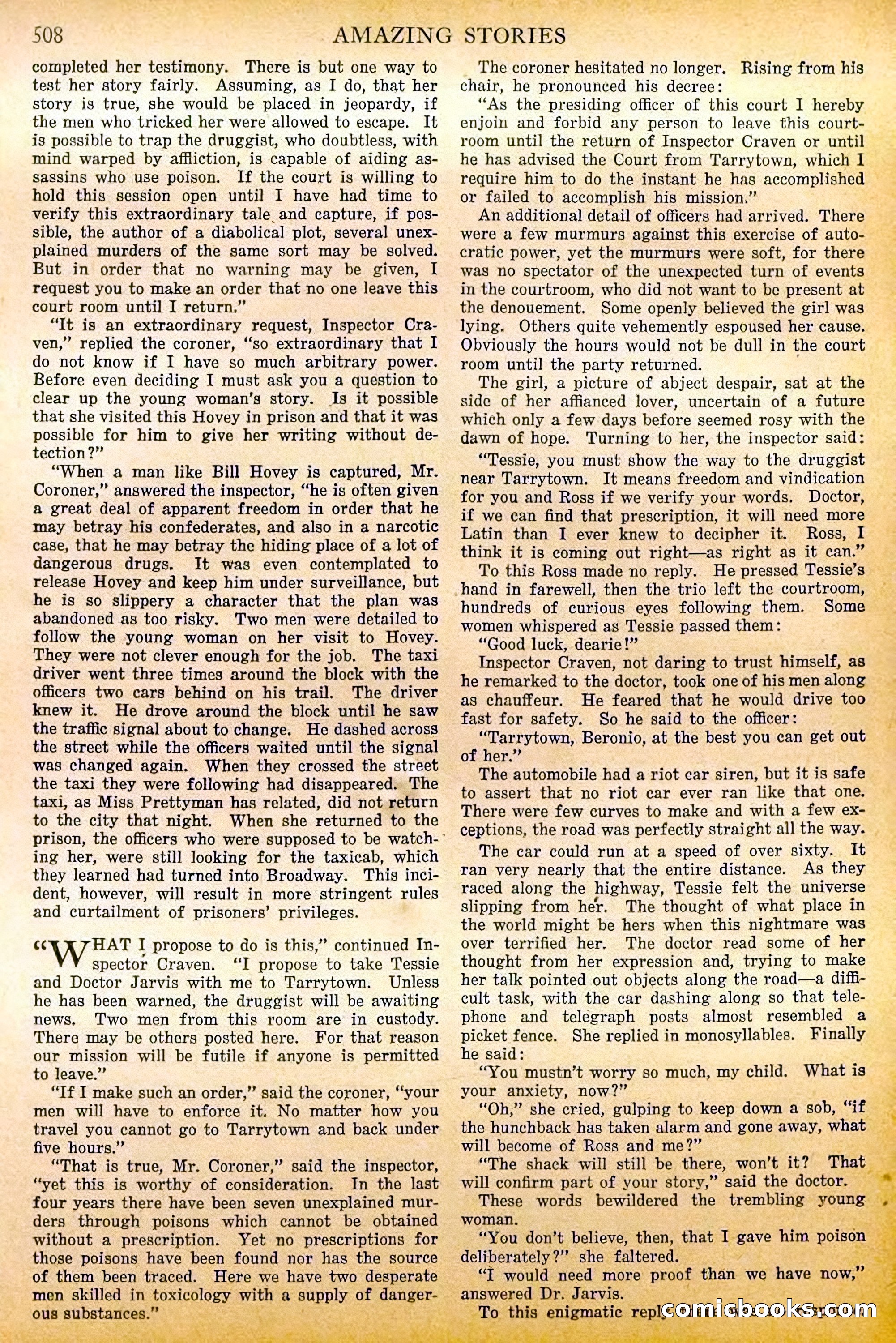
A restored page from Pulp Fiction, 1927. Page through the whole issue in the reader above.
📄 Transcribed text from this page (OCR, searchable)
Machine-transcribed from the original scan — historical spelling and the odd misread are preserved.
508 completed her testimony. There is but one way to test her story fairly. Assuming, as I do, that her story is true, she would be placed in jeopardy, if the men who tricked her were allowed to escape. It is possible to trap the druggist, who doubtless, with mind warped by affliction, is capable of aiding as- sassins who use poison. If the court is willing to hold this session open until I have had time to verify this extraordinary tale and capture, if pos- sible, the author of a diabolical plot, several unex- plained murders of the same sort may be solved. But in order that no warning may be given, I request you to make an order that no one leave this court room until I return.” “Tt is an extraordinary request, Inspector Cra- ven,” replied the coroner, ‘‘so extraordinary that I do not know if I have so much arbitrary power. Before even deciding I must ask you a question to clear up the young woman's story. Is it possible that she visited this Hovey in prison and that it was possible for him to give her writing without de- tection?” “When a man like Bill Hovey is captured, Mr. Coroner,” answered the inspector, “he is often given a great deal of apparent freedom in order that he may betray his confederates, and also in a narcotic case, that he may betray the hiding place of a lot of dangerous drugs. It was even contemplated to release Hovey and keep him under surveillance, but he is so slippery a character that the plan was abandoned as too risky. Two men were detailed to follow the young woman on her visit to Hovey. They were not clever enough for the job. The taxi driver went three times around the block with the officers two cars behind on his trail. The driver knew it. He drove around the block until he saw the traffic signal about to change. He dashed across the street while the officers waited until the signal was changed again. When they crossed the street the taxi they were following had disappeared. The taxi, as Miss Prettyman has related, did not return to the city that night. When she returned to the prison, the officers who were supposed to be watch-~ ing her, were still looking for the taxicab, which they learned had turned into Broadway. This inci- dent, however, will result in more stringent rules and curtailment of prisoners’ privileges. eh 9, Vaasa I propose to do is this,” continued In- spector Craven. “I propose to take Tessie and Doctor Jarvis with me to Tarrytown. Unless he has been warned, the druggist will be awaiting news. Two men from this room are in custody. There may be others posted here. For that reason our mission will be futile if anyone is permitted to leave.” “Tf I make such an order,” said the coroner, “your men will have to enforce it. No matter how you travel you cannot go to Tarrytown and back under five hours.” “That is true, Mr. Coroner,” said the inspector, “yet this is worthy of consideration. In the last four years there have been seven unexplained mur- ders through poisons which cannot be obtained without a prescription. Yet no prescriptions for those poisons have been found nor has the source of them been traced. Here we have two de men skilled in toxicolog deliberately?” sh faltere¢ OR aay | EA NMS Cap eG. ook AMAZING STORIES The coroner hesitated no longer. chair, he pronounced his decree: “As the presiding officer of this court I hereby enjoin and forbid any person to leave this court- room until the return of Inspector Craven or until he has advised the Court from Tarrytown, which I require him to do the instant he has accomplished or failed to accomplish his mission.” : An additional detail of officers had arrived. There were a few murmurs against this exercise of auto- cratic power, yet the murmurs were soft, for there was no spectator of the unexpected turn of events in the courtroom, who did not want to be present at the denouement. Some openly believed the girl was lying. Others quite vehemently espoused her cause. Obviously the hours would not be dull in the court room until the party returned. The girl, a picture of abject despair, sat at the side of her affianced lover, uncertain of a future which only a few days before seemed rosy with the dawn of hope. Turning to her, the inspector said: “Tessie, you must show the way to the druggist near Tarrytown. It means freedom and vindication for you and Ross if we verify your words. Doctor, if we can find that prescription, it will need more Latin than I ever knew to decipher it. Ross, I~ think it is coming out right—as right as it can.” To this Ross made no reply. He pressed Tessie’s — hand in farewell, then the trio left the courtroom, hundreds of curious eyes following them. Some women whispered as Tessie passed them: “Good luck, dearie!” . Inspector Craven, not daring to trust himself, as he remarked to the doctor, took one of his men along a as chauffeur. He feared that he would drive too ~ fast for safety. So he said to the officer: “¥ “Tarrytown, Beronio, at the best you can get out of her.” The automobile had a riot car siren, but it is safe to assert that no riot car ever ran like that one. There were few curves to make and with a few ex- ceptions, the road was perfectly straight all the way. The car could run at a speed of over sixty. It ran very nearly that the entire distance. As they raced along the highway, Tessie felt the universe slipping from her. The thought of what place in the world might be hers when this nightmare was over terrified her. The doctor read some of her thought from her expression and, trying to make her talk pointed out objects along the road—a diffi- cult task, with the car dashing along so that tele- phone and telegraph posts almost resembled a picket fence. She replied in monosyllables. Finally he said: ‘You mustn’t worry so much, my child. What is your anxiety, now?” a “Qh,” she cried, gulping to keep down a sob, “if — the hunchback has taken alarm and gone away, what will become of Ross and me?” “The shack will still be there, won’t it? Th will confirm part of your story,” said the doctor. These words bewildered the trembling woman. ae “You don’t believe, then, that T gave him sa Rising from his oe ee ilk aay