
Pulp Fiction, 1927 · page 92 of 107
Amazing Stories, August 1927 — page 92: what you’re looking at
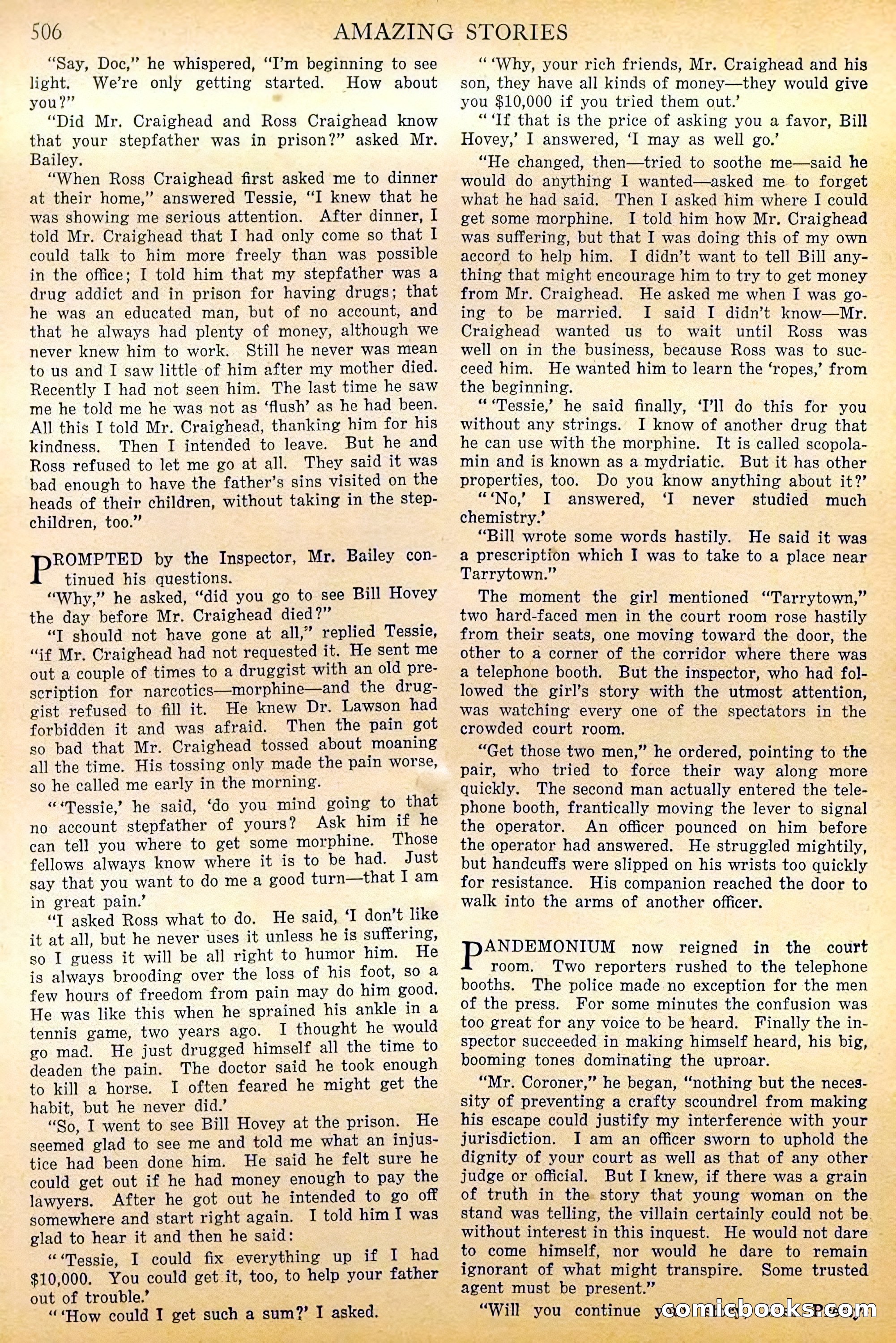
A restored page from Pulp Fiction, 1927. Page through the whole issue in the reader above.
📄 Transcribed text from this page (OCR, searchable)
Machine-transcribed from the original scan — historical spelling and the odd misread are preserved.
506 “Say, Doc,” he whispered, “I’m beginning to see light. We’re only getting started. How about you?” “Did Mr. Craighead and Ross Craighead know that your stepfather was in prison?” asked Mr. Bailey. “When Ross Craighead first asked me to dinner at their home,” answered Tessie, “I knew that he was showing me serious attention. After dinner, I told Mr. Craighead that I had only come so that I could talk to him more freely than was possible in the office; I told him that my stepfather was a drug addict and in prison for having drugs; that he was an educated man, but of no account, and that he always had plenty of money, although we never knew him to work. Still he never was mean to us and I saw little of him after my mother died. Recently I had not seen him. The last time he saw me he told me he was not as ‘flush’ as he had been. All this I told Mr. Craighead, thanking him for his kindness. Then I intended to leave. But he and Ross refused to let me go at all. They said it was bad enough to have the father’s sins visited on the heads of their children, without taking in the step- children, too.” ROMPTED by the Inspector, Mr. Bailey con- tinued his questions. : “Why,” he asked, “did you go to see Bill Hovey the day before Mr. Craighead died?” : “T should not have gone at all,” replied Tessie, ‘Gf Mr, Craighead had not requested it. He sent me out a couple of times to a druggist with an old pre- seription for narcotics—morphine—and the drug- gist refused to fill it. He knew Dr. Lawson had forbidden it and was afraid. Then the pain got so bad that Mr. Craighead tossed about moaning all the time. His tossing only made the pain worse, go he called me early in the morning. “‘Messie” he said, ‘do you mind going to. that no account stepfather of yours? Ask him if he can tell you where to get some morphine. Those fellows always know where it is to be had. Just say that you want to do mea good turn—that I am in great pain.’ : « sitod Ross what to do. He said, ‘I don’t like it at all, but he never uses it unless he is suffering, so I guess it will be all right to humor him. He is always brooding over the loss of his foot, so a few hours of freedom from pain may do him good. He was like this when he sprained his ankle in a tennis game, two years ago. I thought he would go mad. He just drugged himself all the time to deaden the pain. The doctor said he took enough to kill a horse. I often feared he might get the habit, but he never did.’ “So, I went to see Bill Hovey at the prison. He seemed glad to see me and told me what an injus- tice had been done him. He said he felt sure he could get out if he had money enough to pay the lawyers. After he got out he intended to go off somewhere and start right again. I told himI was glad to hear it and then he said: “Tessie, I could fix everything up if I had $10,000. You could get it, too, to help your father out of trouble.’ “How could I get such a sum?’ I asked. AMAZING STORIES “Why, your rich friends, Mr. Craighead and his son, they have all kinds of money—they would give you $10,000 if you tried them out.’ “Tf that is the price of asking you a favor, Bill Hovey,’ I answered, ‘I may as well go.’ “He changed, then—tried to soothe me—said he would do anything I wanted—asked me to forget what he had said. Then I asked him where I could get some morphine, I told him how Mr. Craighead was suffering, but that I was doing this of my own aecord to help him. I didn’t want to tell Bill any- thing that might encourage him to try to get money from Mr. Craighead. He asked me when I was go- ing to be married. I said I didn’t know—Mr. Craighead wanted us to wait until Ross was well on in the business, because Ross was to suc- ceed him. He wanted him to learn the ‘ropes,’ from the beginning. “ ‘Tessie,’ he said finally, ‘I’ll do this for you without any strings. I know of another drug that he can use with the morphine. It is called scopola- min and is known as a mydriatic. But it has other properties, too. Do you know anything about it?’ “‘No,’ I answered, ‘I never studied much chemistry.’ “Bill wrote some words hastily. He said it was a prescription which I was to take to a place near Tarrytown.” The moment the girl mentioned “Tarrytown,” two hard-faced men in the court room rose hastily from their seats, one moving toward the door, the other to a corner of the corridor where there was a telephone booth. But the inspector, who had fol- lowed the girl’s story with the utmost attention, was watching every one of the spectators in the crowded court room. “Get those two men,” he ordered, pointing to the pair, who tried to force their way along more quickly. The second man actually entered the tele- phone booth, frantically moving the lever to signal the operator. An officer pounced on him before the operator had answered. He struggled mightily, but handcuffs were slipped on his wrists too quickly for resistance. His companion reached the door to walk into the arms of another officer. ANDEMONIUM now reigned in the court room. Two reporters rushed to the telephone booths. The police made no exception for the men of the press. For some minutes the confusion was too great for any voice to be heard. Finally the in- spector succeeded in making himself heard, his big, booming tones dominating the uproar. “Mr. Coroner,” he began, “nothing but the neces- sity of preventing a crafty scoundrel from making his escape could justify my interference with your jurisdiction. I am an officer sworn to uphold the dignity of your court as well as that of any other judge or official. But I knew, if there was a grain of truth in the story that young woman on the stand was telling, the villain certainly could not be. without interest in this inquest. He would not dare — to come himself, nor would he dare to remain ignorant of what might transpire. Some trusted agent must be present.” “Will you continue E| Ree ee eae Se Soc michooks.com nati