
Pulp Fiction, 1927 · page 91 of 107
Amazing Stories, August 1927 — page 91: what you’re looking at
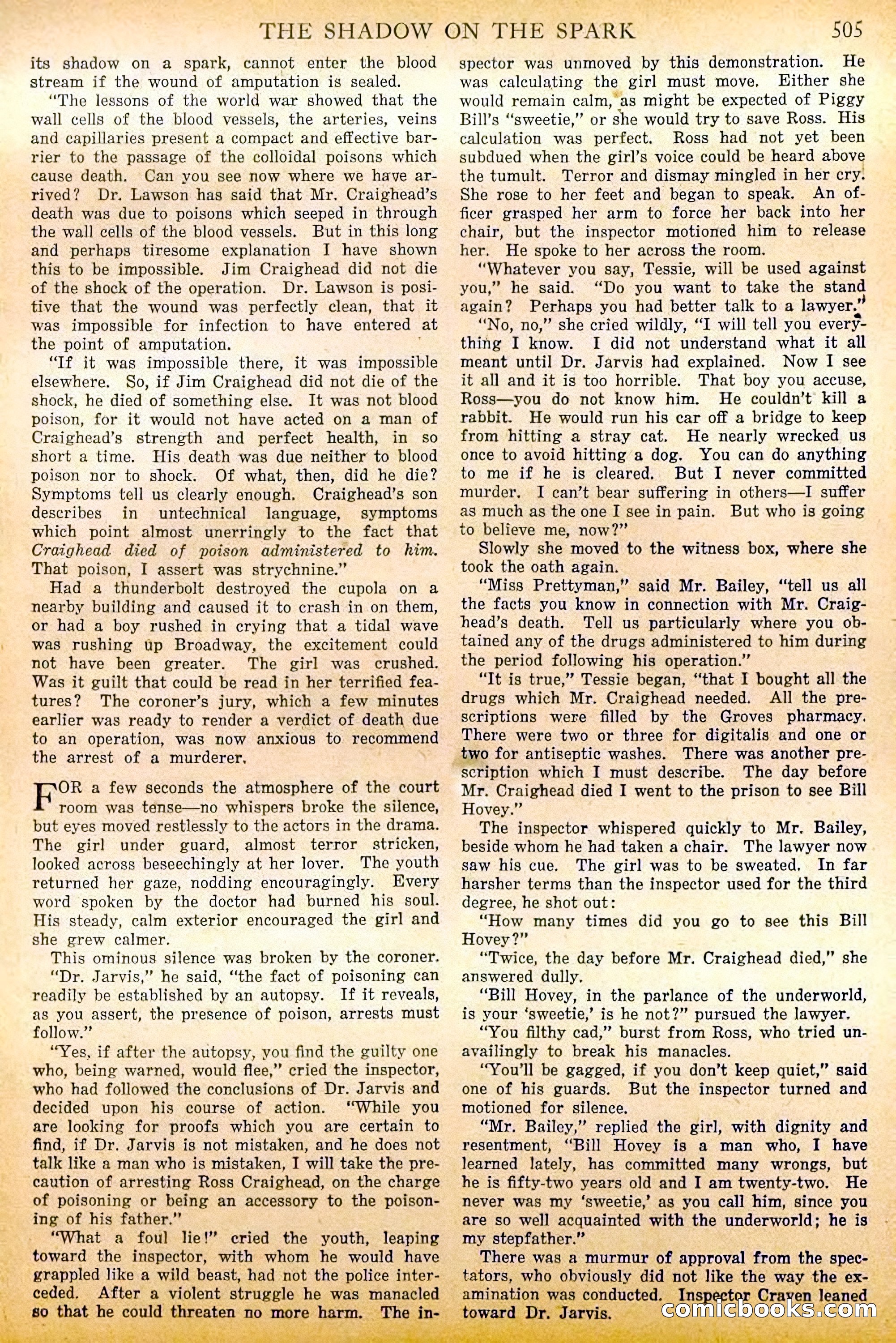
A restored page from Pulp Fiction, 1927. Page through the whole issue in the reader above.
📄 Transcribed text from this page (OCR, searchable)
Machine-transcribed from the original scan — historical spelling and the odd misread are preserved.
_ grappled like a wild beast, had not the police inter- THE SHADOW ON THE SPARK its shadow on a spark, cannot enter the blood stream if the wound of amputation is sealed. “The lessons of the world war showed that the wall cells of the blood vessels, the arteries, veins and capillaries present a compact and effective bar- rier to the passage of the colloidal poisons which cause death. Can vou see now where we have ar- rived? Dr. Lawson has said that Mr. Craighead’s death was due to poisons which seeped in through the wall cells of the blood vessels. But in this long and perhaps tiresome explanation I have shown this to be impossible. Jim Craighead did not die of the shock of the operation. Dr. Lawson is posi- tive that the wound was perfectly clean, that it was impossible for infection to have entered at the point of amputation. “Tf it was impossible there, it was impossible elsewhere, So, if Jim Craighead did not die of the shock, he died of something else. It was not blood poison, for it would not have acted on a man of Craighead’s strength and perfect health, in so short a time. His death was due neither to blood poison nor to shock. Of what, then, did he die? Symptoms tell us clearly enough, Craighead’s son describes in untechnical language, symptoms which point almost unerringly to the fact that Craighead. died of poison administered to him. That poison, I assert was strychnine.” Had a thunderbolt destroyed the cupola on a nearby building and caused it to crash in on them, or had a boy rushed in crying that a tidal wave was rushing tp Broadway, the excitement could not have been greater. The girl was crushed. Was it guilt that could be read in her terrified fea- tures? The coroner’s jury, which a few minutes earlier was ready to render a verdict of death due to an operation, was now anxious to recommend the arrest of a murderer, Ro a few seconds the atmosphere of the court room was tense—no whispers broke the silence, but eyes moved restlessly to the actors in the drama. The girl under guard, almost terror stricken, looked across beseechingly at her lover. The youth returned her gaze, nodding encouragingly. Every word spoken by the doctor had burned his soul. His steady, calm exterior encouraged the girl and she grew calmer. This ominous silence was broken by the coroner, “Dr. Jarvis,” he said, “the fact of poisoning can readily be established by an autopsy. If it reveals, as you assert, the presence of poison, arrests must follow.” “Yes, if after the autopsy, you find the guilty one who, being warned, would flee,” cried the inspector, who had followed the conclusions of Dr. Jarvis and decided upon his course of action. “While you are looking for proofs which you are certain to find, if Dr. Jarvis igs not mistaken, and he does not talk like a man who is mistaken, I will take the pre- ‘caution of arresting Ross Craighead, on the charge of poisoning or being an accessory to the poison- ing of his father.” “What a foul lie!” cried the youth, leaping toward the inspector, with whom he would have a violent truggle he was manacle _two for antiseptic washes. _ tators, who obviously did not like the way aD) ex- 505 spector was unmoved by this demonstration. He was calculating the girl must move, Hither she would remain calm, as might be expected of Piggy Bill’s “sweetie,” or she would try to save Ross. His calculation was perfect. Ross had not yet been subdued when the girl’s voice could be heard above the tumult. Terror and dismay mingled in her cry. She rose to her feet and began to speak. An of- ficer grasped her arm to force her back into her chair, but the inspector motioned him to release her. He spoke to her across the room. “Whatever you say, Tessie, will be used against you,” he said. “Do you want to take the stand again? Perhaps you had better talk to a lawyer,” “No, no,” she cried wildly, “I will tell you every- thing I know. I did not understand what it all meant until Dr. Jarvis had explained. Now I see it all and it is too horrible. That boy you accuse, Ross—you do not know him. He couldn’t kill a rabbit. He would run his car off a bridge to keep from hitting a stray cat. He nearly wrecked us once to avoid hitting a dog. You can do anything to me if he is cleared. But I never committed murder, I can’t bear suffering in others—I suffer as much as the one I seein pain. But who is going to believe me, now?” Slowly she moved to the witness box, where she took the oath again. “Miss Prettyman,” said Mr. Bailey, ‘‘tell us all the facts you know in connection with Mr. Craig- head’s death. Tell us particularly where you ob- tained any of the drugs administered to him during the period following his operation.” “It is true,” Tessie began, “that I bought all the drugs which Mr. Craighead needed. All the pre- scriptions were filled by the Groves pharmacy. There were two or three for digitalis and one or There was another pre- scription which I must describe. The day before Mr. Craighead died I went to the prison to see Bill Hovey.” The inspector whispered quickly to Mr. Bailey, beside whom he had taken a chair. The lawyer now saw his cue. The girl was to be sweated. In far harsher terms than the inspector used for the third degree, he shot out: “How many times did you go to see this Bill Hovey?” “Twice, the day before Mr. Craighead died,” she answered dully. “Bill Hovey, in the parlance of the underworld, is your ‘sweetie,’ is he not?” pursued the lawyer. “You filthy cad,” burst from Ross, who tried un- availingly to break his manacles. “You'll be gagged, if you don’t keep quiet,” said one of his guards. But the inspector turned and motioned for silence. : “Mr. Bailey,” replied the girl, with dignity and resentment, “Bill Hovey is a man who, I have learned lately, has committed many wrongs, but he is fifty-two years old and I am twenty-two. He never was my ‘sweetie,’ as you call him, since you are so well acquainted with the underworld; he is my stepfather.” ‘There was a murmur of approval from the spec- d. oR