
Pulp Fiction, 1927 · page 81 of 107
Amazing Stories, August 1927 — page 81: what you’re looking at
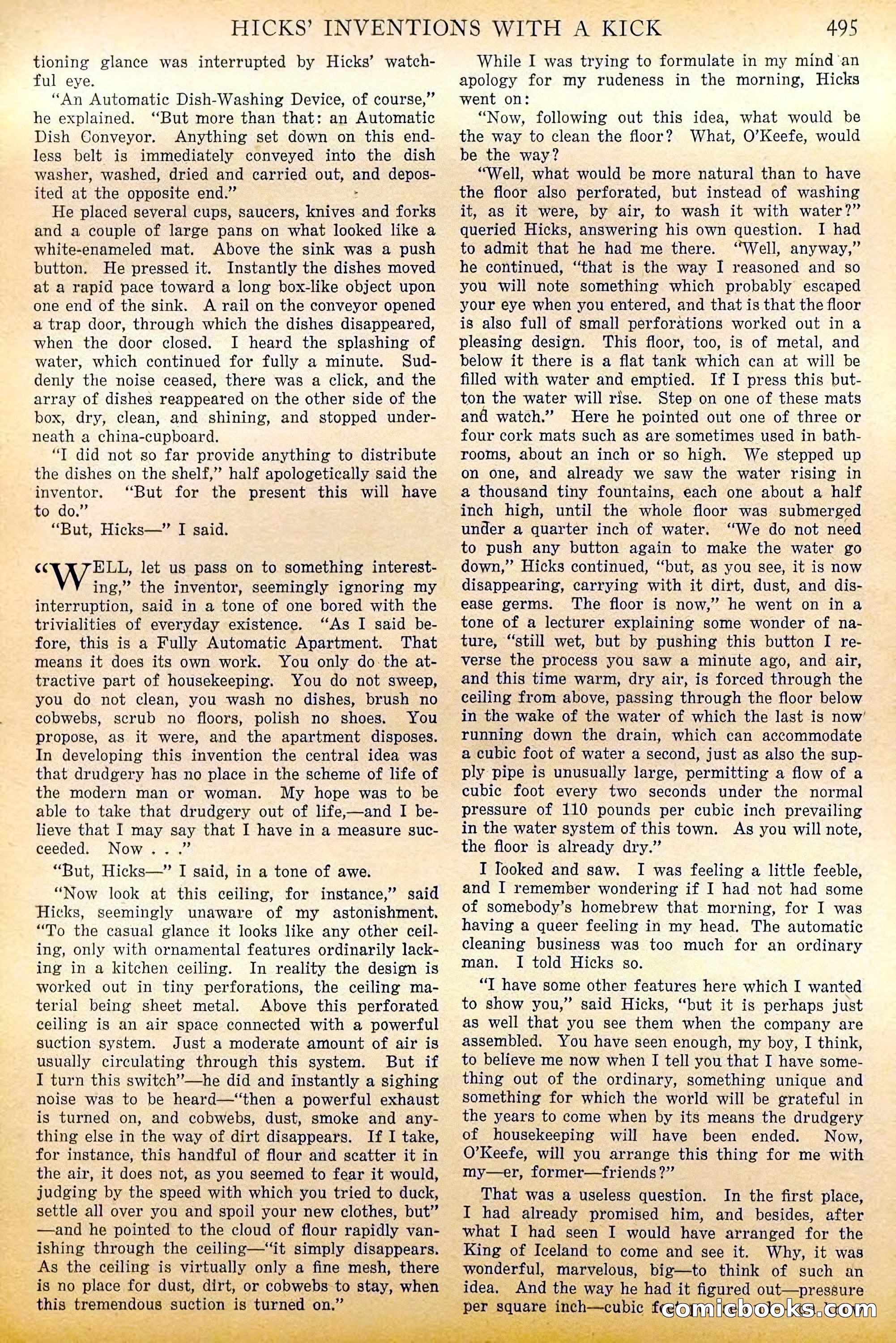
A restored page from Pulp Fiction, 1927. Page through the whole issue in the reader above.
📄 Transcribed text from this page (OCR, searchable)
Machine-transcribed from the original scan — historical spelling and the odd misread are preserved.
HICKS’ INVENTIONS WITH A KICK tioning glance was interrupted by Hicks’ watch- ful eye. “An Automatic Dish-Washing Device, of course,” he explained. ‘But more than that: an Automatic Dish Conyeyor. Anything set down on this end- less belt is immediately conveyed into the dish washer, washed, dried and carried out, any depos- ited at the opposite end.” He placed several cups, saucers, alsed and forks and a couple of large pans on what looked like a white-enameled mat. Above the sink was a push button. He pressed it. Instantly the dishes moved at a rapid pace toward a long box-like object upon one end of the sink. A rail on the conveyor opened a trap door, through which the dishes disappeared, when the door closed. I heard the splashing of water, which continued for fully a minute. Sud- denly the noise ceased, there was a click, and the array of dishes reappeared on the other side of the box, dry, clean, and shining, and stopped under- neath a china-cupboard. “T did not so far provide anything to distribute the dishes on the shelf,” half apologetically said the inventor. ‘But for the present this will have to do.” “But, Hicks—” I said. <4 ELL, let us pass on to something interest- ing,” the inventor, seemingly ignoring my interruption, said in a tone of one bored with the trivialities of everyday existence. “As I said hbe- fore, this is a Fully Automatic Apartment. That means it does its own work. You only do: the at- tractive part of housekeeping. You do not sweep, you do not clean, you wash no dishes, brush no cobwebs, scrub no floors, polish no shoes. You propose, as it were, and the apartment disposes. In developing this invention the central idea was that drudgery has no place in the scheme of life of the modern man or woman. My hope was to be able to take that drudgery out of life,—and I be- lieve that I may say that I have in a measure suc- ceeded. Now...” “But, Hicks—” I said, in a tone of awe. “Now look at this ceiling, for instance,” said Hicks, seemingly unaware of my astonishment, “To the casual glance it looks like any other ceil- ing, only with ornamental features ordinarily lack- ing in a kitchen ceiling. In reality the design is worked out in tiny perforations, the ceiling ma- terial being sheet metal. Above this perforated ceiling is an air space connected with a powerful suction system. Just a moderate amount of air is usually circulating through this system. But if I turn this switch’’—he did and instantly a sighing noise was to be heard—‘“then a powerful exhaust is turned on, and cobwebs, dust, smoke and any- thing else in the way of dirt disappears. If I take, for instance, this handful of flour and scatter it in the air, it does not, as you seemed to fear it would, judging by the speed with which you tried to duck, settle all over you and spoil your new clothes, but” —and he pointed to the cloud of flour rapidly van- ishing through the ceiling—‘it simply disappears. _ As the ceiling is virtually only a fine mesh, there _ is no place for dust, dirt, or cobwebs to stay, when this tremendous suctic : es is turned on.” 495 While I was trying to formulate in my mind ‘an apology for my rudeness in the morning, Hicks went on: “Now, following out this idea, what would be the way to clean the floor? What, O’Keefe, would be the way? “Well, what would be more natural than to have the floor also perforated, but instead of washing it, as it were, by air, to wash it with water?” queried Hicks, answering his own question. I had to admit that he had me there. ‘Well, anyway,” he continued, “that is the way I reasoned and so you will note something which probably escaped your eye when you entered, and that is that the floor is algo full of small perforations worked out in a pleasing design. This floor, too, is of metal, and below it there is a flat tank which can at will be filled with water and emptied. If I press this but- ton the water will rise. Step on one of these mats an(l watch.” Here he pointed out one of three or four cork mats such as are sometimes used in bath- rooms, about an inch or so high. We stepped up on one, and already we saw the water rising in a thousand tiny fountains, each one about a half inch high, until the whole floor was submerged under a quarter inch of water. “We do not need to push any button again to make the water go down,” Hicks continued, “but, as you see, it is now disappearing, carrying with it dirt, dust, and dis- ease germs. The floor is now,” he went on in a tone of a lecturer explaining some wonder of na- ture, “still wet, but by pushing this button I re- verse the process you saw a minute ago, and air, and this time warm, dry air, is forced through the ceiling from aboye, passing through the floor below in the wake of the water of which the last is now’ running down the drain, which can accommodate a cubic foot of water a second, just as also the sup- ply pipe is unusually large, permitting a flow of a cubic foot every two seconds under the normal pressure of 110 pounds per cubic inch prevailing in the water system of this town. As you will note, the floor is already dry.” I Tooked and saw. I was feeling a little feeble, and I remember wondering if I had not had some of somebody’s homebrew that morning, for I was having a queer feeling in my head. The automatic cleaning business was too much for an ordinary man. I told Hicks so. “T have some other features here which I wanted to show you,” said Hicks, “but it is perhaps just as well that you see them when the company are assembled. You have seen enough, my boy, I think, to believe me now when I tell you that I have some- thing out of the ordinary, something unique and something for which the world will be grateful in the years to come when by its means the drudgery of housekeeping will have been ended. Now, O’Keefe, will you arrange this thing for me with my—er, former—friends?” That was a useless question. In the first place, I had already promised him, and besides, after what I had seen I would have arranged for the King of Iceland to come and see it. Why, it was wonderful, marvelous, big—to think of such an ide: i