
Pulp Fiction, 1927 · page 42 of 107
Amazing Stories, August 1927 — page 42: what you’re looking at
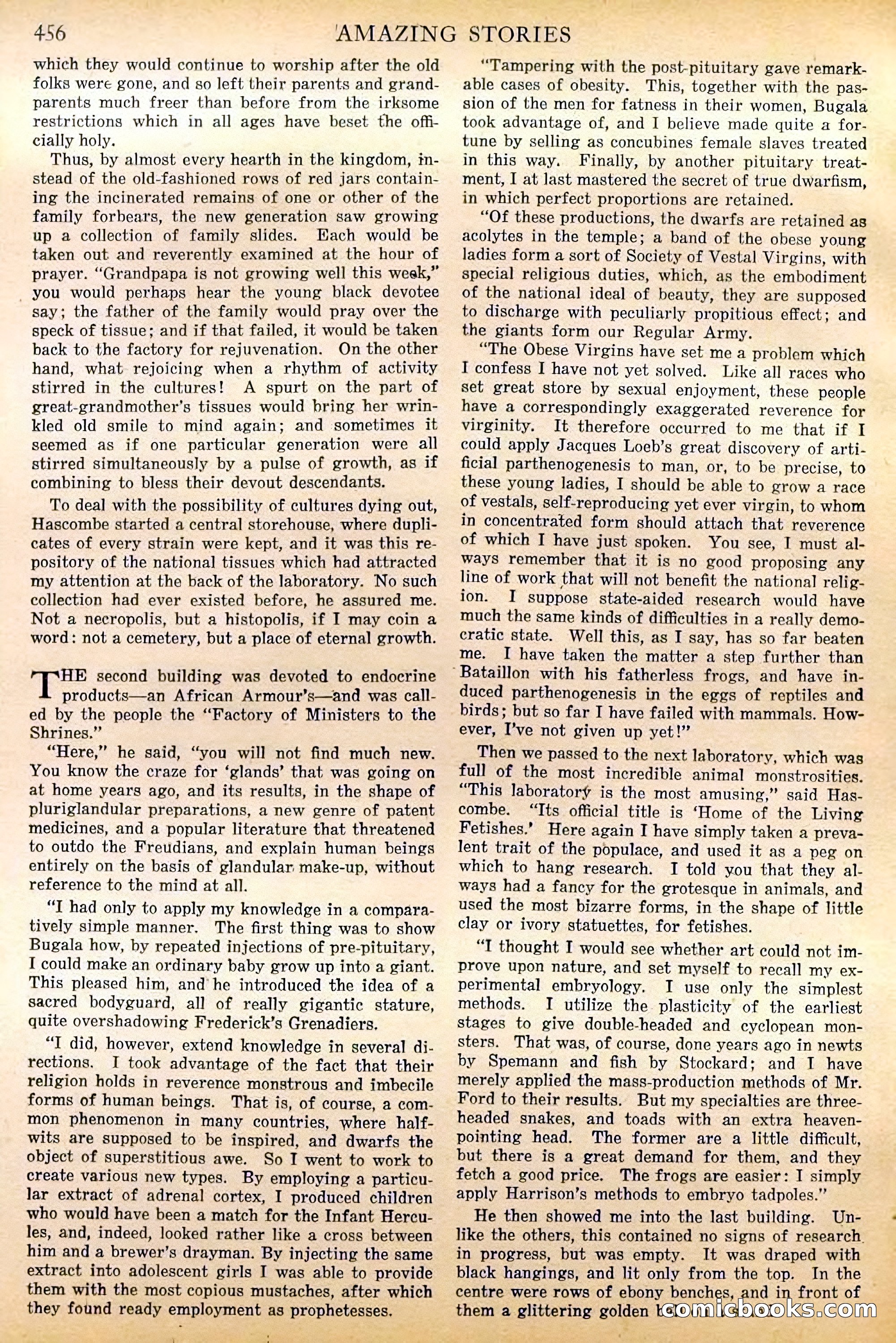
A restored page from Pulp Fiction, 1927. Page through the whole issue in the reader above.
📄 Transcribed text from this page (OCR, searchable)
Machine-transcribed from the original scan — historical spelling and the odd misread are preserved.
456 which they would continue to worship after the old folks were gone, and so left their parents and grand- parents much freer than before from the irksome restrictions which in all ages have beset the offi- cially holy. Thus, by almost every hearth in the kingdom, in- stead of the old-fashioned rows of red jars contain- ing the incinerated remains of one or other of the family forbears, the new generation saw growing up a collection of family slides. Wach would be taken out and reverently examined at the hour of prayer. “Grandpapa is not growing well this week,” _ you would perhaps hear the young black devotee say; the father of the family would pray over the speck of tissue; and if that failed, it would be taken back to the factory for rejuvenation. On the other hand, what rejoicing when a rhythm of activity stirred in the cultures! A spurt on the part of great-grandmother’s tissues would bring her wrin- kled old smile to mind again; and sometimes it seemed as if one particular generation were all stirred simultaneously by a pulse of growth, as if combining to bless their devout descendants. To deal with the possibility of cultures dying out, Hascombe started a central storehouse, where dupli- cates of every strain were kept, and it was this re- pository of the national tissues which had attracted my attention at the back of the laboratory. No such collection had ever existed before, he assured me. Not a necropolis, but a histopolis, if I may coin a word: not a cemetery, but a place of eternal growth. | cee second building was devoted to endocrine products—an African Armour’s—and was call- ed by the people the ‘Factory of Ministers to the Shrines.” “Here,” he said, “you will not find much new. You know the craze for ‘glands’ that was going on at home years ago, and its results, in the shape of pluriglandular preparations, a new genre of patent medicines, and a popular literature that threatened to outdo the Freudians, and explain human beings entirely on the basis of glandular make-up, without reference to the mind at all. “I had only to apply my knowledge in a compara- tively simple manner. The first thing was to show Bugala how, by repeated injections of pre-pituitary, I could make an ordinary baby grow up into a giant. This pleased him, and’he introduced the idea of a sacred bodyguard, all of really gigantic stature, quite overshadowing Frederick’s Grenadiers. “I did, however, extend knowledge in several di- rections. I took advantage of the fact that their religion holds in reverence monstrous and imbecile forms of human beings. That is, of course, a com- mon phenomenon in many countries, where half- wits are supposed to be inspired, and dwarfs the object of superstitious awe. So I went to work to create various new types. By employing a particu- lar extract of adrenal cortex, I produced children who would have been a match for the Infant Herecu- les, and, indeed, looked rather like a cross between him and a brewer’s drayman. By injecting the same extract into adolescent girls I was able to provide them with the most copious mustaches, after which they found ready employment as prophetesses. . y = en AMAZING STORIES “Tampering with the post-pituitary gaye remark- able cases of obesity. This, together with the pas- sion of the men for fatness in their women, Bugala took advantage of, and I believe made quite a for- tune by selling as concubines female slaves treated in this way. Finally, by another pituitary treat- ment, I at last mastered the secret of true dwarfism, in which perfect proportions are retained. “Of these productions, the dwarfs are retained ag acolytes in the temple; a band of the obese young ladies form a sort of Society of Vestal Virgins, with special religious duties, which, as the embodiment of the national ideal of beauty, they are supposed to discharge with peculiarly propitious effect; and the giants form our Regular Army. “The Obese Virgins have set mea problem which I confess I have not yet solved. Like all races who set great store by sexual enjoyment, these people have a correspondingly exaggerated reverence for virginity. It therefore occurred to me that if I could apply Jacques Loeb’s great discovery of arti- ficial parthenogenesis to man, or, to be precise, to these young ladies, I should be able to grow a race of vestals, self-reproducing yet ever virgin, to whom in concentrated form should attach that reverence of which I have just spoken. You see, I must al- ways remember that it is no good proposing any line of work that will not benefit the national relig- ion. I suppose state-aided research would have much the same kinds of difficulties in a really demo- eratic state. Well this, as I say, has so far beaten me. I have taken the matter a step further than ‘Bataillon with his fatherless frogs, and have in- duced parthenogenesis in the eggs of reptiles and birds; but so far I have failed with mammals. How- ever, I’ve not given up yet!” Then we passed to the next laboratory, which was full of the most incredible animal monstrosities. “This laboratory? is the most amusing,” said Has- combe. “Its official title is ‘Home of the Living Fetishes.’ Here again I have simply taken a preva- lent trait of the populace, and used it as a peg on which to hang research. I told you that they al- ways had a fancy for the grotesque in animals, and used the most bizarre forms, in the shape of little clay or ivory statuettes, for fetishes. “I thought I would see whether art could not im- prove upon nature, and set myself to recall my ex- perimental embryology. I use only the simplest methods. I utilize the plasticity of the earliest stages to give double-headed and cyclopean mon- sters. That was, of course, done years ago in newts by Spemann and fish by Stockard: and I have merely applied the mass-production methods of Mr. Ford to their results. But my specialties are three- headed snakes, and toads with an extra heaven- pointing head. The former are a little difficult, but there is a great demand for them, and they fetch a good price. The frogs are easier: I simply apply Harrison’s methods to embryo tadpoles.” He then showed me into the last building. Un- like the others, this contained no signs of research. in progress, but was empty. It was draped with black hangings, and lit only from the top. In the centre were rows of ebony benche ; d in front of S, an them a glittering golden Kei X19) SCO < é we . bi - AF