
Pulp Fiction, 1927 · page 41 of 107
Amazing Stories, August 1927 — page 41: what you’re looking at
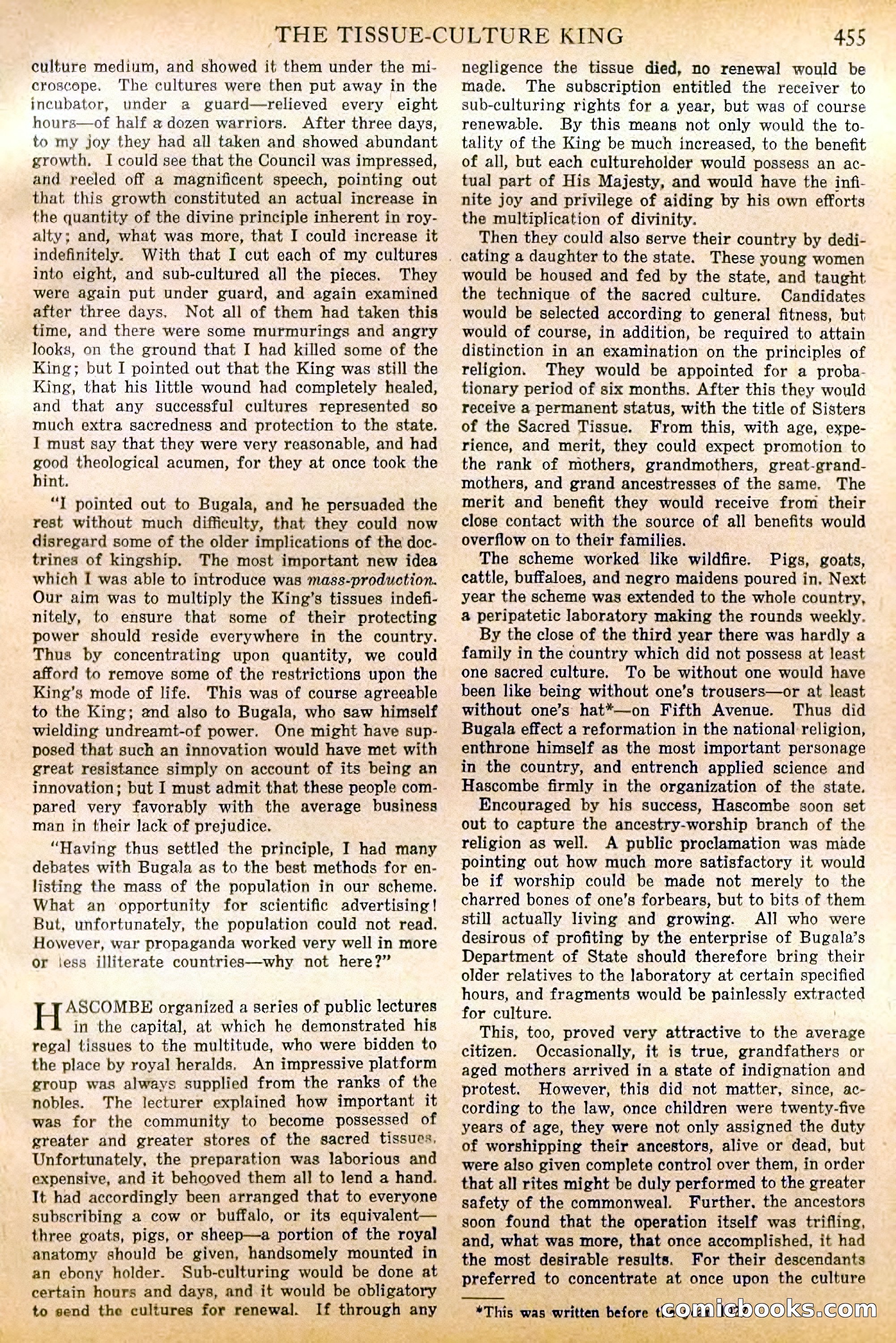
A restored page from Pulp Fiction, 1927. Page through the whole issue in the reader above.
📄 Transcribed text from this page (OCR, searchable)
Machine-transcribed from the original scan — historical spelling and the odd misread are preserved.
_THE TISSUE-CULTURE KING culture medium, and showed it them under the mi- croscope. The cultures were then put away in the incubator, under a guard—relieved every eight hours—of half a dozen warriors. After three days, to my joy they had all taken and showed abundant growth. I could see that the Council was impressed, and reeled off a magnificent speech, pointing out that this growth constituted an actual increase in the quantity of the divine principle inherent in roy- alty; and, what was more, that I could increase it indefinitely. With that I cut each of my cultures into eight, and sub-cultured all the pieces. They wera again put under guard, and again examined after three days. Not all of them had taken this time, and there were some murmurings and angry looks, on the ground that I had killed some of the King; but I pointed out that the King was still the King, that his little wound had completely healed, and that any successful cultures represented so much extra sacredness and protection to the state, I must say that they were very reasonable, and had good theological acumen, for they at once took the hint. “T pointed out to Bugala, and he persuaded the rest without much difficulty, that they could now disregard some of the older implications of the doc- trines of kingship. The most important new idea which I was able to introduce was mass-production. Our aim was to multiply the King’s tissues indefi- nitaly, to ensure that some of their protecting power should reside everywhere in the country. Thua by concentrating upon quantity, we could afford to remove some of the restrictions upon the King’s mode of life. This was of course agreeable to the King; and also to Bugala, who saw himself wielding undreamt-of power. One might have sup- posed that such an innovation would have met with great resistance simply on account of its being an innovation; but I must admit that these people com- pared very favorably with the average business man in their lack of prejudice. “Having thus settled the principle, I had many debates with Bugala as to the best methods for en- listing the mass of the population in our scheme. What an opportunity for scientific advertising! But, unfortunately, the population could not read, However, war propaganda worked very well in more or ‘ess illiterate countries—why not here?” ) Sf seca organized a series of public lectures in the capital, at which he demonstrated his regal tissues to the multitude, who were bidden to the place by royal heralds. An impressive platform group was always supplied from the ranks of the nobles. The lecturer explained how important it was for the community to become possessed of greater and greater stores of the sacred tissues, Unfortunately, the preparation was laborious and expensive, and it behooved them all to lend a hand. It had accordingly been arranged that to everyone subscribing a cow or buffalo, or its equivalent— three goats, pigs, or sheep—a portion of the royal anatomy should be given, handsomely mounted in an ebony holder. Sub-culturing would be done at certain hours and days, and it would be obligatory to send the cultures for renewal. If through any Bae 7a one pS Bon . cating a daughter to the state. ee 455 negligence the tissue died, no renewal would be made. The subscription entitled the receiver to sub-culturing rights for a year, but was of course renewable. By this means not only would the to- tality of the King be much increased, to the benefit of all, but each cultureholder would possess an ac- tual part of His Majesty, and would have the infi- nite joy and privilege of aiding by his own efforts the multiplication of divinity. Then they could also serve their country by dedi- These young women would be housed and fed by the state, and taught the technique of the sacred culture. Candidates would be selected according to general fitness, but would of course, in addition, be required to attain distinction in an examination on the principles of religion. They would be appointed for a proba- tionary period of six months. After this they would receive a permanent status, with the title of Sisters of the Sacred Tissue. From this, with age, expe- rience, and merit, they could expect promotion to the rank of mothers, grandmothers, great-grand- mothers, and grand ancestresses of the same. The merit and benefit they would receive from their close contact with the source of all benefits would overflow on to their families. The scheme worked like wildfire. Pigs, goats, cattle, buffaloes, and negro maidens poured in, Next year the scheme was extended to the whole country, a peripatetic laboratory making the rounds weekly. By the close of the third year there was hardly a family in the country which did not possess at least one sacred culture. To be without one would have been like being without one’s trousers—or at least without one’s hat*—on Fifth Avenue. Thus did Bugala effect a reformation in the national religion, enthrone himself as the most important personage in the country, and entrench applied science and Hascombe firmly in the organization of the state. Encouraged by his success, Hascombe soon set out to capture the ancestry-worship branch of the religion as well. A public proclamation was made pointing out how much more satisfactory it would be if worship could be made not merely to the charred bones of one’s forbears, but to bits of them still actually living and growing. All who were desirous of profiting by the enterprise of Bugala’s Department of State should therefore bring their older relatives to the laboratory at certain specified hours, and fragments would be painlessly extracted for culture. This, too, proved very attractive to the average citizen. Occasionally, it is true, grandfathers or aged mothers arrived in a state of indignation and protest. However, this did not matter, since, ac- cording to the law, once children were twenty-five years of age, they were not only assigned the duty of worshipping their ancestors, alive or dead, but were also given complete control over them, in order that all rites might be duly performed to the greater safety of the commonweal. Further, the ancestors soon found that the operation itself was trifling, and, what was more, that once accomplished, it had the most desirable results. For their descendants preferred to concentrate at once upon the culture *This was written before (SOAK 900 KS.COMM es Rae eS * Pe OO AAS ee ee eee