
Pulp Fiction, 1927 · page 24 of 107
Amazing Stories, August 1927 — page 24: what you’re looking at
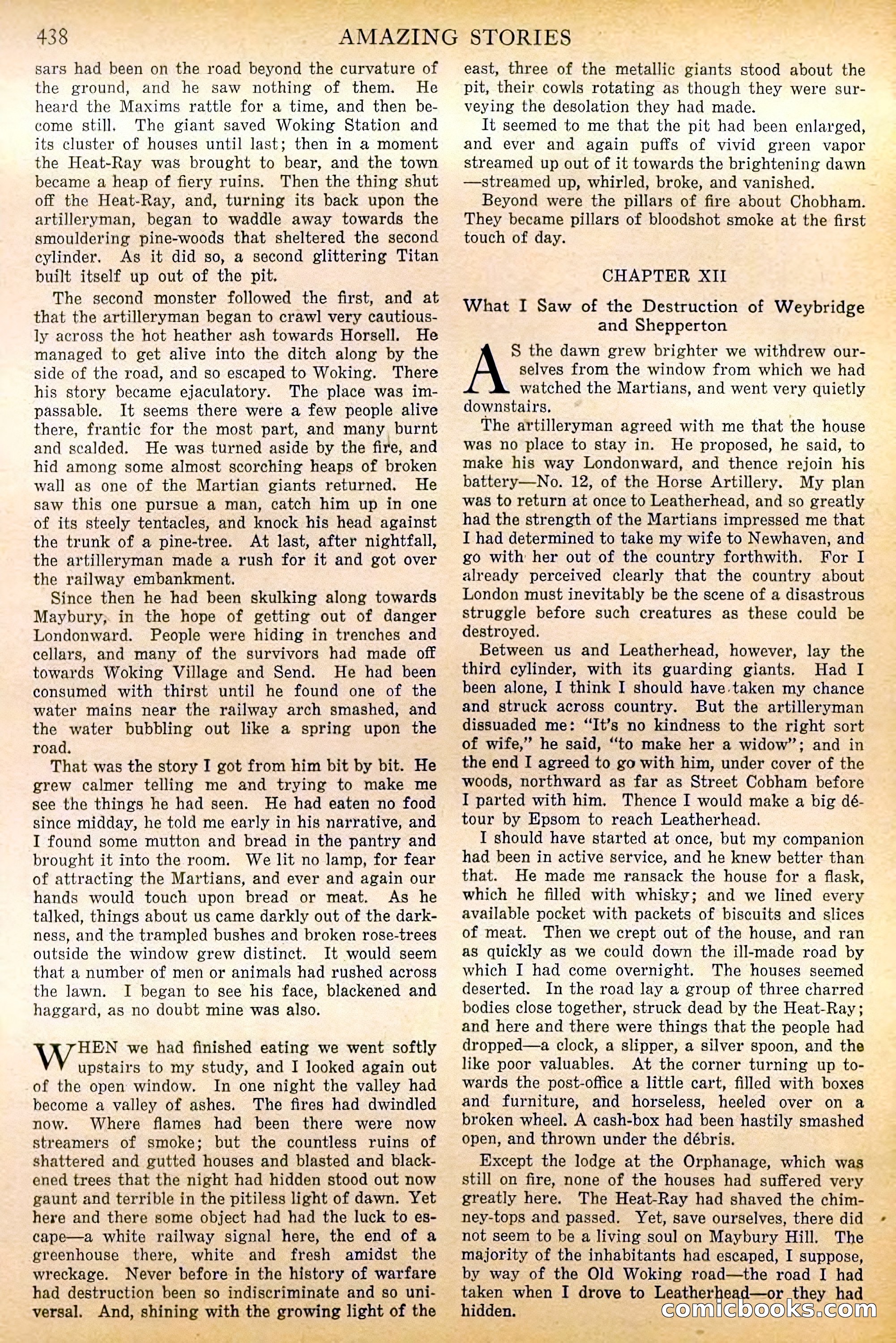
A restored page from Pulp Fiction, 1927. Page through the whole issue in the reader above.
📄 Transcribed text from this page (OCR, searchable)
Machine-transcribed from the original scan — historical spelling and the odd misread are preserved.
438 sars had been on the road beyond the curvature of the ground, and he saw nothing of them. He heard the Maxims rattle for a time, and then be- come still, The giant saved Woking Station and its cluster of houses until last; then in a moment the Heat-Ray was brought to bear, and the town became a heap of fiery ruins. Then the thing shut off the Heat-Ray, and, turning its back upon the artilleryman, began to waddle away towards the smouldering pine-woods that sheltered the second cylinder. As it did so, a second glittering Titan built itself up out of the pit. The second monster followed the first, and at that the artilleryman began to crawl very cautious- ly across the hot heather ash towards Horsell. He managed to get alive into the ditch along by the side of the road, and so escaped to Woking. There his story became ejaculatory. The place was im- passable. It seems there were a few people alive there, frantic for the most part, and many, burnt and scalded. He was turned aside by the fire, and hid among some almost scorching heaps of broken wall as one of the Martian giants returned. He saw this one pursue a man, catch him up in one of its steely tentacles, and knock his head against the trunk of a pine-tree. At last, after nightfall, the artilleryman made a rush for it and got over the railway embankment. Since then he had been skulking along towards Maybury; in the hope of getting out of danger Londonward. People were hiding in trenches and cellars, and many of the survivors had made off towards Woking Village and Send. He had been consumed with thirst until he found one of the water mains near the railway arch smashed, and the water bubbling out like a spring upon the road. That was the story I got from him bit by bit. He grew calmer telling me and trying to make me see the things he had seen. He had eaten no food since midday, he told me early in his narrative, and I found some mutton and bread in the pantry and brought it into the room. We lit no lamp, for fear of attracting the Martians, and ever and again our hands would touch upon bread or meat. As he talked, things about us came darkly out of the dark- ness, and the trampled bushes and broken rose-trees outside the window grew distinct. It would seem that a number of men or animals had rushed across the lawn. I began to see his face, blackened and haggard, as no doubt mine was also. AY, Vilar we had finished eating we went softly upstairs to my study, and I looked again out of the open window. In one night the valley had become a valley of ashes. The fires had dwindled now. Where flames had been there were now streamers of smoke; but the countless ruins of shattered and gutted houses and blasted and black- ened trees that the night had hidden stood out now gaunt and terrible in the pitiless light of dawn. Yet here and there some object had had the luck to es- cape—a white railway signal here, the end of a greenhouse there, white and fresh amidst the wreckage. Never before in the history of warfare had destruction been so indiscriminate and so uni- versal. ee aoe And, shining with the growing light of the AMAZING STORIES east, three of the metallic giants stood about the pit, their cowls rotating as though they were sur- veying the desolation they had made. It seemed to me that the pit had been enlarged, and ever and again puffs of vivid green vapor streamed up out of it towards the brightening dawn —streamed up, whirled, broke, and vanished. Beyond were the pillars of fire about Chobham. They became pillars of bloodshot smoke at the first touch of day. CHAPTER XII What I Saw of the Destruction of Weybridge and Shepperton S the dawn grew brighter we withdrew our- A selves from the window from which we had watched the Martians, and went very quietly downstairs. : The artilleryman agreed with me that the house was no place to stay in. He proposed, he said, to make his way Londonward, and thence rejoin his battery—No. 12, of the Horse Artillery. My plan was to return at once to Leatherhead, and so greatly had the strength of the Martians impressed me that I had determined to take my wife to Newhaven, and go with her out of the country forthwith. For I already perceived clearly that the country about London must inevitably be the scene of a disastrous struggle before such creatures as these could be destroyed. Between us and Leatherhead, however, lay the third cylinder, with its guarding giants, Had I been alone, I think I should have.taken my chance and struck across country. But the artilleryman dissuaded me: “It’s no kindness to the right sort of wife,” he said, “to make her a widow”; and in the end I agreed to go with him, under cover of the woods, northward as far as Street Cobham before I parted with him, Thence I would make a big dé- tour by Epsom to reach Leatherhead. I should have started at once, but my companion had been in active service, and he knew better than that. He made me ransack the house for a flask, which he filled with whisky; and we lined every available pocket with packets of biscuits and slices of meat. Then we crept out of the house, and ran as quickly as we could down the ill-made road by which I had come overnight. The houses seemed deserted. In the road lay a group of three charred bodies close together, struck dead by the Heat-Ray; and here and there were things that the people had dropped—a clock, a slipper, a silver spoon, and the like poor valuables. At the corner turning up to- wards the post-office a little cart, filled with boxes and furniture, and horseless, heeled over on a broken wheel. A cash-box had been hastily smashed open, and thrown under the débris. Except the lodge at the Orphanage, which was still on fire, none of the houses had suffered very greatly here. The Heat-Ray had shaved the chim- ney-tops and passed. Yet, save ourselves, there did not seem to be a living soul on Maybury Hill. The majority of the inhabitants had escaped, I suppose, by way of the Old Woking road—the road I had taken when I drove to Leatherhead—or they had hidden. Ncomicbooks™ Com 7 a FS . ee oH a " aad i YS