
Pulp Fiction, 1927 · page 23 of 107
Amazing Stories, August 1927 — page 23: what you’re looking at
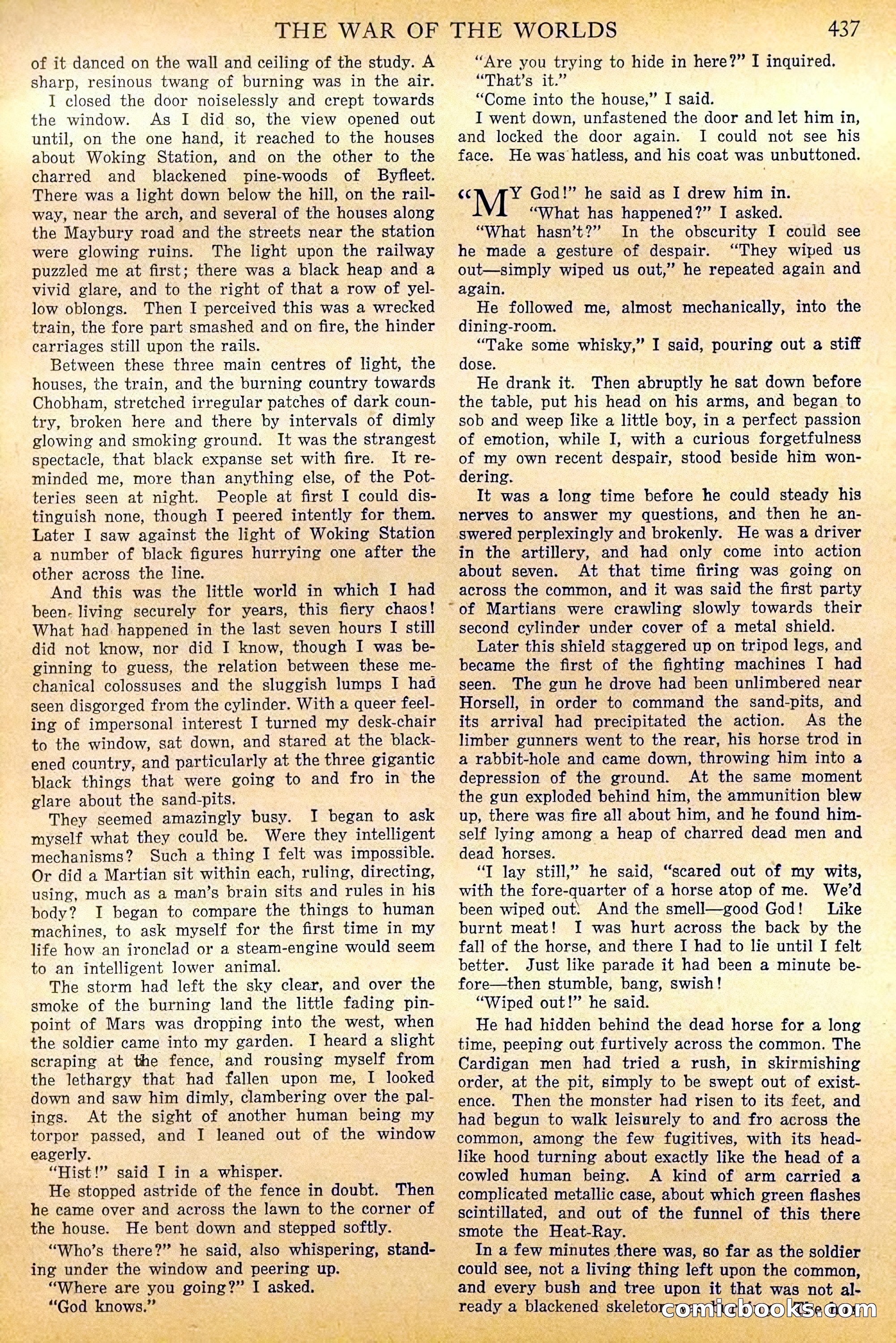
A restored page from Pulp Fiction, 1927. Page through the whole issue in the reader above.
📄 Transcribed text from this page (OCR, searchable)
Machine-transcribed from the original scan — historical spelling and the odd misread are preserved.
THE WAR OF THE WORLDS of it danced on the wall and ceiling of the study. A sharp, resinous twang of burning was in the air. I closed the door noiselessly and crept towards the window. As I did so, the view opened out until, on the one hand, it reached to the houses about Woking Station, and on the other to the charred and blackened pine-woods of Byfleet. There was a light down below the hill, on the rail- way, near the arch, and several of the houses along the Maybury road and the streets near the station were glowing ruins. The light upon the railway puzzled me at first; there was a black heap and a vivid glare, and to the right of that a row of yel- low oblongs. Then I perceived this was a wrecked train, the fore part smashed and on fire, the hinder carriages still upon the rails. Between these three main centres of light, the houses, the train, and the burning country towards Chobham, stretched irregular patches of dark coun- try, broken here and there by intervals of dimly glowing and smoking ground. It was the strangest spectacle, that black expanse set with fire. It re- minded me, more than anything else, of the Pot- teries geen at night. People at first I could dis- tinguish none, though I peered intently for them. Later I saw against the light of Woking Station a number of black figures hurrying one after the other across the line. And this was the little world in which I had been- living securely for years, this fiery chaos! What had happened in the last seven hours I still did not know, nor did I know, though I was be- ginning to guess, the relation between these me- chanical colossuses and the sluggish lumps I had seen disgorged from the cylinder. With a queer feel- ing of impersonal interest I turned my desk-chair to the window, sat down, and stared at the black- ened country, and particularly at the three gigantic black things that were going to and fro in the glare about the sand-pits. They seemed amazingly busy. I began to ask myself what they could be. Were they intelligent mechanisms? Such a thing I felt was impossible. Or did a Martian sit within each, ruling, directing, using, much as a man’s brain sits and rules in his body? I began to compare the things to human machines, to ask myself for the first time in my life how an ironclad or a steam-engine would seem to an intelligent lower animal. The storm had left the sky clear, and over the smoke of the burning land the little fading pin- point of Mars was dropping into the west, when the soldier came into my garden. I heard a slight scraping at the fence, and rousing myself from the lethargy that had fallen upon me, I looked down and saw him dimly, clambering over the pal- ings. At the sight of another human being my torpor passed, and I leaned out of the window eagerly. “Hist!” said I in a whisper. He stopped astride of the fence in doubt. Then he came over and across the lawn to the corner of the house. He bent down and stepped softly. “Who’s there?” he said, also whispering, stand- ing under the window and peering up. “Where are you going?” I asked. “God knows.” ~~ . pues t A Nees ae 4% 437 “Are you trying to hide in here?” I inquired. “That's it.” “Come into the house,” I said. I went down, unfastened the door and let him in, and locked the door again. I could not see his face. He was hatless, and his coat was unbuttoned. «cc Y God!” he said as I drew him in. “What has happened?” I asked. “What hasn’t?” In the obscurity I could see he made a gesture of despair. “They wiped us out—simply wiped us out,” he repeated again and again. : He followed me, almost mechanically, into the dining-room. “Take some whisky,” I said, pouring out a stiff dose. He drank it. Then abruptly he sat down before the table, put his head on his arms, and began to sob and weep like a little boy, in a perfect passion of emotion, while I, with a curious forgetfulness of my own recent despair, stood beside him won- dering. It was a long time before he could steady his nerves to answer my questions, and then he an- ‘Swered perplexingly and brokenly. He was a driver in the artillery, and had only come into action about seven. At that time firing was going on across the common, and it was said the first party of Martians were crawling slowly towards their second cylinder under cover of a metal shield. Later this shield staggered up on tripod legs, and became the first of the fighting machines I had seen. The gun he drove had been unlimbered near Horsell, in order to command the sand-pits, and its arrival had precipitated the action. As the limber gunners went to the rear, his horse trod in a rabbit-hole and came down, throwing him into a depression of the ground. At the same moment the gun exploded behind him, the ammunition blew up, there was fire all about him, and he found him- self lying among a heap of charred dead men and dead horses. “T lay still,” he said, “scared out of my wits, with the fore-quarter of a horse atop of me. We'd been wiped out) And the smell—good God! Like burnt meat! I was hurt across the back by the fall of the horse, and there I had to lie until I felt better. Just like parade it had been a minute be- fore—then stumble, bang, swish! “Wiped out!’ he said. He had hidden behind the dead horse for a long time, peeping out furtively across the common. The Cardigan men had tried a rush, in skirmishing order, at the pit, simply to be swept out of exist- ence. Then the monster had risen to its feet, and had begun to walk leisurely to and fro across the common, among the few fugitives, with its head- like hood turning about exactly like the head of a cowled human being. A kind of arm carried a complicated metallic case, about which green flashes scintillated, and out of the funnel of this there smote the Heat-Ray. In a few minutes there was, so far as the soldier could see, not a living thing left upon the common, and every bush and tree upon it that was not al- ready a blackened skeletorereyaj fie ovoxo)| Se@exnn) Foe Sete