
Pulp Fiction, 1928 · page 78 of 100
Amazing Stories, Vol. 3, No. 2 — page 78: what you’re looking at
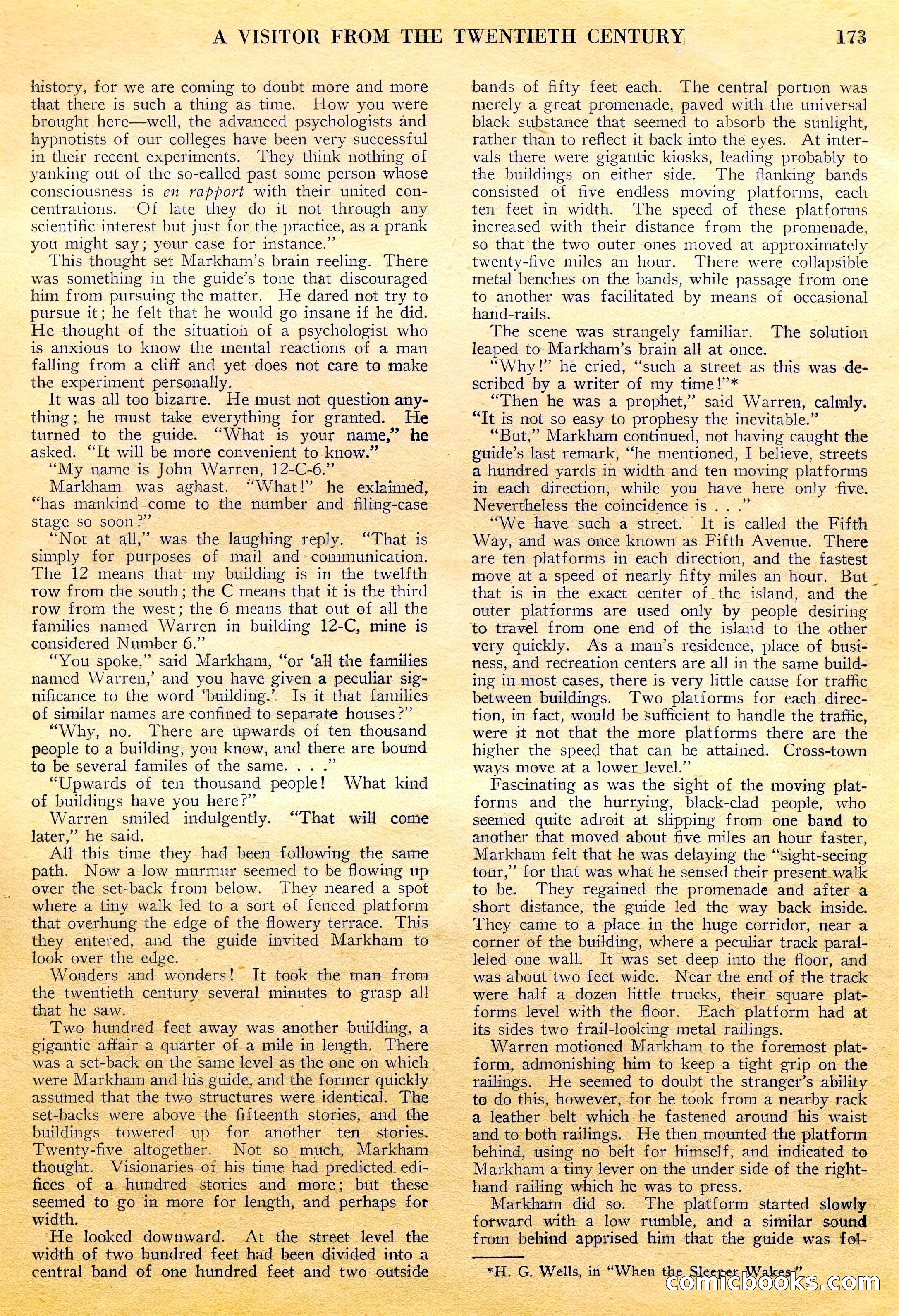
A restored page from Pulp Fiction, 1928. Page through the whole issue in the reader above.
📄 Transcribed text from this page (OCR, searchable)
Machine-transcribed from the original scan — historical spelling and the odd misread are preserved.
A VISITOR FROM THE TWENTIETH CENTURY, 173 history, for we are coming to doubt more and more that there is such a thing as time. How you were brought here—well, the advanced psychologists and hypnotists of our colleges have been very successful in their recent experiments. They think nothing of yanking out of the so-called past some person whose consciousness is en rapport with their united con- centrations. Of late they do it not through any scientific interest but just for the practice, as a prank you might say; your case for instance.” This thought set Markham’s brain reeling. There was something in the guide’s tone that discouraged him from pursuing the matter. He dared not try to pursue it; he felt that he would go insane if he did. He thought of the situation of a psychologist who is anxious to know the mental reactions of a man falling from a cliff and yet does not care to make the experiment personally. It was all too bizarre. He must not question any- thing; he must take everything for granted. He turned to the guide. “What is your name,” he asked. “It will be more convenient to know.” “My name is John Warren, 12-C-6,” Markham was aghast. “What!” he exlaimed, “has mankind come to the number and filing-case stage so soon?” “Not at all,” was the laughing reply. “That is simply for purposes of mail and~ communication. The 12 means that my building is in the twelfth row from the south; the C means that it is the third row from the west; the 6 means that out of all the families named Warren in building 12-C, mine is considered Number 6.” “You spoke,” said Markham, “or ‘all the familtes named Warren,’ and you have given a peculiar sig- nificance to the word “building.” Is it that families of similar names are confined to separate houses?” “Why, no. There are upwards of ten thousand people to a building, you know, and there are bound to be several familes of the same... .” “Upwards of ten thousand people! What kind of buildings have you here?” Warren smiled indulgently. later,” he said, Alf this time they had been following the same path. Now a low murmur seemed to be flowing up over the set-back from below. They neared a spot where a tiny walk led to a sort of fenced platform that overhung the edge of the flowery terrace. This “That will cone they entered, and the guide invited Markham to ~ “look over the edge. Wonders and wonders! It took the man from the twentieth century several minutes to grasp all that he saw. Two hundred feet away was another building, a gigantic affair a quarter of a mile in length. There was a set-back on the same level as the one on which. were Markham and his guide, and the former quickly. assumed that the two structures were identical. The _set-backs were above the fifteenth stories, and the buildings towered up for another ten stoties. — Not so much, Markham _ Twenty-five altogether. thought. Visionaries of his time had predicted edi- fices of a. hundred Stories and more; but these seemed to go in ‘more for engi, and perhaps for = lie. looked downward. Ag the street. level the width of two hundred feet had been divided into a cel and of one hundred feet < and two outside bands of fifty feet each. The central portion was merely a great promenade, paved with the universal black substance that seemed to absorb the sunlight, rather than to reflect it back into the eyes. At inter- vals there were gigantic kiosks, leading probably to the buildings on either side. The flanking bands consisted of five endless moving platforms, each ten feet in width. The speed of these platforms increased with their distance from the promenade, so that the two outer ones moved at approximately twenty-five miles an hour. There were collapsible metal benches on the bands, while passage from one to another was facilitated by means of occasional hand-rails. The scene was strangely familiar. leaped to-Markham’s brain all at once. “Why!” he cried, “such a street as this was de- scribed by a writer of my time!’”* “Then he was a prophet,” said Warren, calmly. “It is not so easy to prophesy the inevitable.” “But,” Markham continued, not having caught the guide's ‘last remark, “he mentioned, I believe, streets a hundred yards in width and ten moving platforms in each direction, while you have here only ‘five. Nevertheless the coincidence is .. .” “We have such a street. It is called the Fifth Way, and was once known as Fifth Avenue. There are ten platforms in each direction, and the fastest move at a speed of nearly fifty miles an hour. But _ that is in the exact center of the island, and the outer platforms are used only by people desiring The solution ‘to travel from one end of the island to the thier very quickly. As a man’s residence, place of busi- ness, and recreation centers are all in the same build- ing im most cases, there is very little cause for traffic - between buildmgs. Two platforms for each direc- tion, in fact, would be sufficient to handle the traffic, were it not that the more platforms there are the higher the speed that can be attained. Cross-town ways move at a lower_level.” Fascinating as was the sight of the moving plat- forms and the hurrying, black-clad people, who seemed quite adroit at slipping from one band to another that moved about five miles an hour faster, Markham felt that he was delaying the “‘sight-seeing tour,’ for that was what he sensed their present walk to be. They regained the promenade and after a short distance, the guide led the way back inside. They came to a place in the huge corridor, near a corner of the building, where a peculiar track paral- leled one wall. It was set deep into the floor, and was about two feet wide. Near the end of the track were half a dozen little trucks, their square plat- forms level with the floor. Each platform had at its sides two frail-looking metal railings. Warren motioned Markham to the foremost plat- - form, admonishing him to keep a tight grip on the railings. He seemed to doubt the stranger’s ability — - to do this, however, for he took from a nearby rack a leather belt which he fastened around his waist ~_and to both railings. He then mounted the platform behind, using no belt for himself, and indicated to _ Markham a tiny lever on the under side of the right- hand railing which he was to press. Markham did so. The platform started slowly — forward with a low rumble, and a similar sound — from behind apprised him that the guide was, fol. 2 Ses in = the omni cboaks!com