
Pulp Fiction, 1928 · page 77 of 100
Amazing Stories, Vol. 3, No. 2 — page 77: what you’re looking at
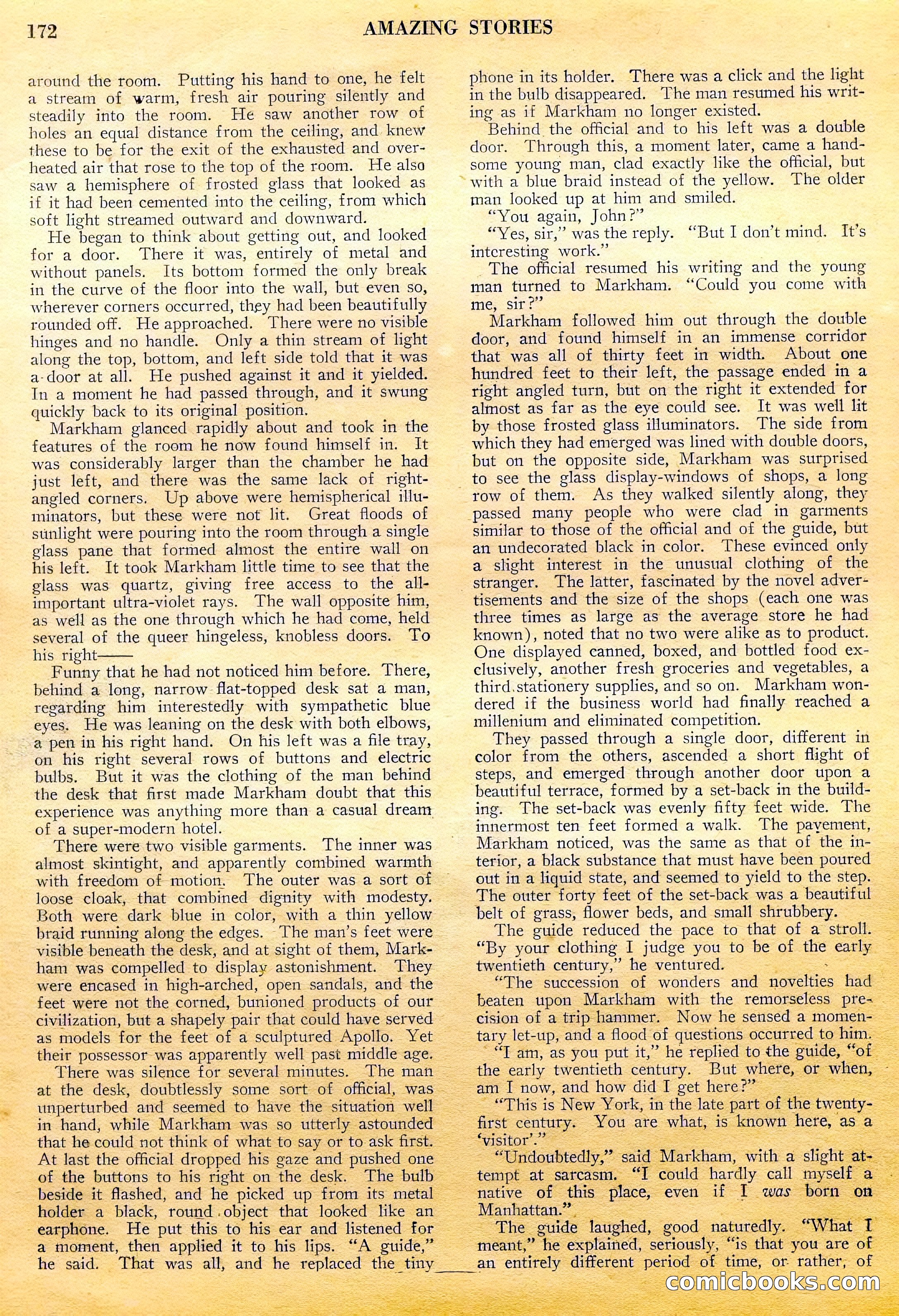
A restored page from Pulp Fiction, 1928. Page through the whole issue in the reader above.
📄 Transcribed text from this page (OCR, searchable)
Machine-transcribed from the original scan — historical spelling and the odd misread are preserved.
172 AMAZING STORIES around the room. Putting his hand to one, he felt a stream of warm, fresh air pouring silently and steadily into the room. He saw another row of holes an equal distance from the ceiling, and knew these to be for the exit of the exhausted and over- heated air that rose to the top of the room. He alsa saw a hemisphere of frosted glass that looked as if it had been cemented into the ceiling, from which soft light streamed outward and downward. He began to think about getting out, and looked for a door. There it was, entirely of metal and without panels. Its bottom formed the only break in the curve of the floor into the wall, but even so, wherever corners occurred, they had been beautifully rounded off. He approached. There were no visible hinges and no handle. Only a thin stream of light along the top, bottom, and left side told that it was a-door at all. He pushed against it and it yielded. In a moment he had passed through, and it swung quickly back to its original position. Markham glanced rapidly about and took in the features of the room he now found himself in. It was considerably larger than the chamber he had just left, and there was the same lack of right- angled corners. Up above were hemispherical illu- minators, but these were not lit. Great floods of sunlight were pouring into the room through a single glass pane that formed almost the entire wall on his left. It took Markham little time to see that the glass was quartz, giving free access to the all- important ultra-violet rays. The wall opposite him, as well as the one through which he had come, held several of the queer hingeless, knobless doors. To his right Funny that he had not noticed him before. There, behind a long, narrow flat-topped desk sat a man, regarding him interestedly with sympathetic blue eyes. He was leaning on the desk with both elbows, -a pen in his right hand. On his left was a file tray, on his right several rows of buttons and electric bulbs. But it was the clothing of the man behind the desk that first made Markham doubt that this experience was anything more than a casual dream, of a super-modern hotel. There were two visible garments. The inner was almost skintight, and apparently combined warmth with freedom of motion. The outer was a sort of loose cloak, that combined dignity with modesty. Both were dark blue in color, with a thin yellow braid running along the edges. The man’s feet were visible beneath the desk, and at sight of them, Marlx- ham was compelled to display astonishment. They were encased in high-arched, open sandals, and the — feet were not the corned, bunioned products of our civilization, but a shapely pair that could have served ~ as models for the feet of a sculptured Apollo. Yet their possessor was appatently well past middle age. | There was silence for several minutes. The man — at the desk, doubtlessly some sort of official, was unperturbed and seemed to have the situation well — in hand, while Markham was so utterly astound that he could not think of what to say or to ask first At last the official dropped his gaze and pushed on of the buttons to his right on the desk. The bu beside it flashed, and he picked up from its me tary let-up, and a flood of questions occurred to him. “This is New York, in the late 1 : wl der a black, round .object that looked like an © sarphone. He put this to his ear and listened for — a moment, then applied it to his lips. “A guide,” — he said. That was all, and he replaced the tiny phone in its holder. There was a click and the light in the bulb disappeared. The man resumed his writ- ing as if Markham no longer existed. Behind the official and to his left was a double door. Through this, a moment later, came a hand- some young man, clad exactly like the official, but ~ with a blue braid instead of the yellow. The older man looked up at him and smiled. “You again, John?” “Ves, sir,” was the reply. “But I don’t mind. It’s intcresting work.” The official resumed his writing and the young man turned to Markham. “Could you come with me, sir?” Markham followed him out through the double door, and found himself in an immense corridor that was all of thirty feet in width. About one hundred feet to their left, the passage ended in a right angled turn, but on the right it extended for almost as far as the eye could see. It was well lit by those frosted glass illuminators. The side from which they had emerged was lined with double doors, but on the opposite side, Markham was surprised to see the glass display-windows of shops, a long row of them. As they walked silently along, they passed many people who were clad in garments similar to those of the official and of the guide, but an undecorated black in color. These evinced only a slight interest in the unusual clothing of the stranger. The latter, fascinated by the novel adver- tisements and the size of the shops (each one was three times as large as the average store he had known), noted that no two were alike as to product. One displayed canned, boxed, and bottled food ex- clusively, another fresh groceries and vegetables, a third.stationery supplies, and so on. Markham won- dered if the business world had finally reached a millenium and eliminated competition. They passed through a single door, different in color from the others, ascended a short flight of steps, and emerged through another door upon a beautiful terrace, formed by a set-back in the build- ing. The set-back was evenly fifty feet wide. The innermost ten feet formed a walk. The pavement, Markham noticed, was the same as that of the in- _ terior, a black substance that must have been poured — out in a liquid state, and seemed to yield to the step. The outer forty feet of the set-back was a beautiful belt of grass, flower beds, and small shrubbery. The guide reduced the pace to that of a stroll “By your clothing I judge you to be of the early twentieth century,” he ventured. eae “The succession of wonders and novelties had beaten upon Markham with the remorseless pr cision of a trip hammer. Now he sensed a momen: * “T am, as you put it,” he replied to the the early twentieth century. But where, am I now, and how did I get here?” eS