
Pulp Fiction, 1927 · page 83 of 105
Amazing Stories, Vol. 2, No. 2 — page 83: what you’re looking at
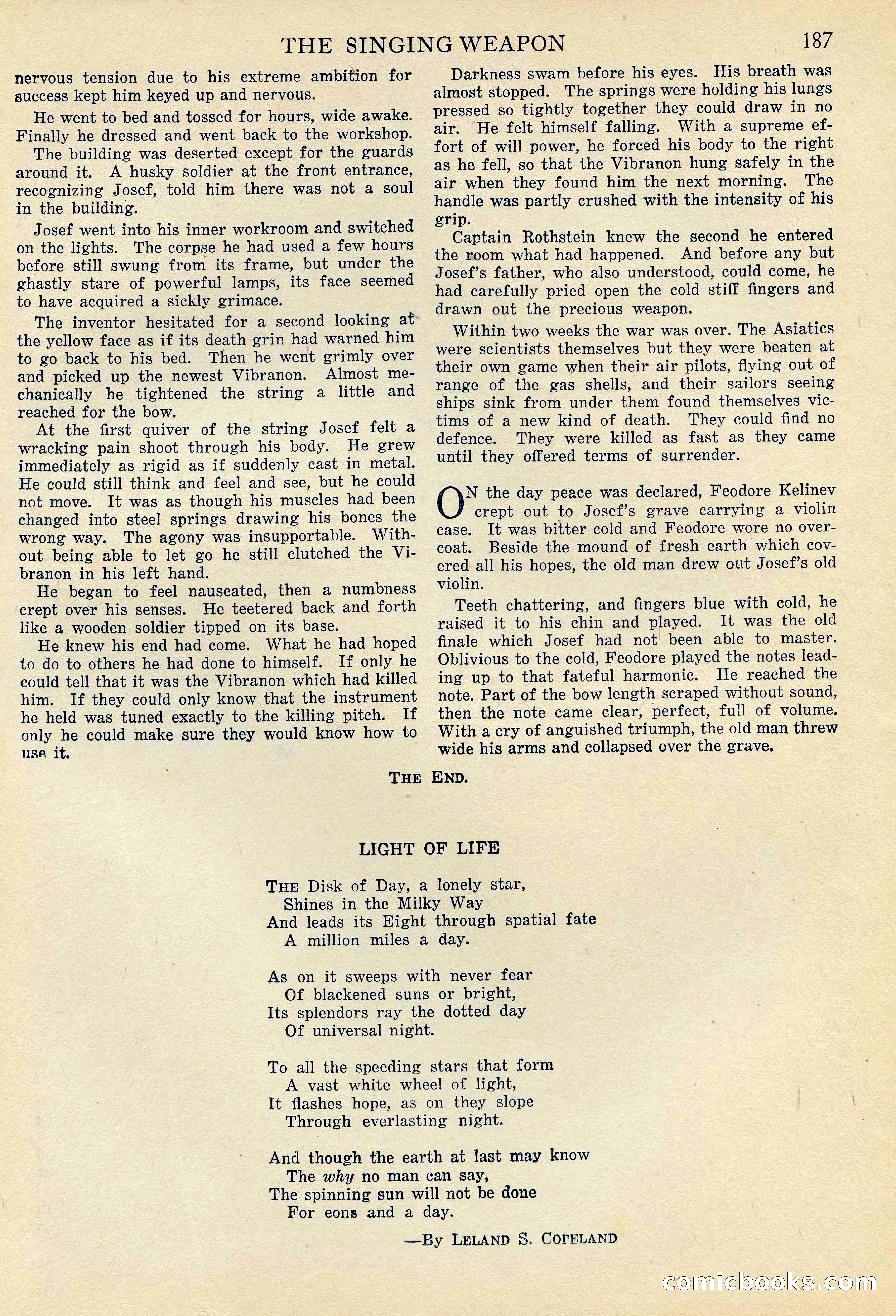
A restored page from Pulp Fiction, 1927. Page through the whole issue in the reader above.
📄 Transcribed text from this page (OCR, searchable)
Machine-transcribed from the original scan — historical spelling and the odd misread are preserved.
THE SINGING WEAPON nervous tension due to his extreme ambition for success kept him keyed up and nervous. He went to bed and tossed for hours, wide awake. Finally he dressed and went back to the workshop. The building was deserted except for the guards around it. A husky soldier at the front entrance, recognizing Josef, told him there was not a soul in the building. Josef went into his inner workroom and switched on the lights. The corpse he had used a few hours before still swung from its frame, but under the ghastly stare of powerful lamps, its face seemed to have acquired a sickly grimace. The inventor hesitated for a second looking at the yellow face as if its death grin had warned him to go back to his bed. Then he went grimly over and picked up the newest Vibranon. Almost me- chanically he tightened the string a little and reached for the bow. At the first quiver of the string Josef felt a wracking pain shoot through his body. He grew immediately as rigid as if suddenly cast in metal. He could still think and feel and see, but he could not move. It was as though his muscles had been changed into steel springs drawing his bones the wrong way. The agony was insupportable. With- out being able to let go he still clutched the Vi- branon in his left hand. He began to feel nauseated, then a numbness crept over his senses. He teetered back and forth like a wooden soldier tipped on its base. He knew his end had come. What he had hoped to do to others he had done to himself. If only he could tell that it was the Vibranon which had killed him. If they could only know that the instrument he held was tuned exactly to the killing pitch. If only he could make sure they would know how to use it. THE 187 Darkness swam before his eyes. His breath was almost stopped. The springs were holding his lungs pressed so tightly together they could draw in no air. He felt himself falling. With a supreme ef- fort of will power, he forced his body to the right as he fell, so that the Vibranon hung safely in the air when they found him the next morning. The handle was partly crushed with the intensity of his grip. Captain Rothstein knew the second he entered the room what had happened. And before any but Josef’s father, who also understood, could come, he had carefully pried open the cold stiff fingers and drawn out the precious weapon. Within two weeks the war was over. The Asiatics were scientists themselves but they were beaten at their own game when their air pilots, flying out of range of the gas shells, and their sailors seeing ships sink from under them found themselves vic- tims of a new kind of death. They could find no defence. They were killed as fast as they came until they offered terms of surrender. N the day peace was declared, Feodore Kelinev crept out to Josef’s grave carrying a violin case. It was bitter cold and Feodore wore no over- coat. Beside the mound of fresh earth which cov- ered all his hopes, the old man drew out Josef’s old violin. Teeth chattering, and fingers blue with cold, he raised it to his chin and played. It was the old finale which Josef had not been able to master. Oblivious to the cold, Feodore played the notes lead- ing up to that fateful harmonic. He reached the note. Part of the bow length scraped without sound, then the note came clear, perfect, full of volume. With a cry of anguished triumph, the old man threw wide his arms and collapsed over the grave. END. LIGHT OF LIFE THE Disk of Day, a lonely star, Shines in the Milky Way And leads its Eight through spatial fate A million miles a day. As on it sweeps with never fear Of blackened suns or bright, Its splendors ray the dotted day Of universal night. To all the speeding stars that form A vast white wheel of light, It flashes hope, as on they slope Through everlasting night. And though the earth at last may know The why no Man can Say, The spinning sun will not be done For eons and a day. —By LELAND S. COPELAND Al E JOO co ES