
Pulp Fiction, 1927 · page 82 of 105
Amazing Stories, Vol. 2, No. 2 — page 82: what you’re looking at
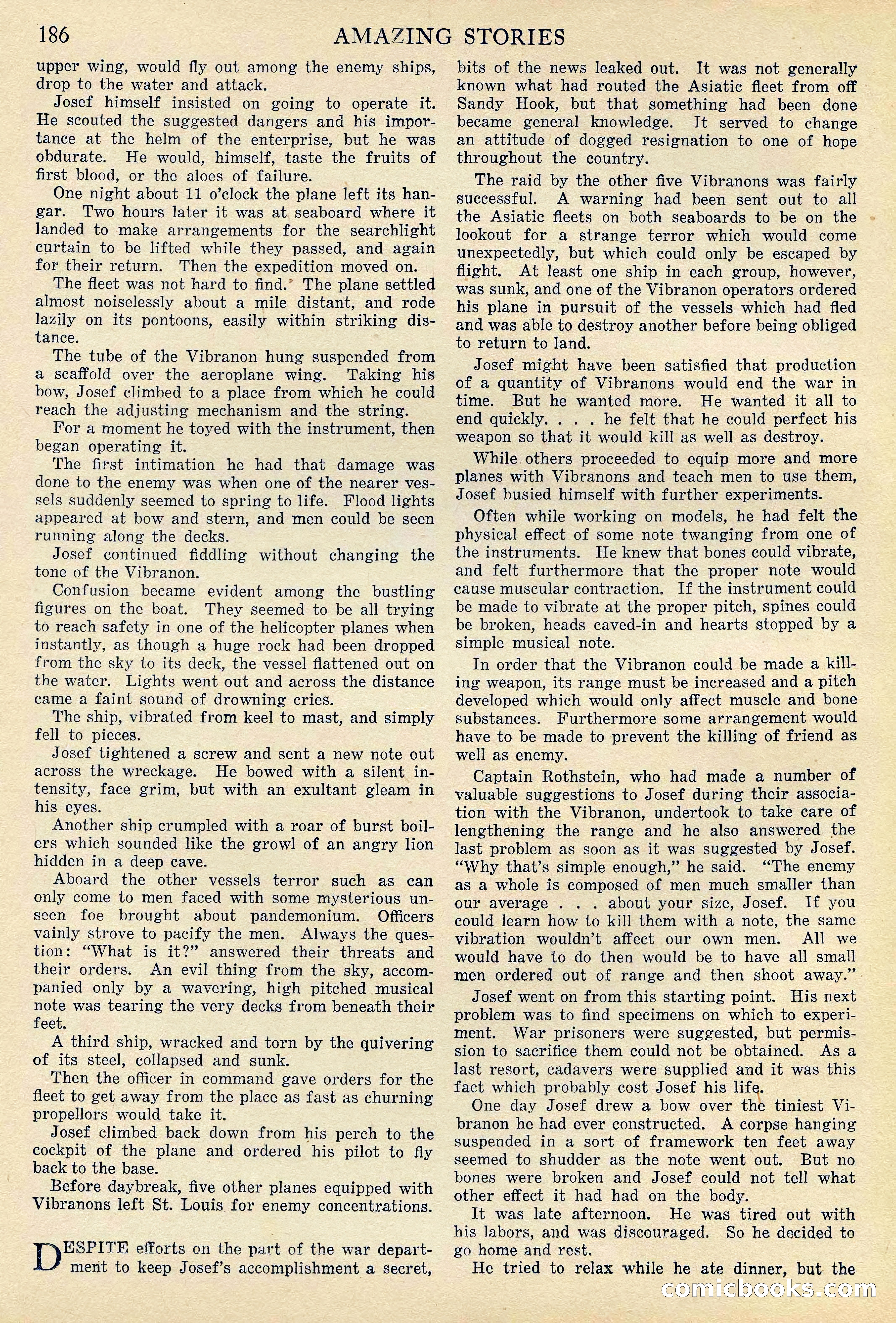
A restored page from Pulp Fiction, 1927. Page through the whole issue in the reader above.
📄 Transcribed text from this page (OCR, searchable)
Machine-transcribed from the original scan — historical spelling and the odd misread are preserved.
186 upper wing, would fly out among the enemy ships, drop to the water and attack. Josef himself insisted on going to operate it. He scouted the suggested dangers and his impor- tance at the helm of the enterprise, but he was obdurate. He would, himself, taste the fruits of first blood, or the aloes of failure. One night about 11 o’clock the plane left its han- gar. Two hours later it was at seaboard where it landed to make arrangements for the searchlight curtain to be lifted while they passed, and again for their return. Then the expedition moved on. The fleet was not hard to find.’ The plane settled almost noiselessly about a mile distant, and rode lazily on its pontoons, easily within striking dis- tance. The tube of the Vibranon hung suspended from a scaffold over the aeroplane wing. Taking his bow, Josef climbed to a place from which he could reach the adjusting mechanism and the string. For a moment he toyed with the instrument, then began operating it. The first intimation he had that damage was done to the enemy was when one of the nearer ves- sels suddenly seemed to spring to life. Flood lights appeared at bow and stern, and men could be seen running along the decks. Josef continued fiddling without changing the tone of the Vibranon. Confusion became evident among the bustling figures on the boat. They seemed to be all trying to reach safety in one of the helicopter planes when instantly, as though a huge rock had been dropped from the sky to its deck, the vessel flattened out on the water. Lights went out and across the distance came a faint sound of drowning cries. The ship, vibrated from keel to mast, and simply fell to pieces. Josef tightened a screw and sent a new note out across the wreckage. He bowed with a silent in- tensity, face grim, but with an exultant gleam in his eyes. Another ship crumpled with a roar of burst boil- ers which sounded like the growl of an angry lion hidden in a deep cave. . Aboard the other vessels terror such as can only come to men faced with some mysterious un- seen foe brought about pandemonium. Officers vainly strove to pacify the men. Always the ques- tion: “What is it?” answered their threats and their orders. An evil thing from the sky, accom- panied only by a wavering, high pitched musical note was tearing the very decks from beneath their feet. A third ship, wracked and torn by the quivering of its steel, collapsed and sunk. Then the officer in command gave orders for the fleet to get away from the place as fast as churning propellors would take it. Josef climbed back down from his perch to the cockpit of the plane and ordered his pilot to fly back to the base. Before daybreak, five other planes equipped with Vibranons left St. Louis for enemy concentrations. Do efforts on the part of the war depart- ment to keep Josef’s accomplishment a secret, AMAZING STORIES bits of the news leaked out. It was not generally known what had routed the Asiatic fleet from off Sandy Hook, but that something had been done became general knowledge. It served to change an attitude of dogged resignation to one of hope throughout the country. The raid by the other five Vibranons was fairly successful. A warning had been sent out to all the Asiatic fleets on both seaboards to be on the - lookout for a strange terror which would come unexpectedly, but which could only be escaped by flight. At least one ship in each group, however, was sunk, and one of the Vibranon operators ordered his plane in pursuit of the vessels which had fled and was able to destroy another before being obliged to return to land. Josef might have been satisfied that production of a quantity of Vibranons would end the war in time. But he wanted more. He wanted it all to end quickly. . . . he felt that he could perfect his weapon so that it would kill as well as destroy. While others proceeded to equip more and more planes with Vibranons and teach men to use them, Josef busied himself with further experiments. Often while working on models, he had felt the physical effect of some note twanging from one of the instruments. He knew that bones could vibrate, and felt furthermore that the proper note would cause muscular contraction. If the instrument could be made to vibrate at the proper pitch, spines could be broken, heads caved-in and hearts stopped by a simple musical note. In order that the Vibranon could be made a kill- ing weapon, its range must be increased and a pitch developed which would only affect muscle and bone substances. Furthermore some arrangement would have to be made to prevent the killing of friend as well as enemy. Captain Rothstein, who had made a number of valuable suggestions to Josef during their associa- tion with the Vibranon, undertook to take care of lengthening the range and he also answered the last problem as soon as it was suggested by Josef. “Why that’s simple enough,” he said. “The enemy as a whole is composed of men much smaller than our average . . . about your size, Josef. If you could learn how to kill them with a note, the same vibration wouldn’t affect our own men. All we would have to do then would be to have all small men ordered out of range and then shoot away.” - Josef went on from this starting point. His next problem was to find specimens on which to experi- ment. War prisoners were suggested, but permis- sion to sacrifice them could not be obtained. As a last resort, cadavers were supplied and it was this fact which probably cost Josef his life. One day Josef drew a bow over the tiniest Vi- branon he had ever constructed. A corpse hanging suspended in a sort of framework ten feet away seemed to shudder as the note went out. But no bones were broken and Josef could not tell what other effect it had had on the body. It was late afternoon. He was tired out with his labors, and was discouraged. So he decided to go home and rest. He tried to relax while he ate dinner, but: the (COA ANCE! oN) KS, (eC)