
Pulp Fiction, 1927 · page 55 of 105
Amazing Stories, Vol. 2, No. 2 — page 55: what you’re looking at
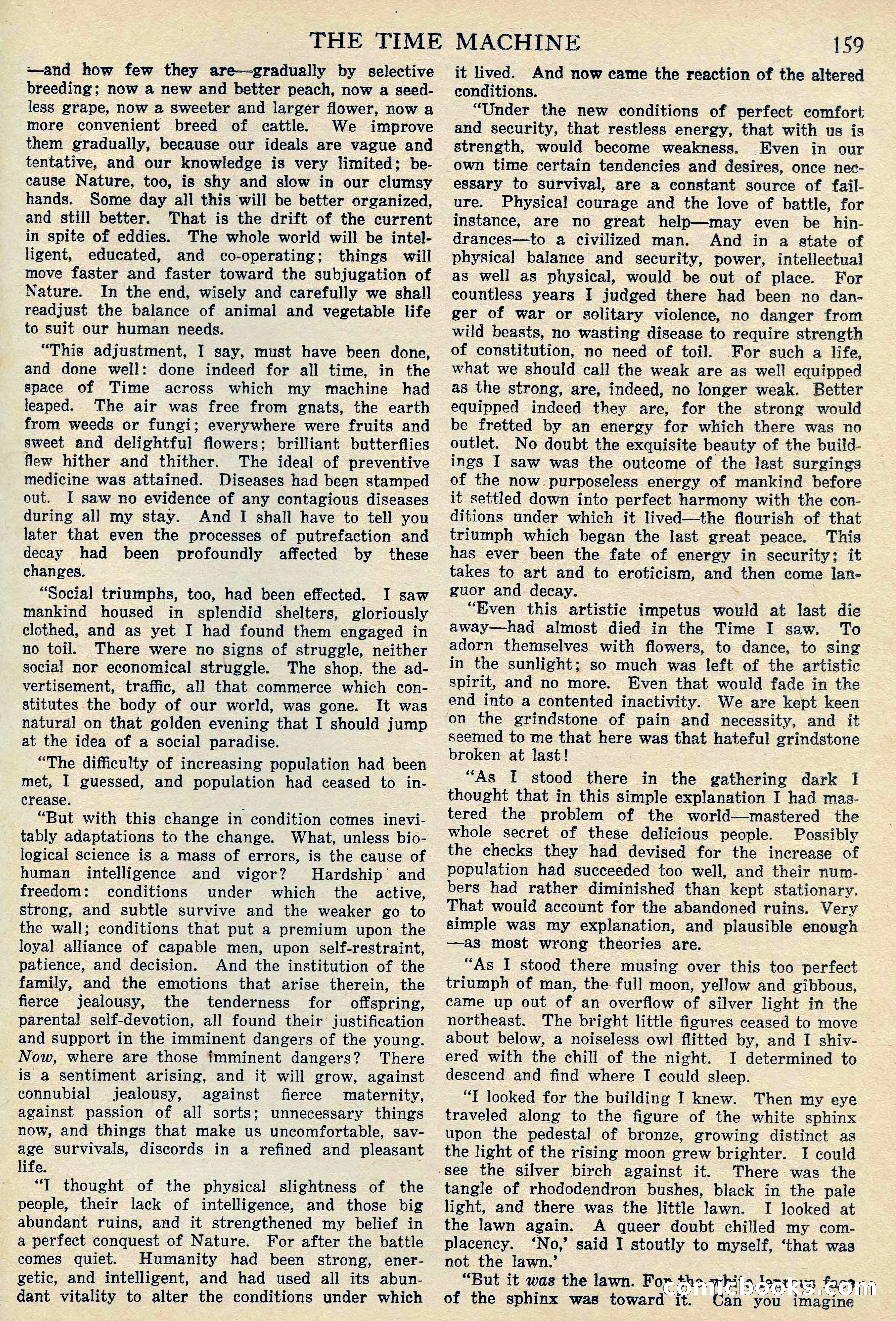
A restored page from Pulp Fiction, 1927. Page through the whole issue in the reader above.
📄 Transcribed text from this page (OCR, searchable)
Machine-transcribed from the original scan — historical spelling and the odd misread are preserved.
THE TIME —and how few they are—gradually by selective breeding; now a new and better peach, now a seed- less grape, now a sweeter and larger flower, now a more convenient breed of cattle. We improve them gradually, because our ideals are vague and tentative, and our knowledge is very limited; be- cause Nature, too, is shy and slow in our clumsy hands. Some day all this will be better organized, and still better. That is the drift of the current in spite of eddies. The whole world will be intel- ligent, educated, and co-operating; things will move faster and faster toward the subjugation of Nature. In the end, wisely and carefully we shall readjust the balance of animal and vegetable life to suit our human needs. “This adjustment, I say, must have been done, and done well: done indeed for all time, in the space of Time across which my machine had leaped. The air was free from gnats, the earth from weeds or fungi; everywhere were fruits and sweet and delightful flowers; brilliant butterflies flew hither and thither. The ideal of preventive medicine was attained. Diseases had been stamped out. I saw no evidence of any contagious diseases during all my stay. And I shall have to tell you later that even the processes of putrefaction and decay had been profoundly affected by these changes. “Social triumphs, too, had been effected. I saw mankind housed in splendid shelters, gloriously clothed, and as yet I had found them engaged in no toil. There were no signs of struggle, neither social nor economical struggle. The shop, the ad- vertisement, traffic, all that commerce which con- stitutes the body of our world, was gone. It was natural on that golden evening that I should jump at the idea of a social paradise. “The difficulty of increasing population had been met, I guessed, and population had ceased to in- crease. : “But with this change in condition comes inevi- tably adaptations to the change. What, unless bio- logical science is a mass of errors, is the cause of human intelligence and vigor? Hardship’ and freedom: conditions under which the active, strong, and subtle survive and the weaker go to the wall; conditions that put a premium upon the loyal alliance of capable men, upon self-restraint, patience, and decision. And the institution of the family, and the emotions that arise therein, the fierce jealousy, the tenderness for offspring, parental self-devotion, all found their justification and support in the imminent dangers of the young. Now, where are those imminent dangers? There is a sentiment arising, and it will grow, against connubial jealousy, against fierce maternity, against passion of all sorts; unnecessary things now, and things that make us uncomfortable, sav- age survivals, discords in a refined and pleasant life. 3 “I thought of the physical slightness of the people, their lack of intelligence, and those big abundant ruins, and it strengthened my belief in a perfect conquest of Nature. For after the battle comes quiet. Humanity had been strong, ener- getic, and intelligent, and had used all its abun- dant vitality to alter the conditions under which -see the silver birch against it. MACHINE 159 it lived. And now came the reaction of the altered conditions. “Under the new conditions of perfect comfort and security, that restless energy, that with us is strength, would become weakness. Even in our own time certain tendencies and desires, once nec- essary to survival, are a constant source of fail- ure. Physical courage and the love of battle, for instance, are no great help—may even be hin- drances—to a civilized man. And in a state of physical balance and security, power, intellectual as well as physical, would be out of place. For countless years I judged there had been no dan- ger of war or solitary violence, no danger from wild beasts, no wasting disease to require strength of constitution, no need of toil. For such a life, what we should call the weak are as well equipped as the strong, are, indeed, no longer weak. Better equipped indeed they are, for the strong would be fretted by an energy for which there was no outlet. No doubt the exquisite beauty of the build- ings I saw was the outcome of the last surgings of the now purposeless energy of mankind before it settled down into perfect harmony with the con- ditions under which it lived—the flourish of that triumph which began the last great peace. This has ever been the fate of energy in security; it takes to art and to eroticism, and then come lan- guor and decay. “Even this artistic impetus would at last die away—had almost died in the Time I saw. To adorn themselves with flowers, to dance, to sing in the sunlight; so much was left of the artistic spirit, and no more. Even that would fade in the end into a contented inactivity. We are kept keen on the grindstone of pain and necessity, and it seemed to me that here was that hateful grindstone broken at last! “As I stood there in the gathering dark I thought that in this simple explanation I had mas- tered the problem of the world—mastered the whole secret of these delicious people. Possibly the checks they had devised for the increase of population had succeeded too well, and their num- bers had rather diminished than kept stationary. That would account for the abandoned ruins. Very simple was my explanation, and plausible enough —as most wrong theories are. “As I stood there musing over this too perfect triumph of man, the full moon, yellow and gibbous, came up out of an overflow of silver light in the northeast. The bright little figures ceased to move about below, a noiseless owl flitted by, and I shiv- ered with the chill of the night. I determined to descend and find where I could sleep. “T looked for the building I knew. Then my eye traveled along to the figure of the white sphinx upon the pedestal of bronze, growing distinct as the light of the rising moon grew brighter. JI could There was the tangle of rhododendron bushes, black in the pale light, and there was the little lawn. I looked at the lawn again. A queer doubt chilled my com- placency. ‘No,’ said I stoutly to myself, ‘that was not the lawn.’ “But it was the lawn. s-comic of the sphinx was toward i ic you imagine