
Pulp Fiction, 1927 · page 54 of 105
Amazing Stories, Vol. 2, No. 2 — page 54: what you’re looking at
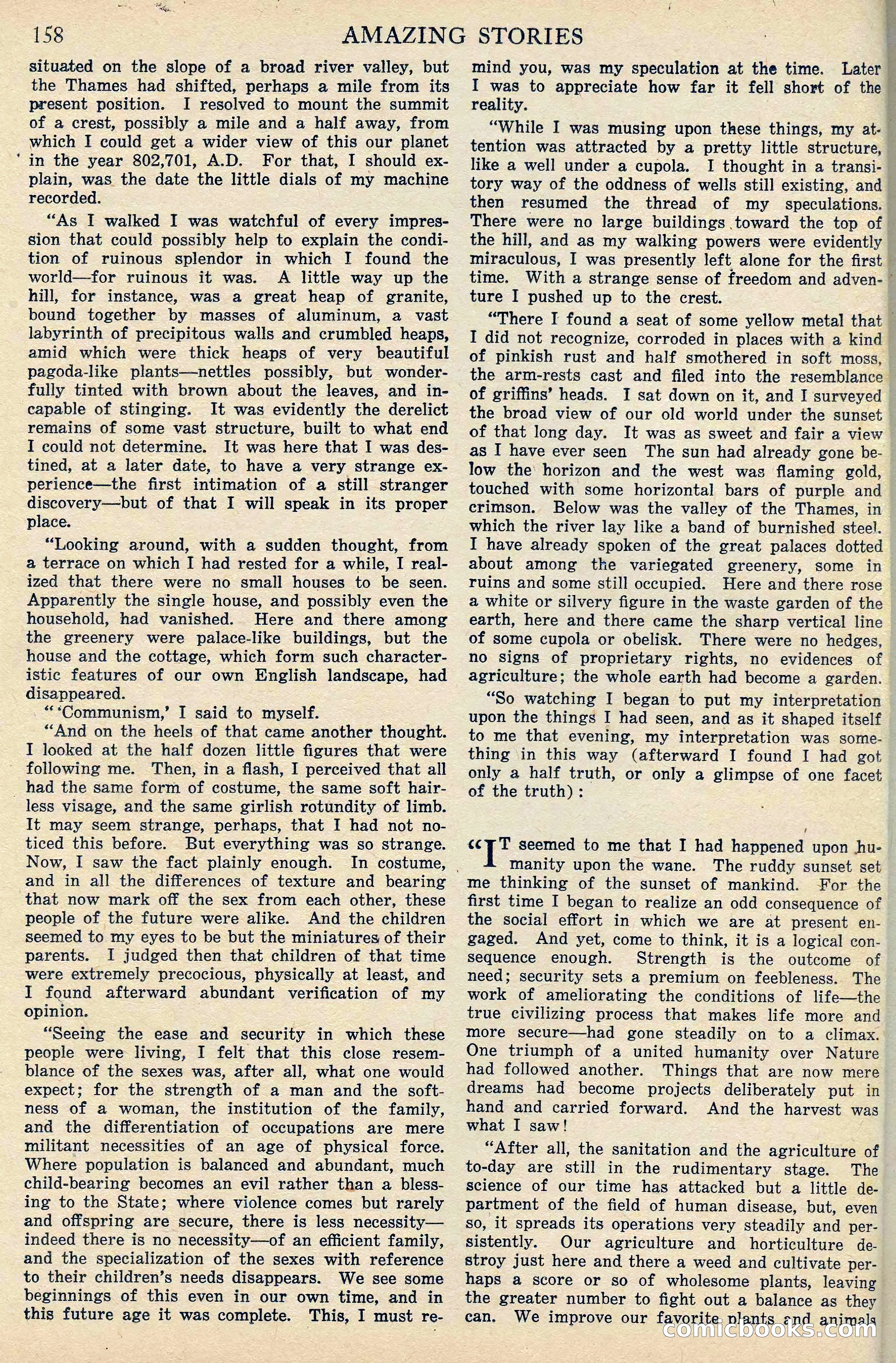
A restored page from Pulp Fiction, 1927. Page through the whole issue in the reader above.
📄 Transcribed text from this page (OCR, searchable)
Machine-transcribed from the original scan — historical spelling and the odd misread are preserved.
158 situated on the slope of a broad river valley, but the Thames had shifted, perhaps a mile from its present position. I resolved to mount the summit of a crest, possibly a mile and a half away, from which I could get a wider view of this our planet ‘in the year 802,701, A.D. For that, I should ex- plain, was the date the little dials of my machine recorded. “As I walked I was watchful of every impres- sion that could possibly help to explain the condi- tion of ruinous splendor in which I found the world—for ruinous it was. A little way up the hill, for instance, was a great heap of granite, bound together by masses of aluminum, a vast labyrinth of precipitous walls and crumbled heaps, amid which were thick heaps of very beautiful pagoda-like plants—nettles possibly, but wonder- fully tinted with brown about the leaves, and in- capable of stinging. It was evidently the derelict remains of some vast structure, built to what end I could not determine. It was here that I was des- tined, at a later date, to have a very strange ex- perience—the first intimation of a still stranger discovery—but of that I will speak in its proper place. “Looking around, with a sudden thought, from a terrace on which I had rested for a while, I real- ized that there were no small houses to be seen. Apparently the single house, and possibly even the household, had vanished. Here and there among the greenery were palace-like buildings, but the house and the cottage, which form such character- istic features of our own English landscape, had disappeared. ~“*Communism,’ I said to myself. “And on the heels of that came another thought. I looked at the half dozen little figures that were - following me. Then, in a flash, I perceived that all _had the same form of costume, the same soft hair- less visage, and the same girlish rotundity of limb. It may seem strange, perhaps, that I had not no- ticed this before. But everything was so strange. Now, I saw the fact plainly enough. and in all the differences of texture and bearing that now mark off the sex from each other, these people of the future were alike. And the children seemed to my eyes to be but the miniatures of their parents. I judged then that children of that time were extremely precocious, physically at least, and I found afterward abundant verification of my opinion. | “Seeing the ease and security in which these people were living, I felt that this close resem- blance of the sexes was, after all, what one would expect; for the strength of a man and the soft- ness of a woman, the institution of the family, and the differentiation of occupations are mere militant necessities of an age of physical force. Where population is balanced and abundant, much child-bearing becomes an evil rather than a bless- ing to the State; where violence comes but rarely and offspring are secure, there is less necessity— indeed there is no necessity—of an efficient family, and the specialization of the sexes with reference to their children’s needs disappears. We see some beginnings of this even in our own time, and in this future age it was complete. This, I must re- In costume, | AMAZING STORIES mind you, was my speculation at the time. Later I was to appreciate how far it fell short of the reality. | “While I was musing upon these things, my at-_ tention was attracted by a pretty little structure, like a well under a cupola. I thought in a transi- tory way of the oddness of wells still existing, and then resumed the thread of my _ speculations. There were no large buildings toward the top of the hill, and as my walking powers were evidently miraculous, I was presently left alone for the first time. With a strange sense of freedom and adven- ~ ture I pushed up to the crest. “There I found a seat of some yellow metal that — I did not recognize, corroded in places with a kind of pinkish rust and half smothered in soft moss, the arm-rests cast and filed into the resemblance of griffins’ heads. I sat down on it, and I surveyed the broad view of our old world under the sunset of that long day. It was as sweet and fair a view as I have ever seen The sun had already gone be- low the horizon and the west was flaming gold, touched with some horizontal bars of purple and crimson. Below was the valley of the Thames, in which the river lay like a band of burnished steel. I have already spoken of the great palaces dotted about among the variegated greenery, some in ruins and some still occupied. Here and there rose a white or silvery figure in the waste garden of the earth, here and there came the sharp vertical line of some cupola or obelisk. There were no hedges, no signs of proprietary rights, no evidences of agriculture; the whole earth had become a garden. “So watching I began to put my interpretation upon the things I had seen, and as it shaped itself to me that evening, my interpretation was some- thing in this way (afterward I found I had got only a half truth, or only a glimpse of one facet of the truth): “ye seemed to me that I had happened upon hu- manity upon the wane. The ruddy sunset set me thinking of the sunset of mankind. ‘For the first time I began to realize an odd consequence of the social effort in which we are at present en- gaged. And yet, come to think, it is a logical con- sequence enough. Strength is the outcome of need; security sets a premium on feebleness. The work of ameliorating the conditions of life—the true civilizing process that makes life more and More secure—had gone steadily on to a climax. One triumph of a united humanity over Nature had followed another. Things that are now mere dreams had become projects deliberately put in hand and carried forward. And the harvest was what I saw! “After all, the sanitation and the agriculture of to-day are still in the rudimentary stage. The science of our time has attacked but a little de- partment of the field of human disease, but, even so, it spreads its operations very steadily and per- sistently. Our agriculture and horticulture de- stroy just here and there a weed and cultivate per- haps a score or so of wholesome plants, leaving the greater number to fight out a balance as they can. We improve our favorite plants. end anjr |