
Pulp Fiction, 1927 · page 46 of 105
Amazing Stories, Vol. 2, No. 2 — page 46: what you’re looking at
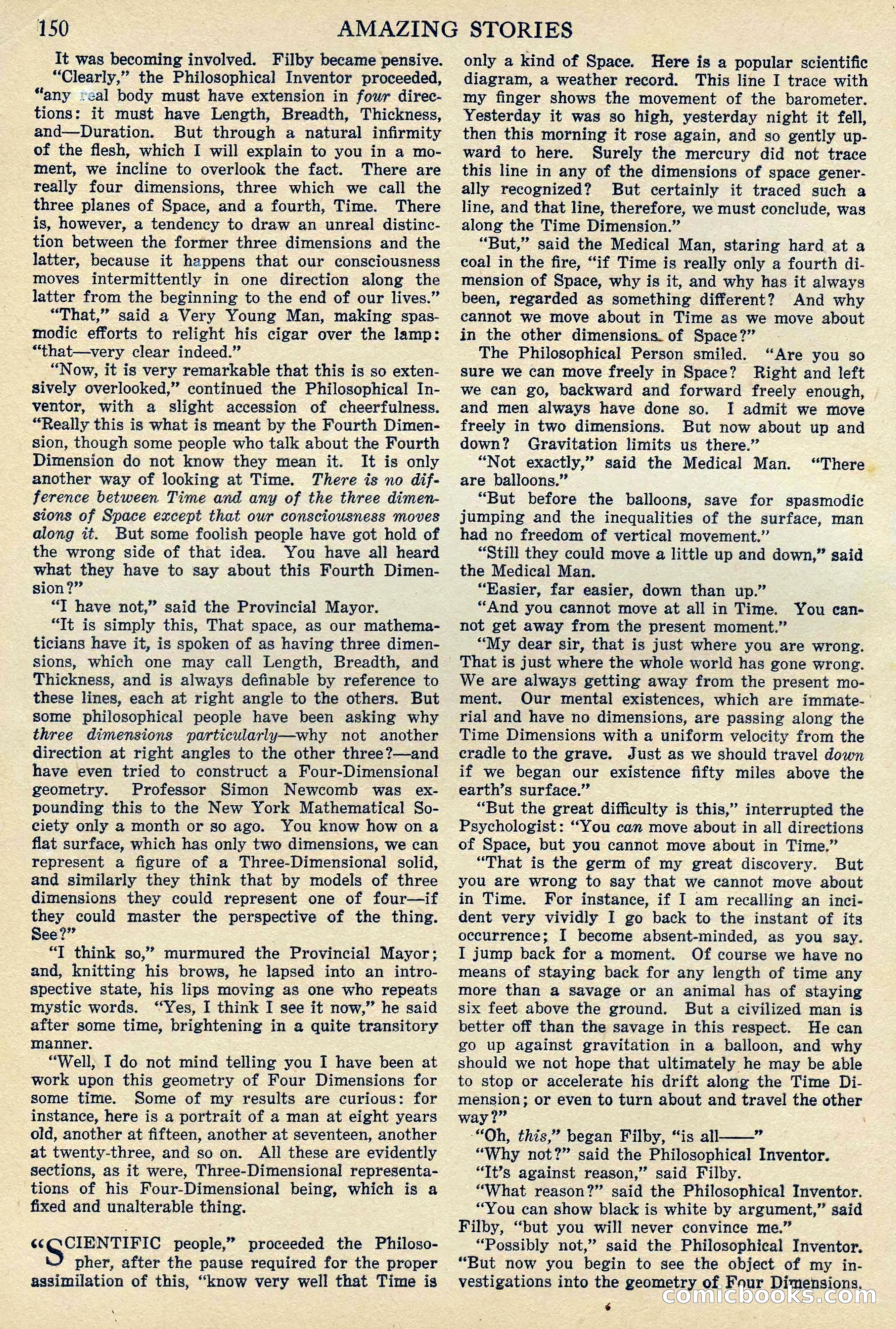
A restored page from Pulp Fiction, 1927. Page through the whole issue in the reader above.
📄 Transcribed text from this page (OCR, searchable)
Machine-transcribed from the original scan — historical spelling and the odd misread are preserved.
150 It was becoming involved. Filby became pensive. “Clearly,” the Philosophical Inventor proceeded, “any «cal body must have extension in four direc- tions: it must have Length, Breadth, Thickness, and—Duration. But through a natural infirmity of the flesh, which I will explain to you in a mo- ment, we incline to overlook the fact. There are really four dimensions, three which we call the three planes of Space, and a fourth, Time. There is, however, a tendency to draw an unreal distinc- tion between the former three dimensions and the latter, because it happens that our consciousness moves intermittently in one direction along the latter from the beginning to the end of our lives.” “That,” said a Very Young Man, making spas- modic efforts to relight his cigar over the lamp: “that—very clear indeed.” “Now, it is very remarkable that this is so exten- sively overlooked,” continued the Philosophical In- ventor, with a slight accession of cheerfulness. “Really this is what is meant by the Fourth Dimen- sion, though some people who talk about the Fourth Dimension do not know they mean it. It is only another way of looking at Time. There is no dif- ference between Time and any of the three dimen- sions of Space except that our consciousness moves along it. But some foolish people have got hold of the wrong side of that idea. You have all heard what they have to say about this Fourth Dimen- sion?” “TI have not,” said the Provincial Mayor. “It is simply this, That space, as our mathema- ticians have it, is spoken of as having three dimen- sions, which one may call Length, Breadth, and Thickness, and is always definable by reference to these lines, each at right angle to the others. But some philosophical people have been asking why three dimensions particularly—why not another direction at right angles to the other three?—and have even tried to construct a Four-Dimensional geometry. Professor Simon Newcomb was ex- pounding this to the New York Mathematical So- ciety only a month or so ago. You know how on a flat surface, which has only two dimensions, we can represent a figure of a Three-Dimensional solid, and similarly they think that by models of three dimensions they could represent one of four—if they could master the perspective of the thing. See?” | “T think so,” murmured the Provincial Mayor; and, knitting his brows, he lapsed into an intro- spective state, his lips moving as one who repeats mystic words. “Yes, I think I see it now,” he said after some time, brightening in a quite transitory manner. “Well, I do not mind telling you I have been at work upon this geometry of Four Dimensions for some time. Some of my results are curious: for instance, here is a portrait of a man at eight years old, another at fifteen, another at seventeen, another at twenty-three, and so on. All these are evidently Sections, as it were, Three-Dimensional representa- tions of his Four-Dimensional being, which is a fixed and unalterable thing. 6c CIENTIFIC people,” proceeded the Philoso- pher, after the pause required for the proper assimilation of this, “know very well that Time is AMAZING STORIES only a kind of Space. Here is a popular scientific diagram, a weather record. This line I trace with my finger shows the movement of the barometer. Yesterday it was so high, yesterday night it fell, then this morning it rose again, and so gently up- ward to here. Surely the mercury did not trace this line in any of the dimensions of space gener- ally recognized? But certainly it traced such a line, and that line, therefore, we must conclude, was along the Time Dimension.” “But,” said the Medical Man, staring hard at a coal in the fire, “if Time is really only a fourth di- mension of Space, why is it, and why has it always been, regarded as something different? And why cannot we move about in Time as we move about in the other dimensions. of Space?” The Philosophical Person smiled. “Are you so sure we can move freely in Space? Right and left we can go, backward and forward freely enough, and men always have done so. I admit we move freely in two dimensions. But now about up and down? Gravitation limits us there.” “Not exactly,” said the Medical Man. are balloons.” “But before the balloons, save for spasmodic jumping and the inequalities of the surface, man had no freedom of vertical movement.” ; “Still they could move a little up and down,” said the Medical Man. “Easier, far easier, down than up.” “And you cannot move at all in Time. not get away from the present moment.” “My dear sir, that is just where you are wrong. That is just where the whole world has gone wrong. We are always getting away from the present mo- ment. Our mental existences, which are immate-— rial and have no dimensions, are passing along the Time Dimensions with a uniform velocity from the cradle to the grave. Just as we should travel down if we began our existence fifty miles above the earth’s surface.” “But the great difficulty is this,” interrupted the Psychologist: ““You can move about in all directions of Space, but you cannot move about in Time.” “That is the germ of my great discovery. But you are wrong to say that we cannot move about in Time. For instance, if I am recalling an inci- dent very vividly I go back to the instant of its occurrence; I become absent-minded, as you gay. I jump back for a moment. Of course we have no means of staying back for any length of time any more than a savage or an animal has of staying six feet above the ground. But a civilized man is better off than the savage in this respect. He can go up against gravitation in a balloon, and why should we not hope that ultimately he may be able to stop or accelerate his drift along the Time Di- mension; or even to turn about and travel the other way?” . “Qh, this,” began Filby, “is all fs “Why not?” said the Philosophical Inventor. “It’s against reason,” said Filby. “What reason?” said the Philosophical Inventor. “You can show black is white by argument,” said Filby, “but you will never convince me.” “Possibly not,” said the Philosophical Inventor. “But now you begin to see the object of my in- vestigations into the geometry of. Fpur Dimensions. : (GOMMIGELXOOKS ACOA “There You can-