
Pulp Fiction, 1927 · page 45 of 105
Amazing Stories, Vol. 2, No. 2 — page 45: what you’re looking at
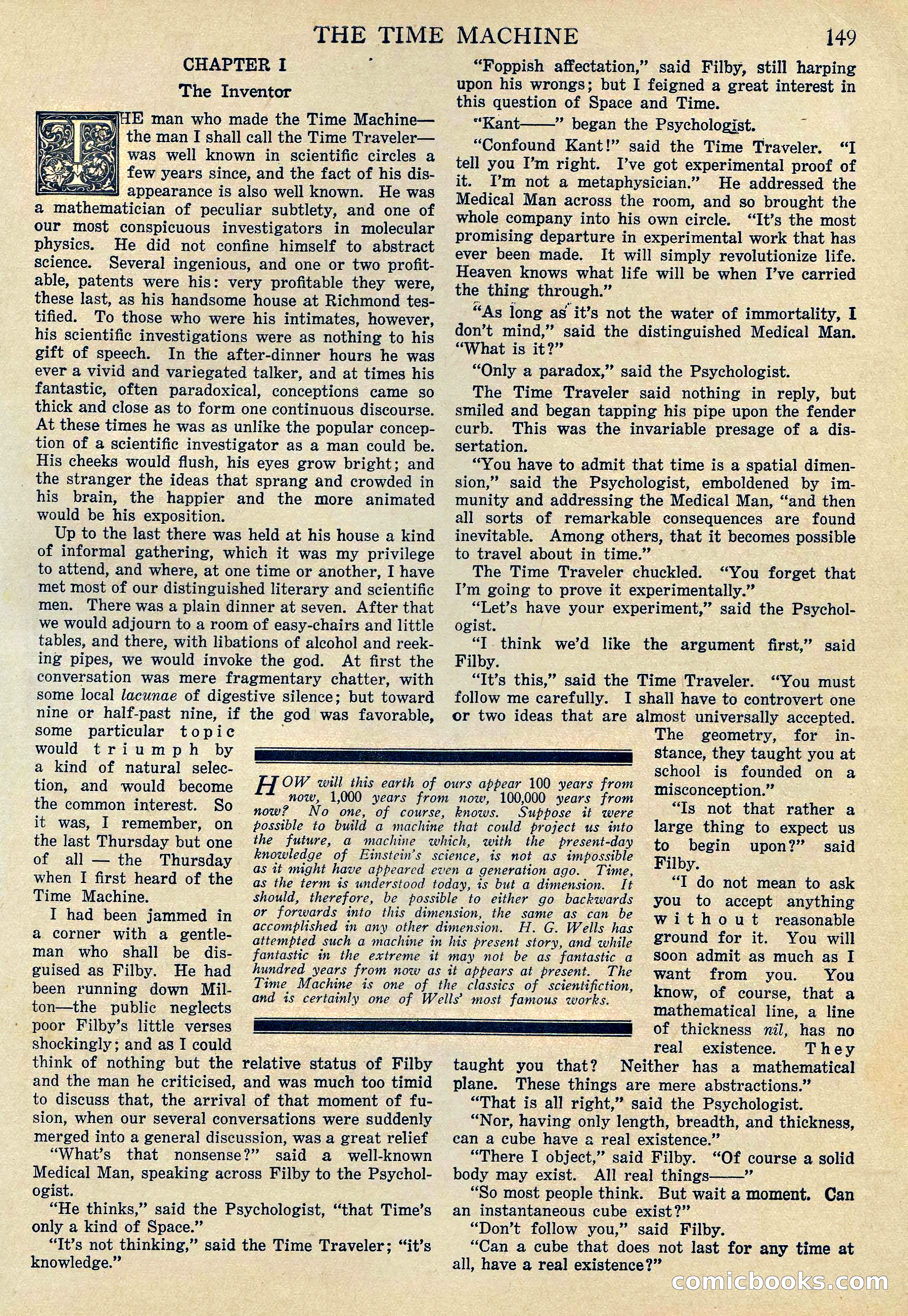
A restored page from Pulp Fiction, 1927. Page through the whole issue in the reader above.
📄 Transcribed text from this page (OCR, searchable)
Machine-transcribed from the original scan — historical spelling and the odd misread are preserved.
THE TIME CHAPTER I E The Inventor =———ese=—iK} man who made the Time Machine— ys Wee! the man I shall call the Time Traveler— was well known in scientific circles a yr eéy| few years since, and the fact of his dis- Eaie23"| appearance is also well known. He was a mathematician of peculiar subtlety, and one of our most conspicuous investigators in molecular physics. He did not confine himself to abstract Science. Several ingenious, and one or two profit- able, patents were his: very profitable they were, these last, as his handsome house at Richmond tes- tified. To those who were his intimates, however, his scientific investigations were as nothing to his gift of speech. In the after-dinner hours he was ever a vivid and variegated talker, and at times his fantastic, often paradoxical, conceptions came so thick and close as to form one continuous discourse. At these times he was as unlike the popular concep- tion of a scientific investigator as a man could be. His cheeks would flush, his eyes grow bright; and the stranger the ideas that sprang and crowded in his brain, the happier and the more animated would be his exposition. Up to the last there was held at his house a kind of informal gathering, which it was my privilege to attend, and where, at one time or another, I have met most of our distinguished literary and scientific men. There was a plain dinner at seven. After that we would adjourn to a room of easy-chairs and little tables, and there, with libations of alcohol and reek- ing pipes, we would invoke the god. At first the conversation was mere fragmentary chatter, with some local lacunae of digestive silence: but toward nine or half-past nine, if the god was favorable, some particular topic would triumph by a kind of natural selec- tion, and would become the common interest. So it was, I remember, on the last Thursday but one of all — the Thursday when I first heard of the Time Machine. I had been jammed in a corner with a gentle- man who shall be dis- euised as Filby. He had been running down Mil- ton—the public neglects poor Filby’s little verses shockingly; and as I could think of nothing but the relative status of Filby and the man he criticised, and was much too timid to discuss that, the arrival of that moment of fu- sion, when our several conversations were suddenly merged into a general discussion, was a great relief “What’s that nonsense?” said a well-known Medical Man, speaking across Filby to the Psychol- ogist. “He thinks,” said the Psychologist, “that Time’s only a kind of Space.” “It’s not thinking,” said the Time Traveler; “it’s knowledge.” Ss) = EN now? H OW will this earth of ours appear 100 years from now, 1,000 years from now, 100,000 years from No one, of course, knows. possible to build a machine that could project us into the future, a machine which, with the present-day knowledge of FEinstein’s science, is not as impossible as it might have appeared even a generation ago. as the term is understood today, is but a dimension. It should, therefore, be possible to either go backwards or forwards into this dimension, the same as can be accomplished in any other dimension. attempted such a machine in his present story, and while fantastic in the extreme it may not be as fantastic a hundred years from now as it appears at present. Time Machine is one of the classics of scientifiction, and is certainly one of Wells’ most famous works. MACHINE — 149 “Foppish affectation,” said Filby, still harping upon his wrongs; but I feigned a great interest in this question of Space and Time. “Kant ” began the Psychologist. “Confound Kant!” said the Time Traveler. “I tell you I’m right. I’ve got experimental proof of it. I’m not a metaphysician.” He addressed the Medical Man across the room, and so brought the whole company into his own circle. “It’s the most promising departure in experimental work that has ever been made. It will simply revolutionize life. Heaven knows what life will be when I’ve carried the thing through.” “As long as it’s not the water of immortality, I don’t mind,” said the distinguished Medical Man. “What is it?” “Only a paradox,” said the Psychologist. The Time Traveler said nothing in reply, but smiled and began tapping his pipe upon the fender curb. This was the invariable presage of a dis- sertation. “You have to admit that time is a spatial dimen- sion,” said the Psychologist, emboldened by im- munity and addressing the Medical Man, ‘‘and then all sorts of remarkable consequences are found inevitable. Among others, that it becomes possible to travel about in time.” The Time Traveler chuckled. “You forget that I’m going to prove it experimentally.” “Let’s have your experiment,” said the Psychol- ogist. “IT. think we’d like the argument first,” said Filby. “It’s this,” said the Time Traveler. “You must follow me carefully. I shall have to controvert one © or two ideas that are almost universally accepted. The geometry, for in- stance, they taught you at school is founded on a misconception.” , “Is not that rather a large thing to expect us to begin upon?” Filby. “I do not mean to ask you to accept anything without reasonable ground for it. You will soon admit as much as I want from you. You know, of course, that a mathematical line, a line of thickness nil, has no real existence. They taught you that? Neither has a mathematical plane. These things are mere abstractions.” “That is all right,” said the Psychologist. “Nor, having only length, breadth, and thickness, can a cube have a real existence.” “There I object,” said Filby. “Of course a solid body may exist. All real things——” “So most people think. But wait a moment. Can an instantaneous cube exist?” “Don’t follow you,” said Filby. “Can a cube that does not last for any time at all, have a real existence?’ Eomichboo Suppose it were Time, H. G. Wells has The said <S (e(@)