
Pulp Fiction, 1927 · page 43 of 105
Amazing Stories, Vol. 2, No. 2 — page 43: what you’re looking at
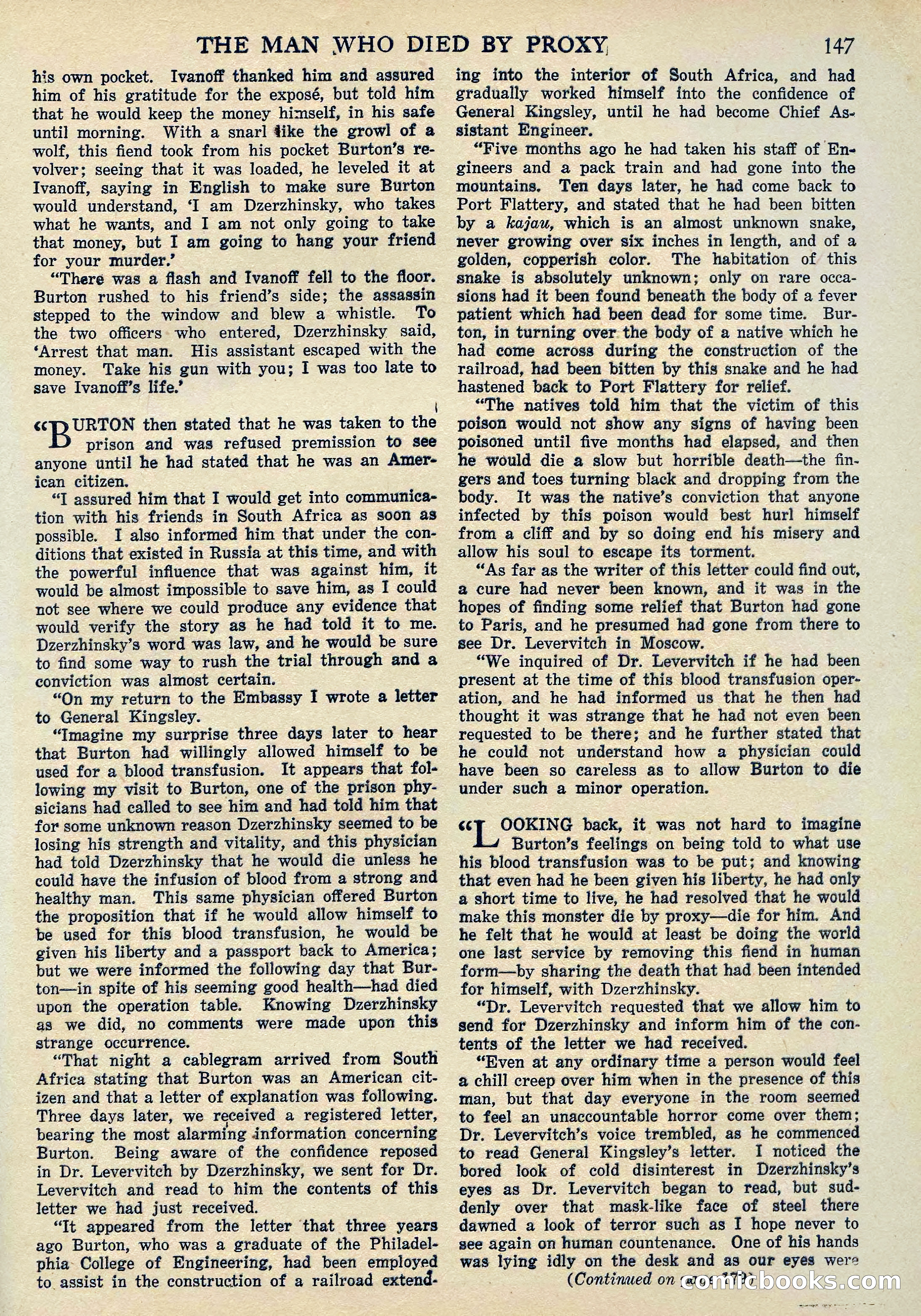
A restored page from Pulp Fiction, 1927. Page through the whole issue in the reader above.
📄 Transcribed text from this page (OCR, searchable)
Machine-transcribed from the original scan — historical spelling and the odd misread are preserved.
THE MAN WHO DIED BY PROXY his own pocket. Ivanoff thanked him and assured him of his gratitude for the exposé, but told him that he would keep the money himself, in his safe until morning. With a snarl dike the growl of a wolf, this fiend took from his pocket Burton’s re- volver; seeing that it was loaded, he leveled it at Ivanoff, saying in English to make sure Burton would understand, ‘I am Dzerzhinsky, who takes what he wants, and I am not only going to take that money, but I am going to hang your friend for your murder.’ “There was a flash and Ivanoff fell to the floor. Burton rushed to his friend’s side; the assassin stepped to the window and blew a whistle. To the two officers who entered, Dzerzhinsky said, ‘Arrest that man. His assistant escaped with the money. Take his gun with you; I was too late to save Ivanofi’s life.’ . \ «CH URTON then stated that he was taken to the prison and was refused premission to see anyone until he had stated that he was an Amer- ican citizen. “T assured him that I would get into communica- tion with his friends in South Africa as soon as possible. I also informed him that under the con- ditions that existed in Russia at this time, and with the powerful influence that was against him, it would be almost impossible to save him, as I could not see where we could produce any evidence that would verify the story as he had told it to me. Dzerzhinsky’s word was law, and he would be sure to find some way to rush the trial through and a conviction was almost certain. “On my return to the Embassy I wrote a letter to General Kingsley. “Imagine my surprise three days later to hear that Burton had willingly allowed himself to be used for a blood transfusion. It appears that fol- lowing my visit to Burton, one of the prison phy- sicians had called to see him and had told him that for some unknown reason Dzerzhinsky seemed to be losing his strength and vitality, and this physician had told Dzerzhinsky that he would die unless he could have the infusion of blood from a strong and healthy man. This same physician offered Burton the proposition that if he would allow himself to be used for this blood transfusion, he would be given his liberty and a passport back to America; but we were informed the following day that Bur- ton—in spite of his seeming good health—had died upon the operation table. Knowing Dzerzhinsky as we did, no comments were made upon this strange occurrence. “That night a ecablegram arrived from South Africa stating that Burton was an American cit- izen and that a letter of explanation was following. Three days later, we received a registered letter, bearing the most alarming information concerning Burton. Being aware of the confidence reposed in Dr. Levervitch by Dzerzhinsky, we sent for Dr. Levervitch and read to him the contents of this letter we had just received. “It appeared from the letter that three years ago Burton, who was a graduate of the Philadel- phia- College of Engineering, had been employed to assist in the construction of a railroad extend- 147 ing into the interior of South Africa, and had gradually worked himself into the confidence of General Kingsley, until he had become Chief As- sistant Engineer. “Five months ago he had taken his staff of En- gineers and a pack train and had gone into the mountains. Ten days later, he had come back to Port Flattery, and stated that he had been bitten by a kajau, which is an almost unknown snake, never growing over six inches in length, and of a golden, copperish color. The habitation of this snake is absolutely unknown; only on rare occa- sions had it been found beneath the body of a fever patient which had been dead for some time. Bur- ton, in turning over the body of a native which he had come across during the construction of the railroad, had been bitten by this snake and he had hastened back to Port Flattery for relief. “The natives told him that the victim of this poison would not show any signs of having been poisoned until five months had elapsed, and then he would die a slow but horrible death—the fin- gers and toes turning black and dropping from the body. It was the native’s conviction that anyone infected by this poison would best hurl himself from a cliff and by so doing end his misery and allow his soul to escape its torment. “As far as the writer of this letter could find out, a cure had never been known, and it was in the hopes of finding some relief that Burton had gone to Paris, and he presumed had gone from there to see Dr. Levervitch in Moscow. “We inquired of Dr. Levervitch if he had been present at the time of this blood transfusion oper- ation, and he had informed us that he then had thought it was strange that he had not even been requested to be there; and he further stated that he could not understand how a2 physician could have been so careless as to allow Burton to die under such a minor operation. ccy OOKING back, it was not hard to imagine . Burton’s feelings on being told to what use his blood transfusion was to be put; and knowing that even had he been given his liberty, he had only a short time to live, he had resolved that he would make this monster die by proxy—die for him. And he felt that he would at least be doing the world one last service by removing this fiend in human form—by sharing the death that had been intended for himself, with Dzerzhinsky. “Dr. Levervitch requested that we allow him to send for Dzerzhinsky and inform him of the con- tents of the letter we had received. “Even at any ordinary time a person would feel a chill creep over him when in the presence of this man, but that day everyone in the room seemed to feel an unaccountable horror come over them; Dr. Levervitch’s voice trembled, as he commenced to read General Kingsley’s letter. I noticed the bored look of cold disinterest in Dzerzhinsky’s eyes as Dr. Levervitch began to read, but sud- denly over that mask-like face of steel there dawned a look of terror such as I hope never to gee again on human countenance. One of his hands was lying idly on the desk and as our eyes were (Continued on (ato nth 22, ooo) KS rene Oe (E(@)