
Pulp Fiction, 1927 · page 42 of 105
Amazing Stories, Vol. 2, No. 2 — page 42: what you’re looking at
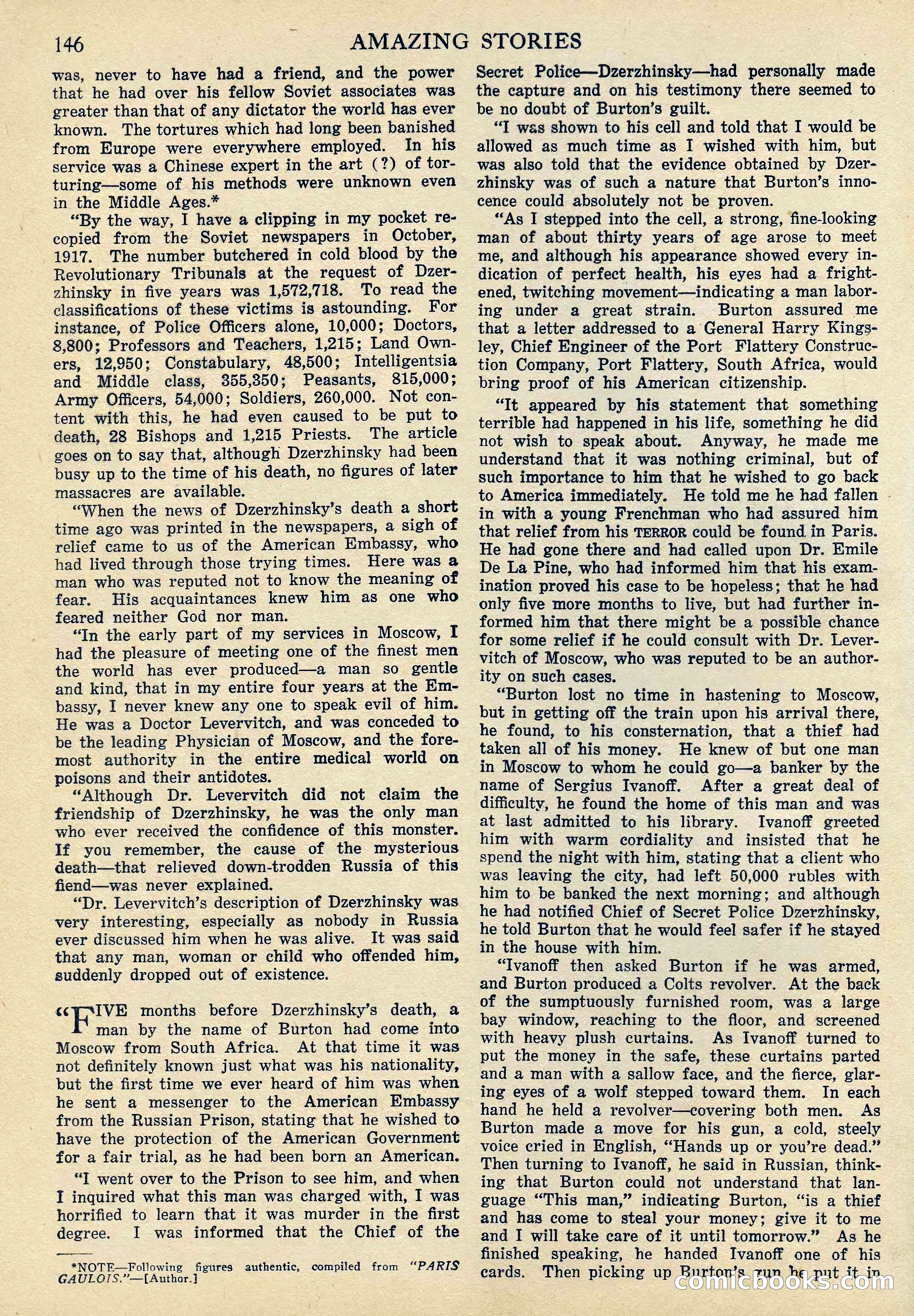
A restored page from Pulp Fiction, 1927. Page through the whole issue in the reader above.
📄 Transcribed text from this page (OCR, searchable)
Machine-transcribed from the original scan — historical spelling and the odd misread are preserved.
146 was, never to have had a friend, and the power that he had over his fellow Soviet associates was greater than that of any dictator the world has ever known. The tortures which had long been banished from Europe were everywhere employed. In his service was 2 Chinese expert in the art (?) of tor- turing—some of his methods were unknown even in the Middle Ages.* “By the way, I have a clipping in my pocket re- copied from the Soviet newspapers in October, 1917. The number butchered in cold blood by the Revolutionary Tribunals at the request of Dzer- zhinsky in five years was 1,572,718. To read the classifications of these victims is astounding. For instance, of Police Officers alone, 10,000; Doctors, 8,800; Professors and Teachers, 1,215; Land Own- ers, 12,950; Constabulary, 48,500; Intelligentsia and Middle class, 355,350; Peasants, 815,000; Army Officers, 54,000; Soldiers, 260,000. Not con- tent with this, he had even caused to be put to death, 28 Bishops and 1,215 Priests. The article goes on to say that, although Dzerzhinsky had been busy up to the time of his death, no figures of later massacres are available. “When the news of Dzerzhinsky’s death a short time ago was printed in the newspapers, a sigh of relief came to us of the American Embassy, who had lived through those trying times. Here was a man who was reputed not to know the meaning of fear. His acquaintances knew him as one who feared neither God nor man. “In the early part of my services in Moscow, I had the pleasure of meeting one of the finest men the world has ever produced—a man so gentle and kind, that in my entire four years at the Em- bassy, I never knew any one to speak evil of him. He was a Doctor Levervitch, and was conceded to be the leading Physician of Moscow, and the fore- most authority in the entire medical world on poisons and their antidotes. “Although Dr. Levervitch did not claim the friendship of Dzerzhinsky, he was the only man who ever received the confidence of this monster. If you remember, the cause of the mysterious death—that relieved down-trodden Russia of this fiend—was never explained. “Dr. Levervitch’s description of Dzerzhinsky was very interesting, especially as nobody in Russia ever discussed him when he was alive. It was said that any man, woman or child who offended him, suddenly dropped out of existence. chee months before Dzerzhinsky’s death, a man by the name of Burton had come into Moscow from South Africa. At that time it was not definitely known just what was his nationality, but the first time we ever heard of him was when he sent a messenger to the American Embassy from the Russian Prison, stating that he wished to have the protection of the American Government for a fair trial, as he had been born an American. “T went over to the Prison to see him, and when I inquired what this man was charged with, I was horrified to learn that it was murder in the first degree. I was informed that the Chief of the *NOTE—Following figures authentic, compiled from “PARIS GAULOIS.”-—[Author.] AMAZING STORIES Secret Police—Dzerzhinsky—had personally made the capture and on his testimony there seemed to be no doubt of Burton’s guilt. “T was shown to his cell and told that I would be allowed as much time as I wished with him, but was also told that the evidence obtained by Dzer- zhinsky was of such a nature that Burton’s inno- cence could absolutely not be proven. ‘‘As I stepped into the cell, a strong, fine-looking man of about thirty years of age arose to meet me, and although his appearance showed every in- dication of perfect health, his eyes had a fright- ened, twitching movement—indicating a man labor- ing under a great strain. Burton assured me that a letter addressed to a General Harry Kings- ley, Chief Engineer of the Port Flattery Construc- tion Company, Port Flattery, South Africa, would bring proof of his American citizenship. “It appeared by his statement that something terrible had happened in his life, something he did not wish to speak about. Anyway, he made me understand that it was nothing criminal, but of such importance to him that he wished to go back to America immediately. He told me he had fallen - in with a young Frenchman who had assured him that relief from his TERROR could be found, in Paris. He had gone there and had called upon Dr. Emile De La Pine, who had informed him that his exam- ination proved his case to be hopeless; that he had only five more months to live, but had further in- formed him that there might be a possible chance for some relief if he could consult with Dr. Lever- vitch of Moscow, who was reputed to be an author- ity on such cases. “Burton lost no time in hastening to Moscow, but in getting off the train upon his arrival there, he found, to his consternation, that a thief had taken all of his money. He knew of but one man in Moscow to whom he could go—a banker by the name of Sergius Ivanoff. After a great deal of difficulty, he found the home of this man and was at last admitted to his library. Ivanoff greeted him with warm cordiality and insisted that he spend the night with him, stating that a client who was leaving the city, had left 50,000 rubles with him to be banked the next morning; and although he had notified Chief of Secret Police Dzerzhinsky, he told Burton that he would feel safer if he stayed in the house with him. “Tvanoff then asked Burton if he was armed, and Burton produced a Colts revolver. At the back of the sumptuously furnished room, was a large bay window, reaching to the floor, and screened with heavy plush curtains. As Ivanoff turned to put the money in the safe, these curtains parted and a man with a sallow face, and the fierce, glar- ing eyes of a wolf stepped toward them. In each hand he held a revolver—covering both men. As Burton made a move for his gun, a cold, steely voice cried in English, “Hands up or you’re dead.” Then turning to Ivanoff, he said in Russian, think- ing that Burton could not understand that lan- guage “This man,” indicating Burton, “is a thief and has come to steal your money; give it to me and I will take care of it until tomorrow.” As he finished speaking, he handed Ivanoff one of his ecards. Then picking up EG rors. bo he put com