
Pulp Fiction, 1927 · page 28 of 108
Amazing Stories, Vol. 2, No. 1 — page 28: what you’re looking at
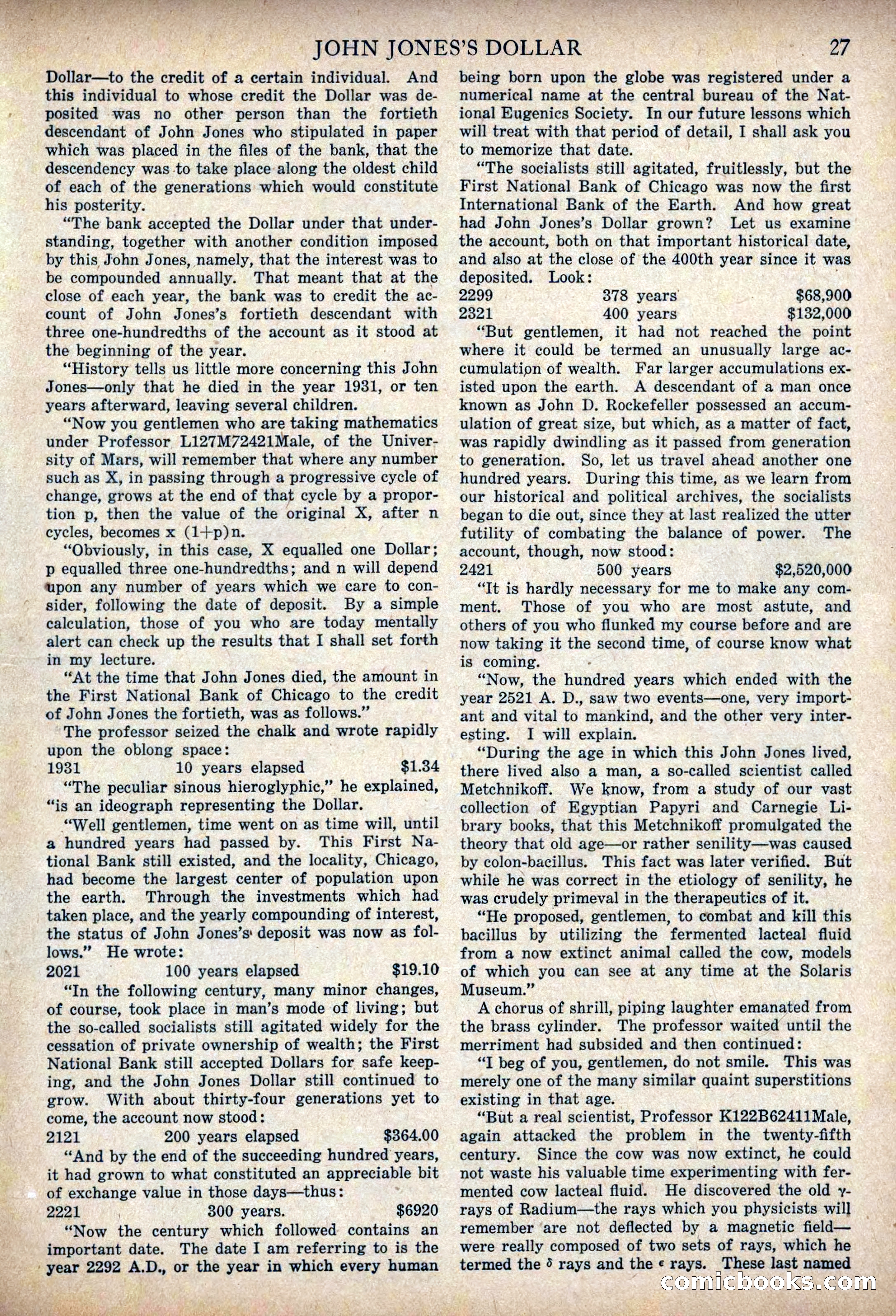
A restored page from Pulp Fiction, 1927. Page through the whole issue in the reader above.
📄 Transcribed text from this page (OCR, searchable)
Machine-transcribed from the original scan — historical spelling and the odd misread are preserved.
f + 1) he i) 2 ae Dollar—to the credit of a certain individual. And this individual to whose credit the Dollar was de- posited was no other person than the fortieth descendant of John Jones who stipulated in paper which was placed in the files of the bank, that the descendency was -to take place along the oldest child of each of the generations which would constitute his posterity. “The bank accepted the Dollar under that under- standing, together with another condition imposed by this John Jones, namely, that the interest was to be compounded annually. That meant that at the close of each year, the bank was to credit the ac- count of John Jones’s fortieth descendant with three one-hundredths of the account as it stood at the beginning of the year. “History tells us little more concerning this John Jones—only that he died in the year 1931, or ten years afterward, leaving several children. “Now you gentlemen who are taking mathematics under Professor L127M72421Male, of the Univer- sity of Mars, will remember that where any number such as X, in passing through a progressive cycle of change, grows at the end of that cycle by a propor- tion p, then the value of the original X, after n cycles, becomes x (1++p)n. “Obviously, in this case, X equalled one Dollar; p equalled three one-hundredths; and n will depend upon any number of years which we care to con- sider, following the date of deposit. By a simple calculation, those of you who are today mentally alert can check up the results that I shall set forth in my lecture. “At the time that John Jones died, the amount in the First National Bank of Chicago to the credit of John Jones the fortieth, was as follows.” The professor seized the chalk and wrote rapidly upon the oblong space: 1931 10 years elapsed $1.34 “The peculiar sinous hieroglyphic,” he explained, “is an ideograph representing the Dollar. “Well gentlemen, time went on as time will, until a hundred years had passed by. This First Na- tional Bank still existed, and the locality, Chicago, had become the largest center of population upon the earth. Through the investments which had taken place, and the yearly compounding of interest, the status of John Jones’s' deposit was now as fol- lows.” He wrote: : 2021 100 years elapsed $19.10 “In the following century, many minor changes, of course, took place in man’s mode of living; but the so-called socialists still agitated widely for the cessation of private ownership of wealth; the First National Bank still accepted Dollars for safe keep- ing, and the John Jones Dollar still continued to grow. With about thirty-four generations yet to come, the account now stood: 2121 200 years elapsed $364.00 “And by the end of the succeeding hundred years, it had grown to what constituted an appreciable bit of exchange value in those days—thus: 2221 300 years. $6920 “Now the century which followed contains an important date. The date I am referring to is the ‘year 2292 A.D., or the year in which every human Set " ‘s rt?) pcs SHALES OAR ive és A. .% aa as er. 4 “ . & 4 4 JOHN JONES'S DOLLAR ct we Fe ee a. ee ta a FS Ein PREG ce i ote eae TE Bes 2p teeta Co 8 hire >, 6 bd ° * ¢ 4 , 27 being born upon the globe was registered under a numerical name at the central bureau of the Nat- ional Eugenics Society. In our future lessons which will treat with that period of detail, I shall ask you to memorize that date. “The socialists still agitated, fruitlessly, but the First National Bank of Chicago was now the first International Bank of the Earth. And how great had John Jones’s Dollar grown? Let us examine the account, both on that important historical date, and also at the close of the 400th year since it was deposited. Look: 2299 378 years $68,900 2321 400 years $132,000 “But gentlemen, it had not reached the point where it could be termed an unusually large ac- cumulation of wealth. Far larger accumulations ex- isted upon the earth. A descendant of a man once known as John D. Rockefeller possessed an accum- ulation of great size, but which, as a matter of fact, was rapidly dwindling as it passed from generation to generation. So, let us travel ahead another one hundred years. During this time, as we learn from our historical and political archives, the socialists began to die out, since they at last realized the utter futility of combating the balance of power. The account, though, now stood: 2421 500 years $2,520,000 “It is hardly necessary for me to make any com- ment. Those of you who are most astute, and others of you who flunked my course before and are now taking it the second time, of course know what is coming. . “Now, the hundred years which ended with the year 2521 A. D., saw two events—one, very import- ant and vital to mankind, and the other very inter- esting. I will explain. “During the age in which this John Jones lived, there lived also a man, a so-called scientist called Metchnikoff. We know, from a study of our vast collection of Egyptian Papyri and Carnegie Li- brary books, that this Metchnikoff promulgated the theory that old age—or rather senility—was caused by colon-bacillus. This fact was later verified. But while he was correct in the etiology of senility, he was crudely primeval in the therapeutics of it. “He proposed, gentlemen, to combat and kill this bacillus by utilizing the fermented lacteal fluid from a now extinct animal called the cow, models of which you can see at any time at the Solaris Museum.” A chorus of shrill, piping laughter emanated from the brass cylinder. The professor waited until the merriment had subsided and then continued: “IT beg of you, gentlemen, do not smile. This was merely one of the many similar quaint superstitions existing in that age. “But a real scientist, Professor K122B62411Male, again attacked the problem in the twenty-fifth century. Since the cow was now extinct, he could not waste his valuable time experimenting with fer- mented cow lacteal fluid. He discovered the old y- rays of Radium—the rays which you physicists will remember ‘are not deflected by a magnetic field— were really composed of two sets of rays, which he termed the 5 rays and the « rays. These last named GOMIcbooks:co . Ls 4 Bt Te 2 Ona . Fas $34 : ” eG se im. I ‘ ; A) oe +t? 5 | 7