
Pulp Fiction, 1927 · page 27 of 108
Amazing Stories, Vol. 2, No. 1 — page 27: what you’re looking at
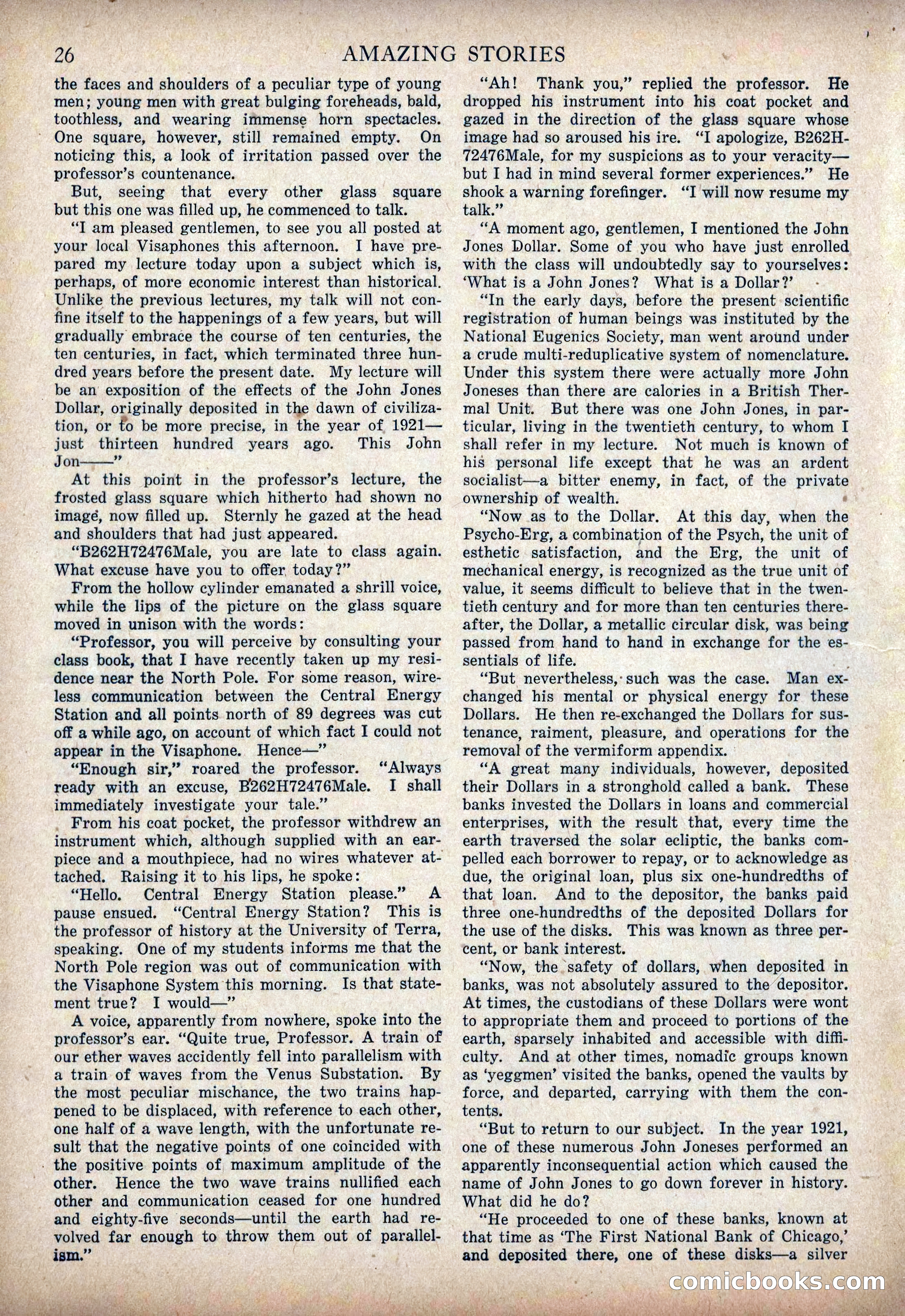
A restored page from Pulp Fiction, 1927. Page through the whole issue in the reader above.
📄 Transcribed text from this page (OCR, searchable)
Machine-transcribed from the original scan — historical spelling and the odd misread are preserved.
the faces and shoulders of a peculiar type of young men; young men with great bulging foreheads, bald, toothless, and wearing immense horn spectacles. - One square, however, still remained empty. On noticing this, a look of irritation passed over the professor’s countenance. But, seeing that every other glass square but this one was filled up, he commenced to talk. “T am pleased gentlemen, to see you all posted at your local Visaphones this afternoon. I have pre- pared my lecture today upon a subject which is, perhaps, of more economic interest than historical. Unlike the previous lectures, my talk will not con- fine itself to the happenings of a few years, but will gradually embrace the course of ten centuries, the ten centuries, in fact, which terminated three hun- dred years before the present date. My lecture will _ be an exposition of the effects of the John Jones Dollar, originally deposited in the dawn of civiliza- tion, or to be more precise, in the year of 1921— just thirteen hundred years ago. This John Jon " At this point in the professor’s lecture, the frosted glass square which hitherto had shown no imageé, now filled up. Sternly he gazed at the head and shoulders that had just appeared. “B262H72476Male, you are late to class again. What excuse have you to offer, today?” From the hollow cylinder emanated a shrill voice, while the lips of the picture on the glass square moved in unison with the words: “Professor, you will perceive by consulting your class book, that I have recently taken up my resi- dence near the North Pole. For some reason, wire- less communication between the Central Energy Station and all points north of 89 degrees was cut off a while ago, on account of which fact I could not appear in the Visaphone. Hence—” “Rnough sir,” roared the professor. ready with an excuse, B262H72476Male. immediately investigate your tale.” _ From his coat pocket, the professor withdrew an instrument which, although supplied with an ear- “Always I shall piece and a mouthpiece, had no wires whatever at- tached. Raising it to his lips, he spoke: “Hello. Central Energy Station please.” <A pause ensued. ‘Central Energy Station? This is the professor of history at the University of Terra, speaking. One of my students informs me that the North Pole region was out of communication with the Visaphone System this morning. Is that state- ment true? I would—” A voice, apparently from nowhere, spoke into the professor’s ear. “Quite true, Professor. A train of our ether waves accidently fell into parallelism with a train of waves from the Venus Substation. By the most peculiar mischance, the two trains hap- pened to be displaced, with reference to each other, one half of a wave length, with the unfortunate re- sult that the negative points of one coincided with . the positive points of maximum amplitude of the other. Hence the two wave trains nullified each other and communication ceased for one hundred and eighty-five seconds—until the earth had re- volved far enough to throw them out of parallel- ism.” | . 26 | AMAZING STORIES ‘ “Ah! Thank you,” replied the professor. He dropped his instrument into his coat pocket and gazed in the direction of the glass square whose image had so aroused his ire. ‘I apologize, B262H- 72476Male, for my suspicions as to your veracity— but I had in mind several former experiences.” He shook a warning forefinger. “I will now resume my talk.” “A moment ago, gentlemen, I mentioned the John Jones Dollar. Some of you who have just enrolled with the class will undoubtedly say to yourselves: ‘What is a John Jones? What is a Dollar?’ “In the early days, before the present scientific registration of human beings was instituted by the National Eugenics Society, man went around under a crude multi-reduplicative system of nomenclature. Under this system there were actually more John Joneses than there are calories in a British Ther- mal Unit. But there was one John Jones, in par- ticular, living in the twentieth century, to whom I shall refer in my lecture. Not much is known of his personal life except that he was an ardent socialist—a bitter enemy, in fact, of the private ownership of wealth. ‘ “Now as to the Dollar. At this day, when the Psycho-Erg, a combination of the Psych, the unit of esthetic satisfaction, and the Erg, the unit of mechanical energy, is recognized as the true unit of value, it seems difficult to believe that in the twen- tieth century and for more than ten centuries there- after, the Dollar, a metallic circular disk, was being passed from hand to hand in exchange for the es- sentials of life. “But nevertheless,-such was the case. Man ex- changed his mental or physical energy for these Dollars. He then re-exchanged the Dollars for sus- tenance, raiment, pleasure, and operations for the removal of the vermiform appendix. | “A great many individuals, however, deposited their Dollars in a stronghold called a bank. These banks invested the Dollars in loans and commercial enterprises, with the result that, every time the earth traversed the solar ecliptic, the banks com- pelled each borrower to repay, or to acknowledge as due, the original loan, plus six one-hundredths of that loan. And to the depositor, the banks paid three one-hundredths of the deposited Dollars for the use of the disks. This was known as three per- cent, or bank interest. “Now, the safety of dollars, when deposited in banks, was not absolutely assured to the depositor. At times, the custodians of these Dollars were wont to appropriate them and proceed to portions of the earth, sparsely inhabited and accessible with diffi- culty. And at other times, nomadic groups known as ‘yeggmen’ visited the banks, opened the vaults by force, and departed, carrying with them the con- tents. “But to return to our subject. In the year 1921, one of these numerous John Joneses performed an apparently inconsequential action which caused the name of John Jones to go down forever in history. What did he do? “He proceeded to one of these banks, known at that time as ‘The First National Bank of Chicago,’ and deposited there, one of these disks—a silver comicbooks.com