
Pulp Fiction, 1920 · page 34 of 164
All-Story Weekly, Vol. 112, No. 1 — page 34: what you’re looking at
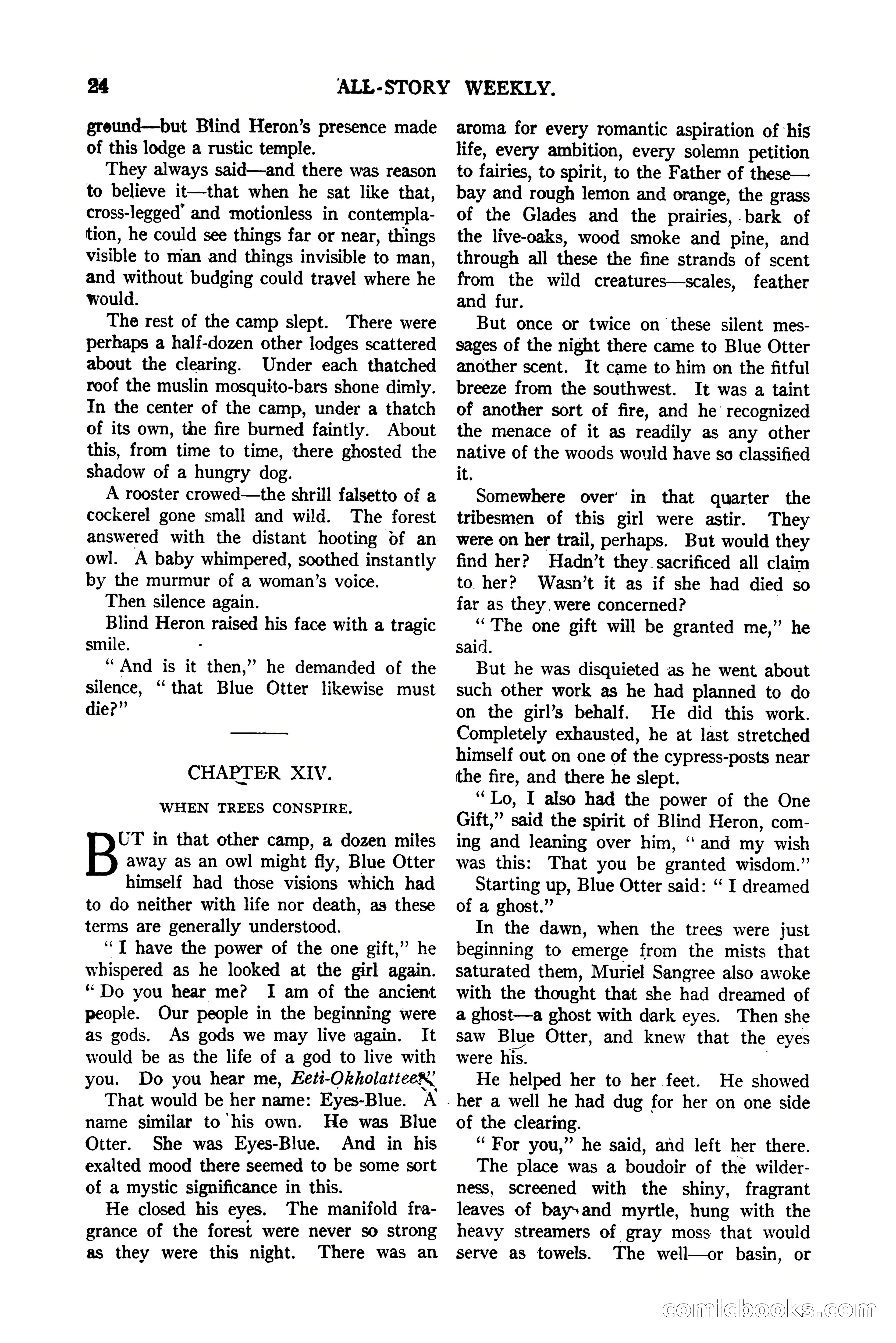
A restored page from Pulp Fiction, 1920. Page through the whole issue in the reader above.
📄 Transcribed text from this page (OCR, searchable)
Machine-transcribed from the original scan — historical spelling and the odd misread are preserved.
a4 greund—but Blind Heron’s presence made of this lodge a rustic temple. They always said—and there was reason to believe it—that when he sat like that, cross-legged’ and motionless in contempla- tion, he could see things far or near, things visible to man and things invisible to man, and without budging could travel where he would. The rest of the camp slept. There were perhaps a half-dozen other lodges scattered about the clearing. Under each thatched roof the muslin mosquito-bars shone dimly. In the center of the camp, under a thatch of its own, the fire burned faintly. About this, from time to time, there ghosted the shadow of a hungry dog. A rooster crowed—the shrill falsetto of a cockerel gone small and wild. The forest answered with the distant hooting of an owl. A baby whimpered, soothed instantly by the murmur of a woman’s voice. Then silence again. Blind Heron raised his face with a tragic smile. “And is it then,” he demanded of the silence, “that Blue Otter likewise must die?” CHAPTER XIV. WHEN TREES CONSPIRE. UT in that other camp, a dozen miles away aS an owl might fly, Blue Otter himself had those visions which had to do neither with life nor death, as these terms are generally understood. ‘“] have the power of the one gift,” he whispered as he looked at the girl again. “Do vou hear me? I am of the ancient people. Our people in the beginning were as gods. As gods we may live again. It would be as the life of a god to live with you. Do you hear me, Eeti-OkholatieeX’ That would be her name: Eyes-Blue. A name similar to his own. He was Blue Otter. She was Eyes-Blue. And in his exalted mood there seemed to be some sort of a mystic significance in this. He closed his eyes. The manifold fra- grance of the forest were never so strong as they were this night. There was an ALE-STORY WEEKLY. aroma for every romantic aspiration of his life, every ambition, every solemn petition to fairies, to spirit, to the Father of these— bay and rough lemon and orange, the grass of the Glades and the prairies, bark of the live-oaks, wood smoke and pine, and through all these the fine strands of scent from the wild creatures—scales, feather and fur. But once or twice on these silent mes- sages of the night there came to Blue Otter another scent. It came to him on the fitful breeze from the southwest. It was a taint of another sort of fire, and he recognized the menace of it as readily as any other native of the woods would have so classified it. Somewhere over’ in that quarter the tribesmen of this girl were astir. They were on her trail, perhaps. But would they find her? Hadn’t they sacrificed all claim to her? Wasn’t it as if she had died so far as they were concerned? “The one gift will be granted me,” he said. But he was disquieted as he went about such other work as he had planned to do on the girl’s behalf. He did this work. Completely exhausted, he at last stretched himself out on one of the cypress-posts near the fire, and there he slept. “Lo, I also had the power of the One Gift,” said the spirit of Blind Heron, com- ing and leaning over him, ‘‘ and my wish was this: That you be granted wisdom.” Starting up, Blue Otter said: ‘ I dreamed of a ghost.” In the dawn, when the trees were just beginning to emerge from the mists that saturated them, Muriel Sangree also awoke with the thought that she had dreamed of a ghost—a ghost with dark eyes. Then she saw Blue Otter, and knew that the eyes were his. | He helped her to her feet. He showed -her a well he had dug for her on one side of the clearing. ‘For you,” he said, and left her there. The place was a boudoir of the wilder- ness, screened with the shiny, fragrant leaves of bay~and myrtle, hung with the heavy streamers of gray moss that would serve as towels. The well—or basin, or cCoOmiclbooks C©