
Pulp Fiction, 1920 · page 33 of 164
All-Story Weekly, Vol. 112, No. 1 — page 33: what you’re looking at
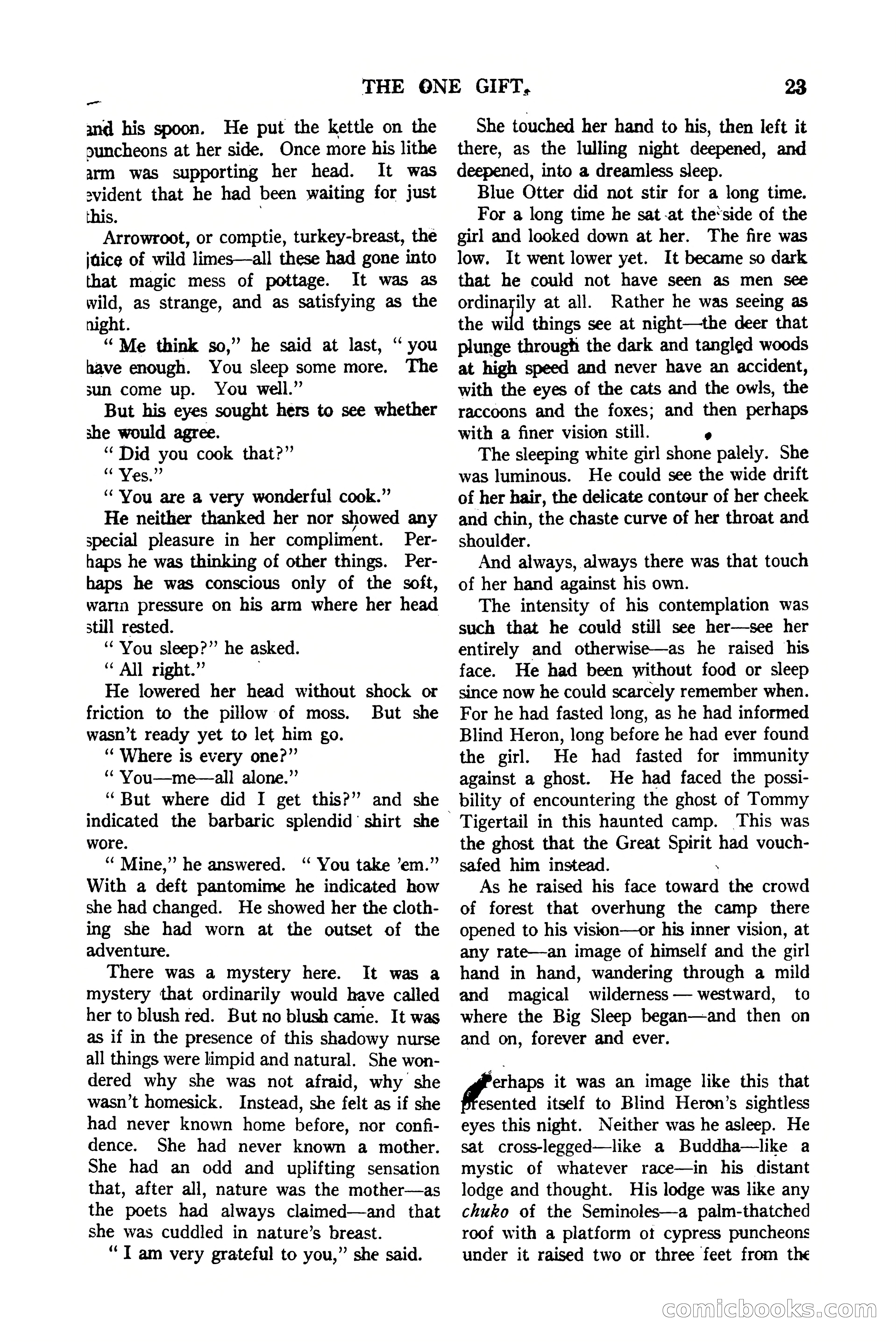
A restored page from Pulp Fiction, 1920. Page through the whole issue in the reader above.
📄 Transcribed text from this page (OCR, searchable)
Machine-transcribed from the original scan — historical spelling and the odd misread are preserved.
THE ONE GIFT, —_— and his spoon. He put the kettle on the suncheons at her side. Once more his lithe arm was supporting her head. It was svident that he had been waiting for Just this. Arrowroot, or comptie, turkey-breast, the iaice of wild limes—all these had gone into that magic mess of pottage. It was as wild, as strange, and as satisfying as the night. “Me think so,” he said at last, “ you have enough. You sleep some more. The sun come up. You well.” But his eyes sought hers to see whether she would agree. “Did you cook that?” c¢ Yes.” ‘You are a very wonderful cook.” He neither thanked her nor showed any special pleasure in her compliment. Per- haps he was thinking of other things. Per- haps he was conscious only of the soft, warn pressure on his arm where her head still rested. “You sleep?” he asked. ‘* All right.” He lowered her head without shock or friction to the pillow of moss. But she wasn’t ready yet to let him go. ‘“‘ Where is every one?” ‘* You—me—all alone.” ‘But where did I get this?’’ and she indicated the barbaric splendid’ shirt she wore. *“* Mine,” he answered. ‘ You take ’em.” With a deft pantomime he indicated how she had changed. He showed her the cloth- ing she had worn at the outset of the adventure. There was a mystery here. It was a mystery that ordinarily would have called her to blush red. But no blush came. It was as if in the presence of this shadowy nurse all things were limpid and natural. She won- dered why she was not afraid, why she wasn’t homesick. Instead, she felt as if she had never known home before, nor confi- dence. She had never known a mother. She had an odd and uplifting sensation that, after all, nature was the mother—as the poets had always claimed—and that she was cuddled in nature’s breast. “I am very grateful to you,” she said. 23 She touched her hand to his, then left it there, as the lulling night deepened, and deepened, into a dreamless sleep. Blue Otter did not stir for a long time. For a long time he sat at the‘side of the girl and looked down at her. The fire was low. It went lower yet. It became so dark that he could not have seen as men see ordinarily at all. Rather he was seeing as the wild things see at night—the deer that plunge through the dark and tangled woods at high speed and never have an accident, with the eyes of the cats and the owls, the raccoons and the foxes; and then perhaps with a finer vision still. ° The sleeping white girl shone palely. She was luminous. He could see the wide drift of her hair, the delicate contour of her cheek and chin, the chaste curve of her throat and shoulder. And always, always there was that touch of her hand against his own. The intensity of his contemplation was such that he could still see her—see her entirely and otherwise—as he raised his face. He had been without food or sleep since now he could scarcely remember when. For he had fasted long, as he had informed Blind Heron, long before he had ever found the girl, He had fasted for immunity against a ghost. He had faced the possi- bility of encountering the ghost of Tommy Tigertail in this haunted camp. This was the ghost that the Great Spirit had vouch- safed him instead. As he raised his face towand the crowd of forest that overhung the camp there opened to his vision—or his inner vision, at any rate—an image of himself and the girl hand in hand, wandering through a mild and magical wilderness — westward, to where the Big Sleep began—and then on and on, forever and ever. ‘erhaps it was an image like this that esented itself to Blind Heron’s sightless eyes this night. Neither was he asleep. He sat cross-legged—like a Buddha—like a mystic of whatever race—in his distant lodge and thought. His lodge was like any chuko of the Seminoles—a palm-thatched roof with a platform ot cypress puncheons under it raised two or three feet from the COmiIclooOo SS C©