
Pulp Fiction, 1920 · page 28 of 164
All-Story Weekly, Vol. 112, No. 1 — page 28: what you’re looking at
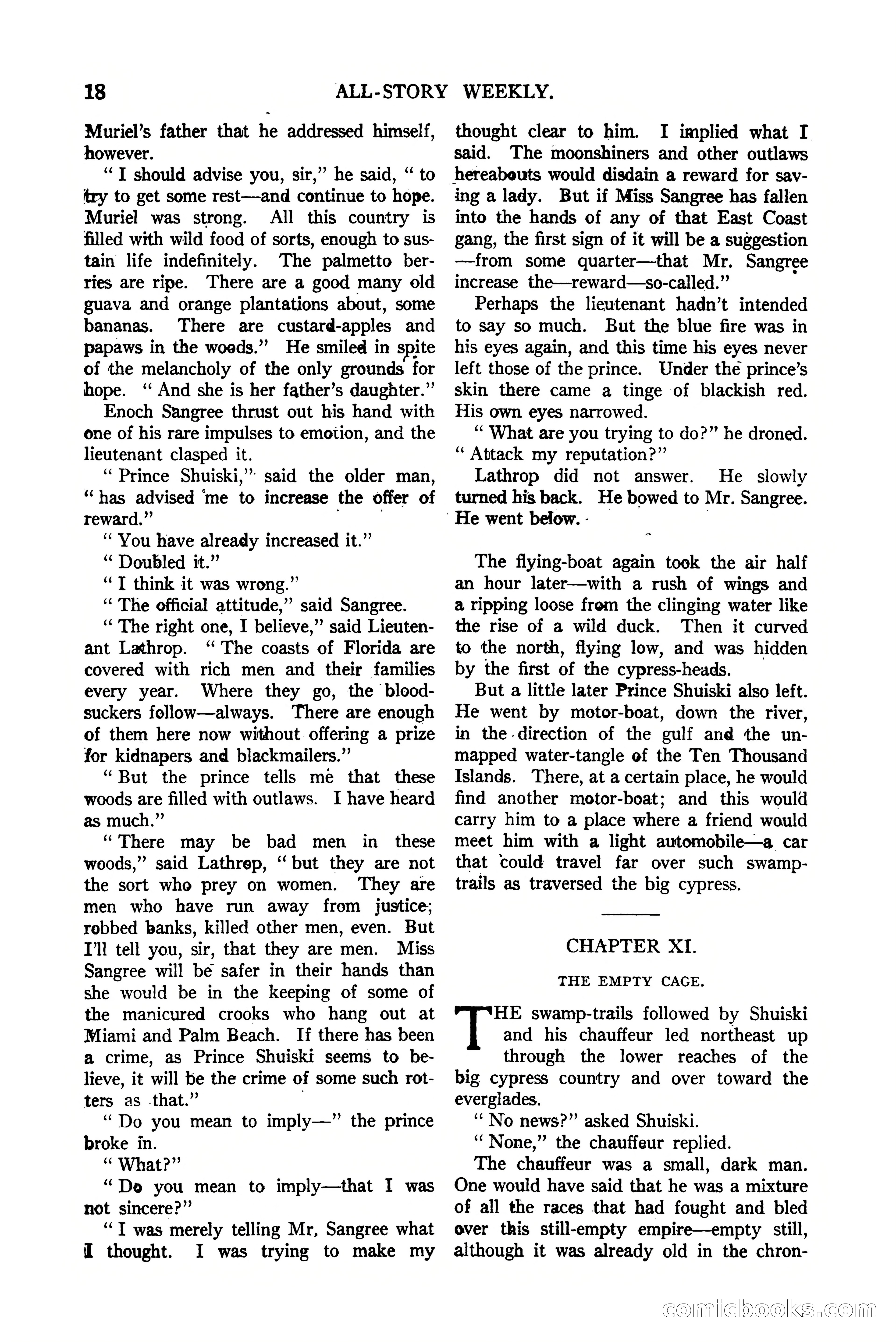
A restored page from Pulp Fiction, 1920. Page through the whole issue in the reader above.
📄 Transcribed text from this page (OCR, searchable)
Machine-transcribed from the original scan — historical spelling and the odd misread are preserved.
18 Muriel’s father that he addressed himself, however. ‘“‘T should advise you, sir,” he said, ‘‘ to try to get some rest—and continue to hope. Muriel was strong. All this country is filled with wild food of sorts, enough to sus- tain life indefinitely. The palmetto ber- ries are ripe. There are a good many old guava and orange plantations about, some bananas. There are custard-apples and papaws in the woeds.”” He smiled in spite of the melancholy of the only grounds for hope. ‘‘ And she is her father’s daughter.” Enoch Sangree thrust out his hand with one of his rare impulses to emotion, and the lieutenant clasped it. ‘Prince Shuiski,’” said the older man, ‘““has advised ‘me to increase the offer of reward.” , | ‘You have already increased it.” “ Doubled it.” ‘“‘T think it was wrong.” ‘“‘ The official attitude,” said Sangree. ‘“‘ The right one, I believe,” said Lieuten- ant Lathrop. ‘ The coasts of Florida are covered with rich men and their families every year. Where they go, the blood- suckers follow—always. There are enough of them here now without offering a prize for kidnapers and blackmailers.”’ “But the prince tells me that these woods are filled with outlaws. I have heard as much.” “There may be bad men in these woods,”’ said Lathrep, ‘‘ but they are not the sort who prey on women. They are men who have run away from _ justice; robbed banks, killed other men, even. But I'll tell you, sir, that they are men. Miss Sangree will be safer in their hands than she would be in the keeping of some of the manicured crooks who hang out at Miami and Palm Beach. If there has been a crime, as Prince Shuiski seems to be- lieve, it will be the crime of some such rot- ters as that.” | “Do you mean to imply—” the prince broke in. ce What?” “Do you mean to imply—that I was not sincere?”’ ‘“‘T was merely telling Mr, Sangree what {@ thought. I was trying to make my ALL-STORY WEEKLY. thought clear to him. I implied what I said. The moonshiners and other outlaws thereabouts would disdain a reward for sav- ing a lady. But if Miss Sangree has fallen into the hands of any of that East Coast gang, the first sign of it will be a suggestion —from some quarter—that Mr. Sangree increase the—reward—so-called.”’ Perhaps the lieutenant hadn’t intended to say so much. But the blue fire was in his eyes again, and this time his eyes never left those of the prince. Under the prince’s skin there came a tinge of blackish red. His own eyes narrowed. ‘What are you trying to do?” he droned. ‘“ Attack my reputation?” Lathrop did not answer. He slowly turned his back. He bowed to Mr. Sangree. He went below. - re The flying-boat again took the air half an hour later—with a rush of wings and a ripping loose from the clinging water like the rise of a wild duck. Then it curved to the north, flying low, and was hidden by the first of the cypress-heads. But a little later Prince Shuiski also left. He went by motor-boat, down the river, in the direction of the gulf and the un- mapped water-tangle of the Ten Thousand Islands. There, at a certain place, he would find another motor-boat; and this would carry him to a place where a friend would meet him with a light automobile—g car that could travel far over such swamp- trails as traversed the big cypress. CHAPTER XI. THE EMPTY CAGE. HE swamp-trails followed by Shuiski and his chauffeur led northeast up through the lower reaches of the big cypress country and over toward the everglades. ‘“ No news?” asked Shuiski. ‘“ None,” the chauffeur replied. The chauffeur was a small, dark man. One would have said that he was a mixture of all the races that had fought and bled over this still-empty empire—empty still, although it was already old in the chron- COmiIclooOo SS C©