
Pulp Fiction, 1920 · page 27 of 164
All-Story Weekly, Vol. 112, No. 1 — page 27: what you’re looking at
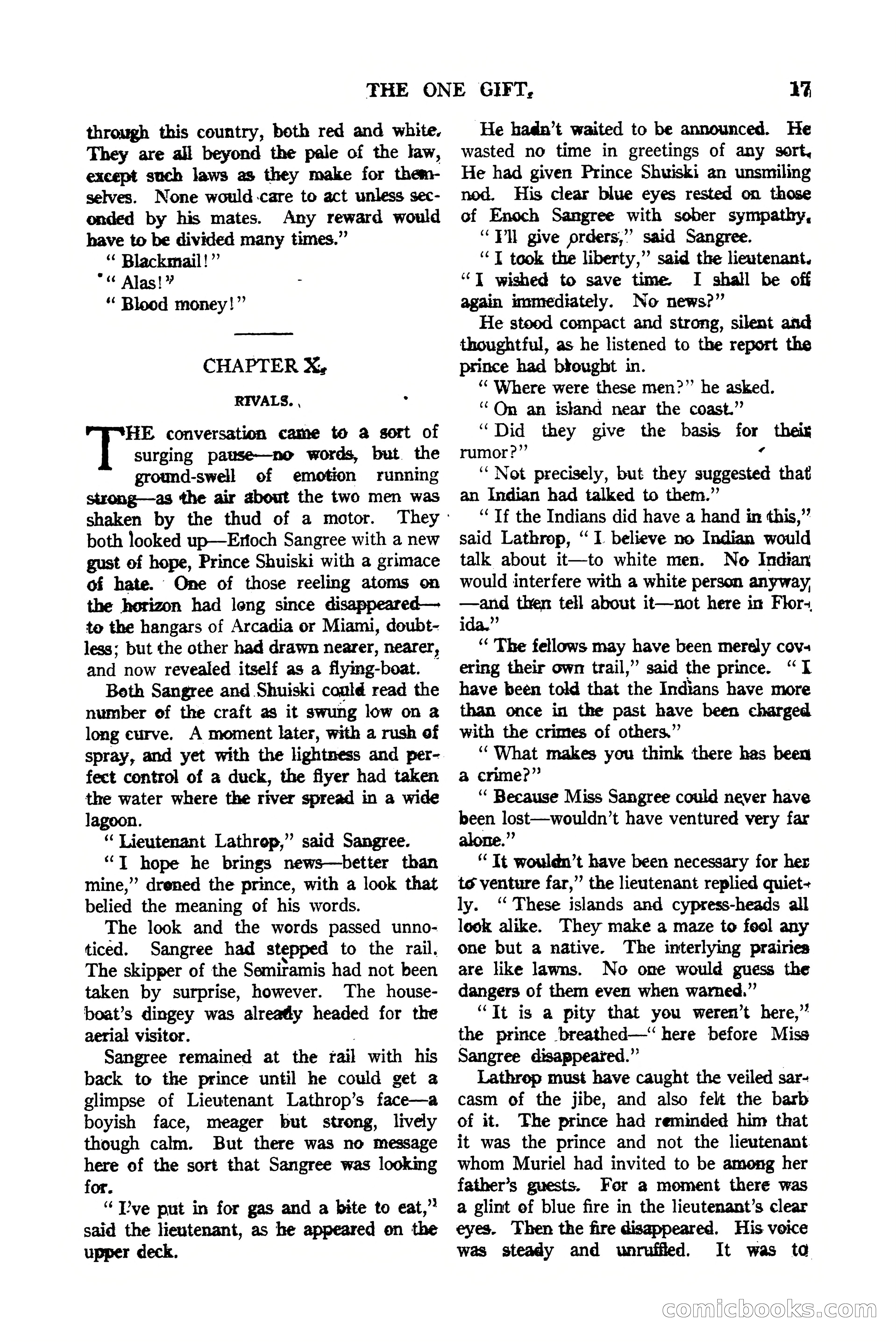
A restored page from Pulp Fiction, 1920. Page through the whole issue in the reader above.
📄 Transcribed text from this page (OCR, searchable)
Machine-transcribed from the original scan — historical spelling and the odd misread are preserved.
THE ONE GIFT, through this country, beth red and white. They are all beyond the pale of the law, except such laws as they make for them- selves. None would care to act unless sec- onded by his mates. Any reward would have to be divided many times.” “ Blackmail!” "© Alas! “‘ Blood money!”’ RIVALS. , HE conversation came to a sort of T surging pause—no words, but. the ground-swell of emotion running strong—as the air about the two men was shaken by the thud of a motor. both looked up—Enoch Sangree with a new gust of hope, Prince Shuiski with a grimace of hate. One of those reeling atoms on the horizon had leng since disappeared— to the hangars of Arcadia or Miami, doubt- less; but the other had drawn nearer, nearer, and now revealed itself as a flymg-boat. Beth Sangree and Shuiski could read the number of the craft as it swung low on 2 long curve. A moment later, with a rush of spray, and yet with the lightness and per- fect control of a duck, the flyer had taken the water where the river spread in a wide lagoon. ‘“ Lieutenant Lathrop,” said Sangree. “T hope he brings news—better than mine,” drened the prince, with a look that belied the meaning of his words. The look and the words passed unno- ticed. Sangree had stepped to the rail, The skipper of the Semiramis had not been taken by surprise, however. The house- boat’s dingey was alreafly headed for the aerial visitor. Sangree remained at the rail with his back to the prince until he could get 2 glimpse of Lieutenant Lathrop’s face—a boyish face, meager but strong, lively though calm. But there was no message here of the sort that Sangree was looking for. “Tve put in for gas and a bite to eat,” said the lieutenant, as he appeared on the upper deck. They ° 14 He hadn’t waited to be announced. He wasted no time in greetings of any sort, He had given Prince Shuiski an unsmiling nod. His clear blue eyes rested on those of Enoch Sangree with sober sympathy, ‘Vl give orders,” said Sangree. “I took the liberty,” said the lieutenant. “I wished to save time. I shall be off again immediately. No news?” He stood compact and strong, silent and thoughtful, as he listened to the report the prince had bkought in. ““ Where were these men?” he asked. “On an island near the coast.” “Did they give the basis for theis rumor?” - ‘Not precisely, but they suggested that an Indian had talked to them.” ‘“‘ Tf the Indians did have a hand in this,”’ said Lathrop, “I believe no Indian would talk about it—to white men. No Indian would interfere with a white person anyway, —and then tell about it—not here in Flor- ida.”’ “ The fellows may have been merely cov- ering their own trail,” said the prince. “I have been told that the Indians have more than once in the past have been charged with the crimes of others.” “What makes you think there has been a crime?” ‘“‘ Because Miss Sangree could never have been lost—wouldn’t have ventured very far alone.” “It wouldn’t have been necessary for her té venture far,” the lieutenant replied quiet- ly. ‘“‘ These islands and cypress-heads all look alike. They make a maze to feel any one but a native. The interlying prairies are like lawns. No one would guess the dangers of them even when warned.” “It is a pity that you weren’t here,” the prince breathed—“ here before Miss Sangree disappeared.”’ Lathrop must have caught the veiled sar- casm of the jibe, and also felt the barb of it. The prince had reminded him that it was the prince and not the lieutenant whom Muriel had invited to be among her father’s guests. For a moment there was a glint of blue fire in the lieutenant’s clear eyes. Then the fire disappeared. His voice was steady and unruffled. It was ta cCoOmiclbooks C©