
Pulp Fiction, 1920 · page 19 of 164
All-Story Weekly, Vol. 112, No. 1 — page 19: what you’re looking at
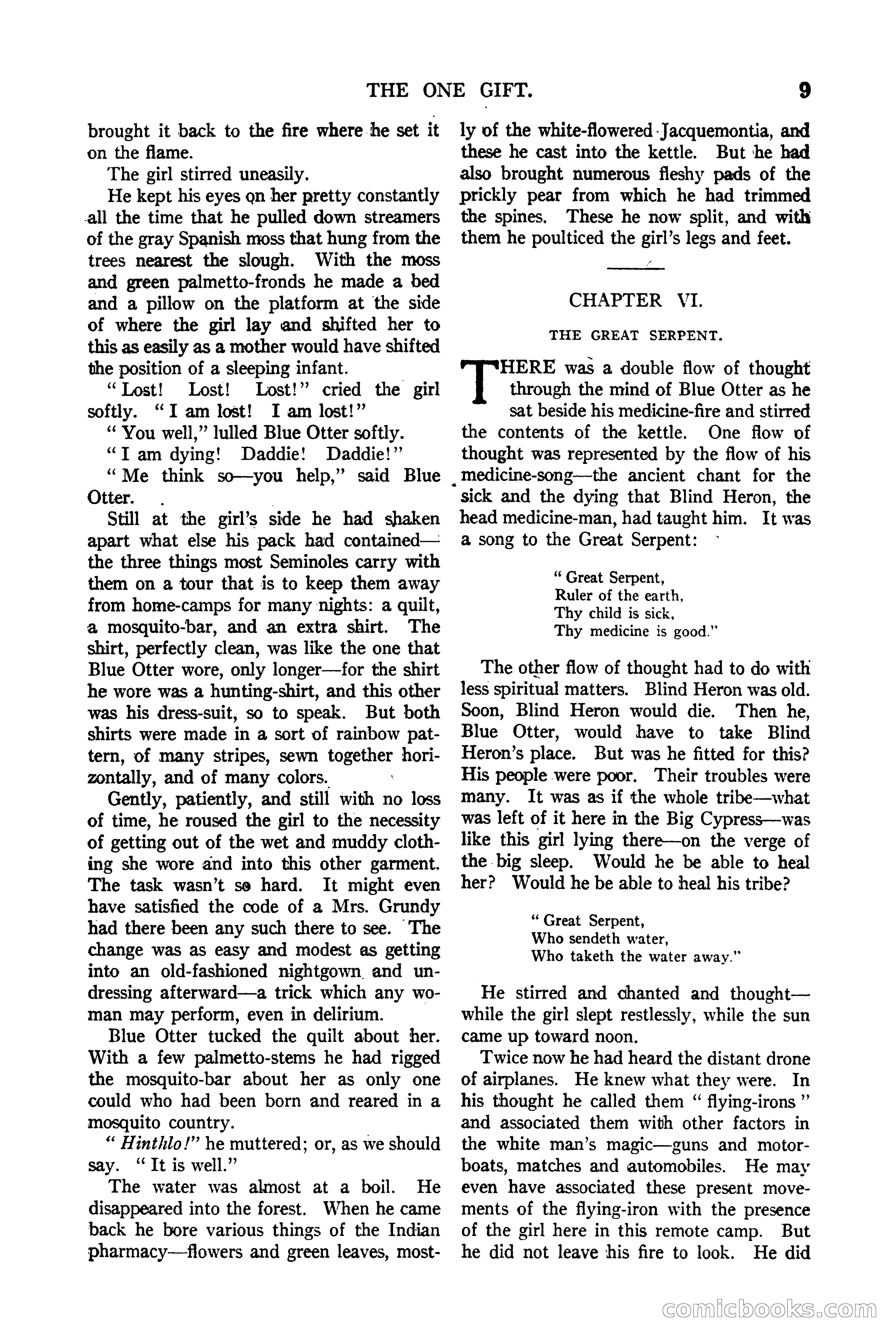
A restored page from Pulp Fiction, 1920. Page through the whole issue in the reader above.
📄 Transcribed text from this page (OCR, searchable)
Machine-transcribed from the original scan — historical spelling and the odd misread are preserved.
THE ONE GIFT. brought it back to the fire where he set it on the flame. The girl stirred uneasily. He kept his eyes qn her pretty constantly all the time that he pulled down streamers of the gray Spanish moss that hung from the trees nearest the slough. With the moss and green palmetto-fronds he made a bed and a pillow on the platform at the side of where the girl lay and shifted her to this as easily as a mother would have shifted the position of a sleeping infant. “Lost! Lost! Lost!” cried the girl softly. “I am lost! I am lost!” “You well,” lulled Blue Otter softly. “T am dying! Daddie! Daddie!”’ “Me think so—you help,” said Blue Otter. . Still at the girl’s side he had shaken apart what else his pack had contained— the three things most Seminoles carry with them on a tour that is to keep them away from home-camps for many nights: a quilt, a mosquito-bar, and an extra shirt. The shirt, perfectly clean, was like the one that Blue Otter wore, only longer—for the shirt he wore was a hunting-shirt, and this other was his dress-suit, so to speak. But both shirts were made in a sort of rainbow pat- tern, of many stripes, sewn together hori- zontally, and of many colors. Gently, patiently, and still with no loss of time, he roused the girl to the necessity of getting out of the wet and muddy cloth- ing she wore and into this other garment. The task wasn’t so hard. It might even have satisfied the code of a Mrs. Grundy had there been any such there to see. The change was as easy and modest as getting into an old-fashioned nightgown and un- dressing afterward—a trick which any wo- man may perform, even in delirium. Blue Otter tucked the quilt about her. With a few palmetto-stems he had rigged the mosquito-bar about her as only one could who had been born and reared in a mosquito country. “ Hinthlo!” he muttered; or, as we should say. ‘It is well.” The water was almost at a boil. He disappeared into the forest. When he came back he bore various things of the Indian pharmacy—flowers and green leaves, most- 9 ly of the white-flowered -Jacquemontia, and these he cast into the kettle. But he had also brought numerous fleshy pads of the prickly pear from which he had trimmed the spines. These he now split, and with them he poulticed the girl’s legs and feet. CHAPTER VI. THE GREAT SERPENT. HERE was a double flow of thought through the mind of Blue Otter as he sat beside his medicine-fire and stirred the contents of the kettle. One flow of thought was represented by the flow of his . medicine-song—the ancient chant for the sick and the dying that Blind Heron, the head medicine-man, had taught him. It was a song to the Great Serpent: “* Great Serpent, Ruler of the earth, Thy child is sick, Thy medicine is good.” The other flow of thought had to do with less spiritual matters. Blind Heron was old. Soon, Blind Heron would die. Then he, Blue Otter, would have to take Blind Heron’s place. But was he fitted for this? His people were poor. Their troubles were many. It was as if the whole tribe—what was left of it here in the Big Cypress—was like this girl lying there—on the verge of the big sleep. Would he be able to heal her? Would he be able to heal his tribe? “‘ Great Serpent, Who sendeth water, Who taketh the water away.” He stirred and chanted and thought— while the girl slept restlessly, while the sun came up toward noon. Twice now he had heard the distant drone of airplanes. He knew what they were. In his thought he called them “ flying-irons ” and associated them with other factors in the white man’s magic—guns and motor- boats, matches and automobiles. He may even have associated these present move- ments of the flying-iron with the presence of the girl here in this remote camp. But he did not leave his fire to look. He did cCoOmiclbooks C©