
Pulp Fiction, 1920 · page 18 of 164
All-Story Weekly, Vol. 112, No. 1 — page 18: what you’re looking at
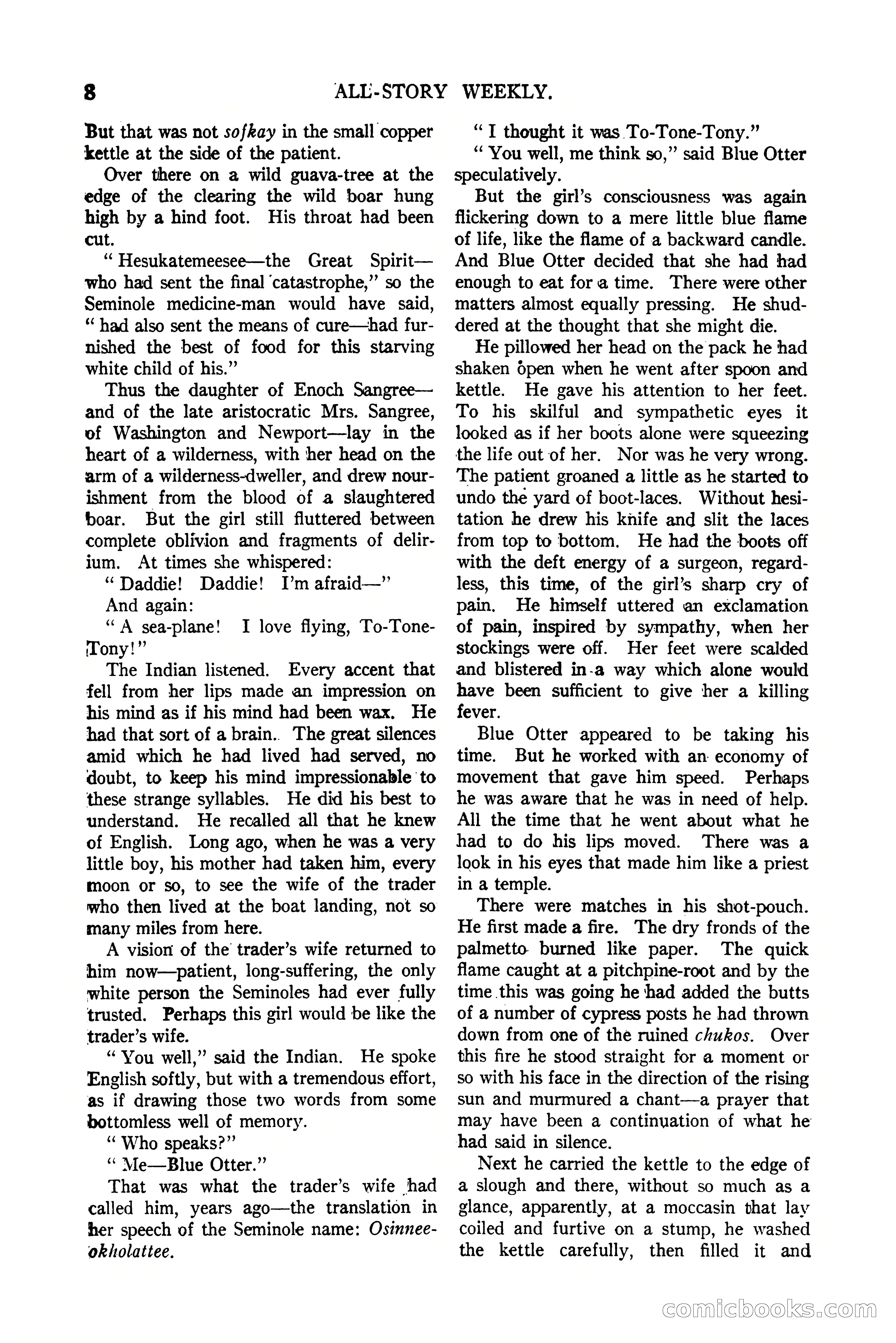
A restored page from Pulp Fiction, 1920. Page through the whole issue in the reader above.
📄 Transcribed text from this page (OCR, searchable)
Machine-transcribed from the original scan — historical spelling and the odd misread are preserved.
But that was not sofkay in the small copper kettle at the side of the patient. Over there on a wild guava-tree at the edge of the clearing the wild boar hung high by a hind foot. His throat had been cut. ‘“‘ Hesukatemeesee—the Great Spirit— who had sent the final ‘catastrophe,” so the Seminole medicine-man would have said, ‘had also sent the means of cure—had fur- nished the best of food for this starving white child of his.” Thus the daughter of Enoch Sangree— and of the late aristocratic Mrs. Sangree, of Washington and Newport—lay in the heart of a wilderness, with her head on the arm of a wilderness-dweller, and drew nour- ishment from the blood of a slaughtered boar. But the girl still fluttered between complete oblivion and fragments of delir- ium. At times she whispered: “Daddie! Daddie! I’m afraid—” And again: ‘“‘ A sea-plane! I love flying, To-Tone- irony!” The Indian listened. Every accent that fell from her lips made an impression on his mind as if his mind had been wax. He had that sort of a brain. The great silences amid which he had lived had served, no doubt, to keep his mind impressionable ‘to these strange syllables. He did his best to understand. He recalled all that he knew of English. Long ago, when he was a very little boy, his mother had taken him, every moon or so, to see the wife of the trader who then lived at the boat landing, not so many miles from here. A vision of the trader’s wife returned to him now—patient, long-suffering, the only white person the Seminoles had ever fully trusted. Perhaps this girl would be like the trader’s wife. “ You well,” said the Indian. He spoke English softly, but with a tremendous effort, as if drawing those two words from some bottomless well of memory. “Who speaks?”’ ““ Me—Blue Otter.” That was what the trader’s wife ‘had called him, years ago—the translation in her speech of the Seminole name: Osinnee- okholattee. ALL-STORY WEEKLY. “IT thought it was To-Tone-Tony.” ‘You well, me think so,” said Blue Otter speculatively. But the girl’s consciousness was again flickering down to a mere little blue flame of life, like the flame of a backward candle. And Blue Otter decided that she had had enough to eat fora time. There were other matters almost equally pressing. He shud- dered at the thought that she might die. He pillowed her head on the pack he had shaken open when he went after spoon and kettle. He gave his attention to her feet. To his skilful and sympathetic eyes it looked as if her boots alone were squeezing the life out of her. Nor was he very wrong. The patient groaned a little as he started to undo the yard of boot-laces. Without hesi- tation he drew his knife and slit the laces from top to bottom. He had the boots off with the deft energy of a surgeon, regard- less, this time, of the girl’s sharp cry of pain, He himself uttered an exclamation of pain, inspired by sympathy, when her stockings were off. Her feet were scalded and blistered in-a way which alone would have been sufficient to give her a killing fever. Blue Otter appeared to be taking his time. But he worked with an economy of movement that gave him speed. Perhaps he was aware that he was in need of help. All the time that he went about what he had to do his lips moved. There was a look in his eyes that made him like a priest in a temple. There were matches in his shot-pouch. He first made a fire. The dry fronds of the palmetto burned like paper. The quick flame caught at a pitchpine-root and by the time this was going he ‘had added the butts of a number of cypress posts he had thrown down from one of the ruined chukos. Over this fire he stood straight for a moment or so with his face in the direction of the rising sun and murmured a chant—a prayer that may have been a continuation of what he had said in silence. Next he carried the kettle to the edge of a slough and there, without so much as a glance, apparently, at a moccasin that lav coiled and furtive on a stump, he washed the kettle carefully, then filled it and COMICOooe C S C©