
Pulp Fiction, 1920 · page 12 of 164
All-Story Weekly, Vol. 112, No. 1 — page 12: what you’re looking at
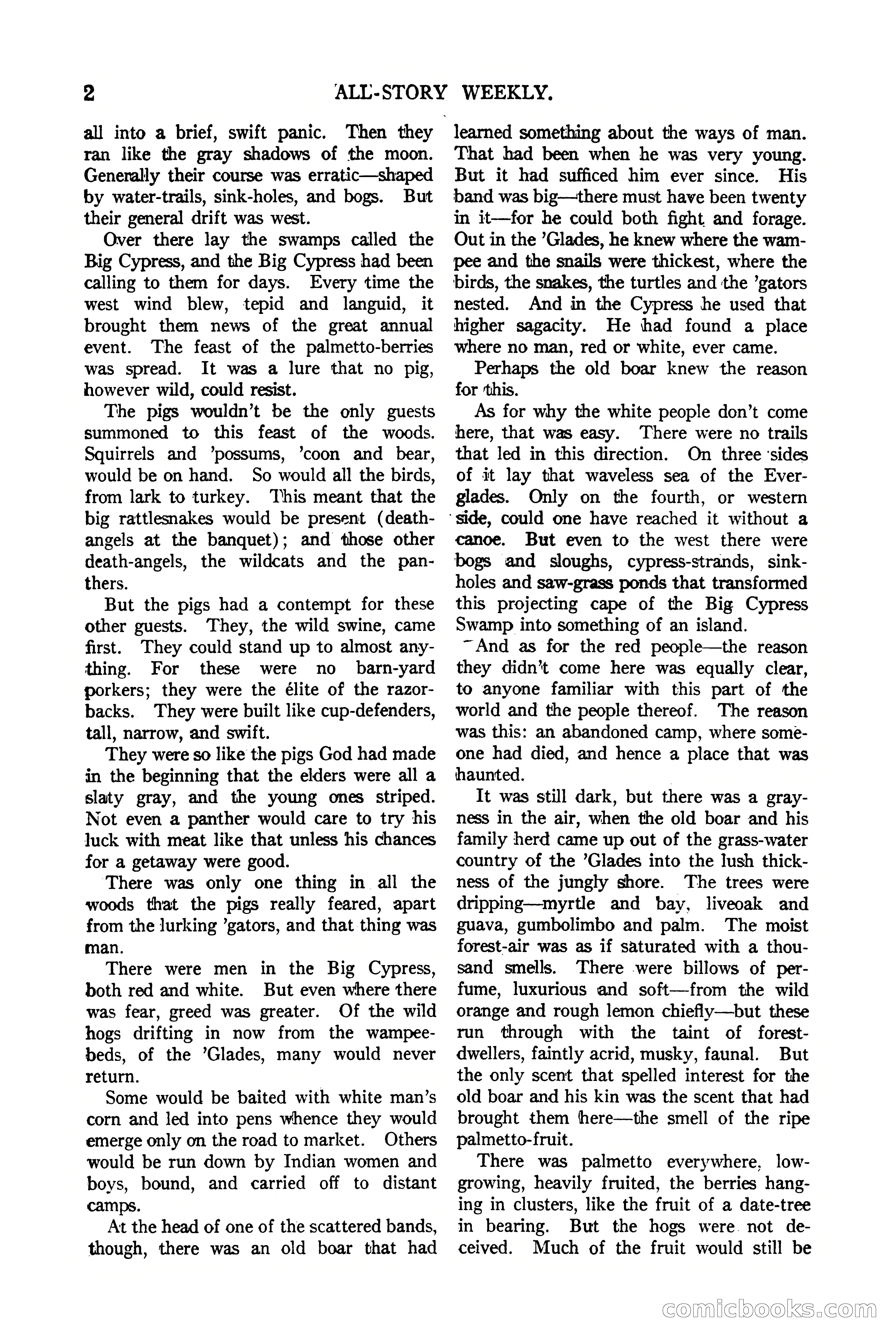
A restored page from Pulp Fiction, 1920. Page through the whole issue in the reader above.
📄 Transcribed text from this page (OCR, searchable)
Machine-transcribed from the original scan — historical spelling and the odd misread are preserved.
2 ALL-STORY WEEKLY. all into a brief, swift panic. Then they ran like the gray shadows of the moon. Generally their course was erratic—shaped by water-trails, sink-holes, and bogs. But their general drift was west. Over there lay the swamps called the Big Cypress, and the Big Cypress had been calling to them for days. Every time the west wind blew, tepid and languid, it brought them news of the great annual event. The feast of the palmetto-berries was spread. It was a lure that no pig, however wild, could resist. The pigs wouldn’t be the only guests summoned to this feast of the woods. Squirrels and ’possums, ’coon and _ bear, would be on hand. So would all the birds, from lark to turkey. This meant that the big rattlesnakes would be present (death- angels at the banquet); and those other death-angels, the wildcats and the pan- thers. But the pigs had a contempt for these other guests. They, the wild swine, came first. They could stand up to almost any- thing. For these were no_ barn-yard porkers; they were the élite of the razor- backs. They were built like cup-defenders, tall, narrow, and swift. They were so like the pigs God had made in the beginning that the elders were all a slaty gray, and the young ones striped. Not even a panther would care to try his luck with meat like that unless his chances for a getaway were good. ‘There was only one thing in all the woods that the pigs really feared, apart from the lurking ’gators, and that thing was man. There were men in the Big Cypress, both red and white. But even where there was fear, greed was greater. Of the wild hogs drifting in now from the wampee- beds, of the ’Glades, many would never return. Some would be baited with white man’s corn and led into pens whence they would emerge only on the road to market. Others would be run down by Indian women and boys, bound, and carried off to distant camps. At the head of one of the scattered bands, though, there was an old boar that had learned something about the ways of man. That had been when he was very young. But it had sufficed him ever since. His band was big—there must have been twenty in it—for he could both fight and forage. Out in the ’Glades, he knew where the wam- pee and the snails were thickest, where the birds, the snakes, the turtles and the ’gators nested. And in the Cypress he used that higher sagacity. He thhad found a place where no man, red or white, ever came. Perhaps the old boar knew the reason for this. As for why the white people don’t come here, that was easy. There were no trails that led in this direction. On three ‘sides of it lay that waveless sea of the Ever- glades. Only on the fourth, or western ‘side, could one have reached it without a canoe. But even to the west there were bogs and sloughs, cypress-strands, sink- holes and saw-grass ponds that transformed this projecting cape of the Big Cypress Swamp into something of an island. ~And as for the red people—the reason they didn’t come here was equally clear, to anyone familiar with this part of the world and the people thereof. The reason was this: an abandoned camp, where some- one had died, and hence a place that was haunted. | It was still dark, but there was a gray- ness in the air, when the old boar and his family herd came up out of the grass-water country of the ’Glades into the lush thick- ness of the jungly shore. The trees were dripping—myrtle and bay, liveoak and guava, gumbolimbo and palm. The moist forest-air was as if saturated with a thou- sand smells. There were billows of per- fume, luxurious and soft—from the wild orange and rough lemon chiefly—but these run through with the taint of forest- dwellers, faintly acrid, musky, faunal. But the only scent that spelled interest for the old boar and his kin was the scent that had brought them here—the smell of the ripe palmetto-fruit. There was palmetto everywhere, low- growing, heavily fruited, the berries hang- ing in clusters, like the fruit of a date-tree in bearing. But the hogs were. not de- ceived. Much of the fruit would still be COMICOooe SS C©