
Pulp Fiction, 1920 · page 11 of 164
All-Story Weekly, Vol. 112, No. 1 — page 11: what you’re looking at
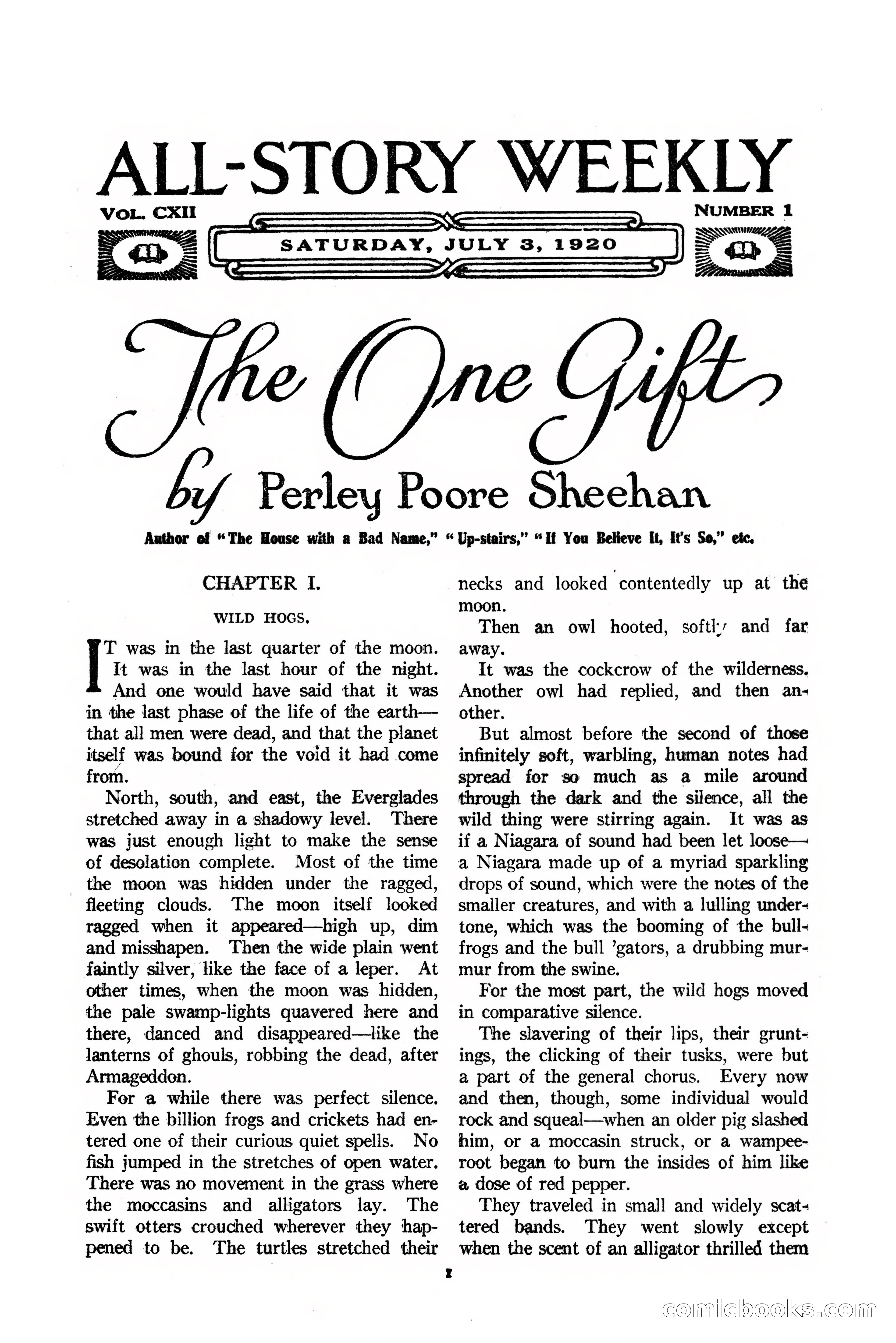
A restored page from Pulp Fiction, 1920. Page through the whole issue in the reader above.
📄 Transcribed text from this page (OCR, searchable)
Machine-transcribed from the original scan — historical spelling and the odd misread are preserved.
ALL- STORY WEERLY ‘oe esas iter 1 hy Perley Poore Sheehan Author of “The House with a Bad Name,” “Up-stairs,” “If You Believe It, It’s Se,” etc. CHAPTER I. WILD HOGS. It was in the last hour of the night. And one would have said that it was in the last phase of the life of the earth— that all men were dead, and that the planet itself was bound for the void it had come from. North, south, and east, the Everglades stretched away in a shadowy level. There was just enough light to make the sense of desolation complete. Most of the time the moon was hidden under the ragged, fleeting clouds. The moon itself looked ragged when it appeared—high up, dim and misshapen. Then the wide plain went faintly silver, like the face of a leper. At other times, when the moon was hidden, the pale swamp-lights quavered here and there, danced and disappeared—like the lanterns of ghouls, robbing the dead, after Armageddon. For a while there was perfect silence. Even the billion frogs and crickets had en- tered one of their curious quiet spells. No fish jumped in the stretches of open water. There was no movement in the grass where the moccasins and alligators lay. The swift otters crouched wherever they hap- pened to be. The turtles stretched their [’ was in the last quarter of the moon. necks and looked ‘contentedly up at the moon. Then an owl hooted, softly and far away. It was the cockcrow of the wilderness. Another owl had replied, and then an- other. But almost before the second of those infinitely soft, warbling, human notes had spread for so much as a mile around through the dark and the silence, all the wild thing were stirring again. It was as if a Niagara of sound had been let loose— a Niagara made up of a myriad sparkling drops of sound, which were the notes of the smaller creatures, and with a lulling under- tone, which was the booming of the bull- frogs and the bull ’gators, a drubbing mur- mur from the swine. For the most part, the wild hogs moved in comparative silence. The slavering of their lips, their grunt- ings, the clicking of their tusks, were but a part of the general chorus. Every now and then, though, some individual would rock and squeal—when an older pig slashed him, or a moccasin struck, or a wampee- root began to burn the insides of him like a dose of red pepper. They traveled in small and widely scat- tered bands. They went slowly except when the scent of an alligator thrilled them COMIC OO Cc S C©