
Pulp Fiction, 1919 · page 131 of 192
All-Story Weekly, March 1, 1919 — page 131: what you’re looking at
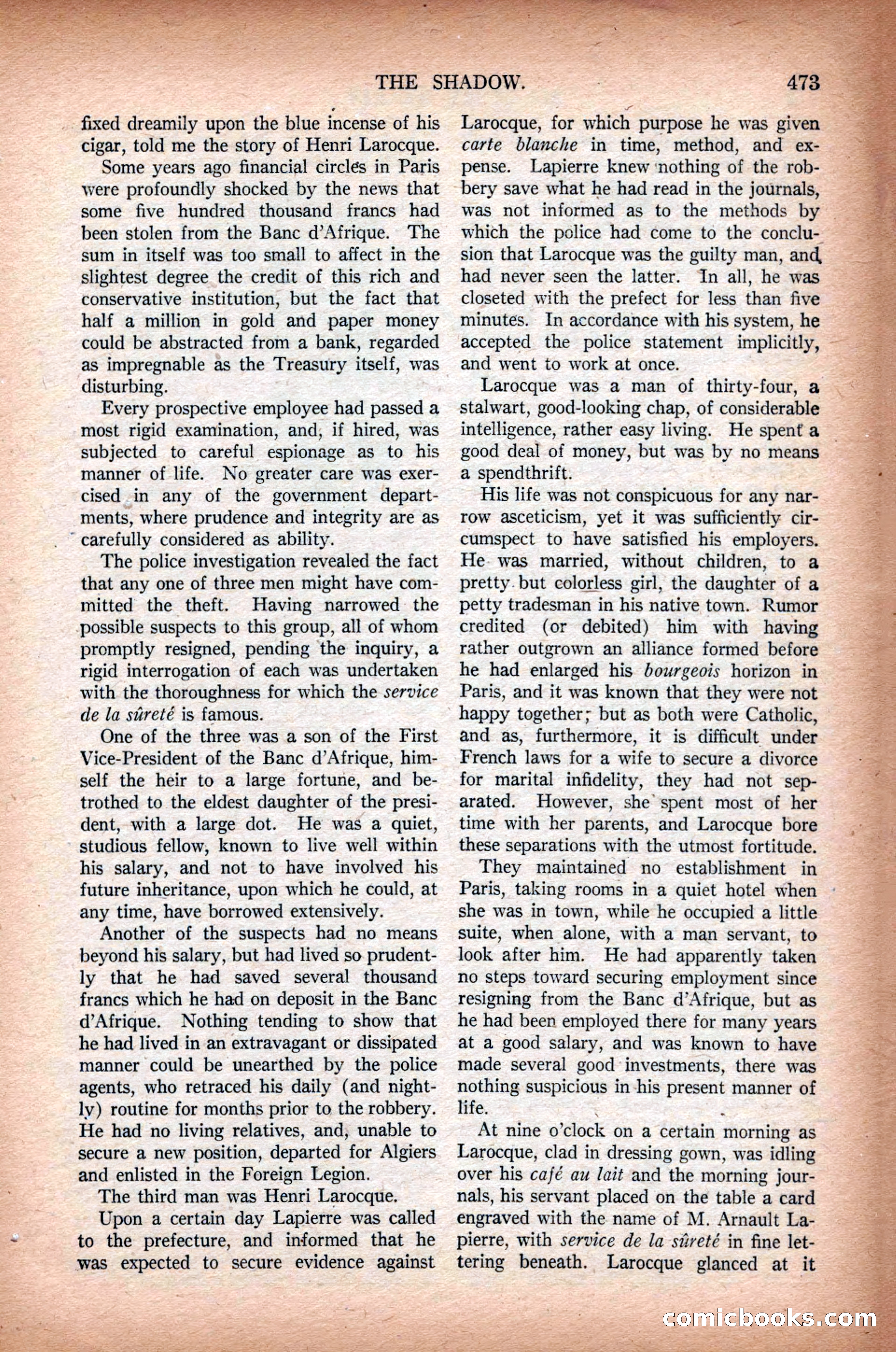
A restored page from Pulp Fiction, 1919. Page through the whole issue in the reader above.
📄 Transcribed text from this page (OCR, searchable)
Machine-transcribed from the original scan — historical spelling and the odd misread are preserved.
fos ; m 7 f , me as = on ~ wage plead ea - => a SS ee Wee aw ase aoe ee ee = 2 ~ - me ; ’ 5< : > ae ae Sa =i > 5 oe - — = ~ = oes _. fixed dreamily upon the blue incense of his cigar, told me the story of Henri Larocque. Some years ago financial circlés in Paris were profoundly shocked by the news that some five hundred thousand francs had been stolen from the Banc d’Afrique. The sum in itself was too small to affect in the slightest degree the credit of this rich and conservative institution, but the fact that half a million in gold and paper money could be abstracted from a bank, regarded as impregnable as the Treasury itself, was disturbing. Every prospective employee had passed a most rigid examination, and, if hired, was subjected to careful espionage as to his manner of life. No greater care was exer- cised in any of the government depart- ments, where prudence and integrity are as ~ carefully considered as ability. The police investigation revealed the fact that any one of three men might have com- mitted the theft. Having narrowed the possible suspects to this group, all of whom promptly resigned, pending the inquiry, a rigid interrogation of each was undertaken _ with the thoroughness for which the service de la stireté is famous. One of the three was a son of the First Vice-President of the Banc d’Afrique, him- self the heir to a large fortune, and be- trothed to the eldest daughter of the presi- dent, with a large dot. He was a quiet, studious fellow, known to live well within his salary, and not to have involved his future inheritance, upon which he could, at any time, have borrowed extensively. Another of the suspects had no means beyond his salary, but had lived so. prudent- ly that he had saved several thousand francs which he had on deposit in the Banc d’Afrique. Nothing tending to show that he had lived in an extravagant or dissipated manner could be unearthed by the police agents, who retraced his daily (and night- ly) routine for months prior to the robbery. He had no living relatives, and, unable to ‘secure a new position, departed for Algiers and enlisted in the Foreign Legion. The third man was Henri Larocque. Upon a certain day Lapierre was called to the prefecture, and informed that he was expected to secure evidence against at ae ae - ow" oc rt ry ee — a Spas = ee eS S : oP Sty awn t ~~ ae “ = ES THE SHADOW. Larocque, for which purpose he was given carte blanche in time, method, and ex- — pense. Lapierre knew ‘nothing of the rob- | ~-bery save what he had read in the journals, — was not informed as to the methods by which the police had come to the conclu-— sion that Larocque was the guilty man, and, had never seen the latter. ‘In all, he was closeted with the prefect for less than five minutes. and went to work at once. In accordance with his system, he accepted the police statement implicitly, ~~ Larocque was a man of thirty-four, a stalwart, good-looking chap, of considerable intelligence, rather easy living. He spent a good deal of money, but was by no means a spendthrift. His life was not conspicuous for any nar- row asceticism, yet it was sufficiently cir- cumspect to have satisfied his employers. He. was married, without children, to a | pretty. but colorless girl, the daughter of a petty tradesman in his native town. Rumor credited (or debited) him with having rather outgrown an alliance formed before he had enlarged his bourgeois horizon in Paris, and it was known that they were not happy together; but as both were Catholic, and as, furthermore, it is difficult under French laws for a wife to secure a divorce for marital infidelity, they had not sep- arated. However, she spent most of her time with her parents, and Larocque bore these separations with the utmost fortitude. They maintained no establishment in Paris, taking rooms in a quiet hotel when she was in town, while he occupied a little suite, when alone, with a man servant, to look after him. He had apparently taken no steps toward securing employment since resigning from the Banc d’Afrique, but as he had been employed there for many years at a good salary, and was known to have made several good investments, there was nothing suspicious in-his present manner of life. ; At nine o ‘clock on a certain morning as Larocque, clad in dressing gown, was idling ~ over his café au lait and the morning jour- nals, his servant placed on the table a card engraved with the name of M. Arnault La- Z pierre, with service de la stireté in fine let tering beneath. Bee dee hg sated at it = a eK eS “ Ry 7m P ee oy APS! Sai