
Pulp Fiction, 1919 · page 130 of 192
All-Story Weekly, March 1, 1919 — page 130: what you’re looking at
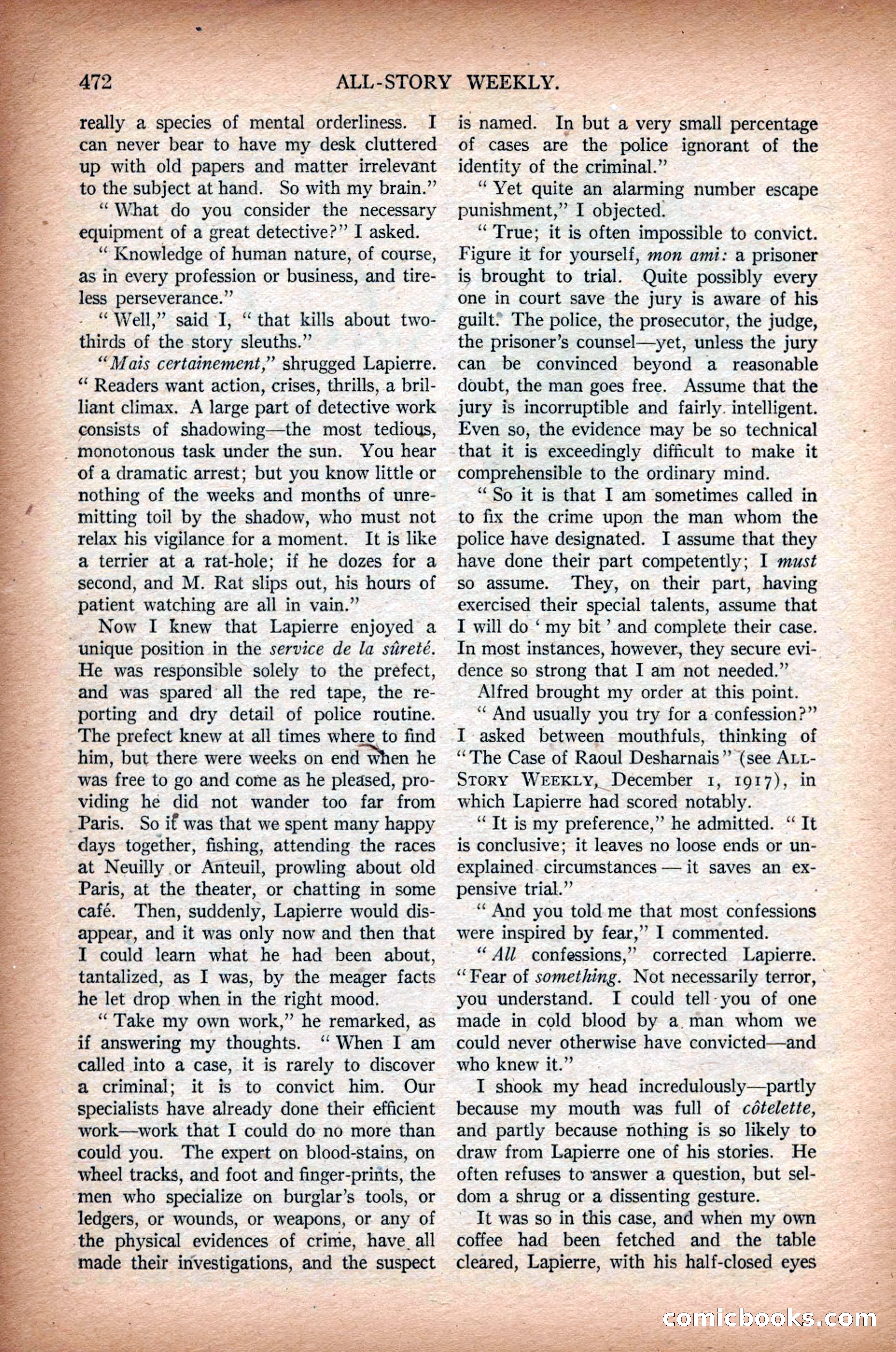
A restored page from Pulp Fiction, 1919. Page through the whole issue in the reader above.
📄 Transcribed text from this page (OCR, searchable)
Machine-transcribed from the original scan — historical spelling and the odd misread are preserved.
5 ron Re = a2 E ceally a species of mental rdetiipess. I = x oe : , heer Pad = — ieee . em — ~ 5 hk a te! = — 3 ° = ee Ore —— - can never bear to have my desk cluttered up with old papers and matter irrelevant to the subject at hand. So with my brain.” “What do you consider the necessary equipment of a great detective?” I asked. “Knowledge of human nature, of course, as in every profession or business, and tire- less perseverance.” “Well,” said I, “that kills about two- thirds of the story sleuths.” “Mais certainement,”’ shrugged Lapierre. “ Readers want action, crises, thrills, a bril- liant climax. A large part of detective work consists of shadowing—the most tedious, - monotonous task under the sun. You hear of a dramatic arrest; but you know little or nothing of the weeks and months of unre- mitting toil by the shadow, who must not relax his vigilance for a moment. It is like a terrier at a rat-hole; if he dozes for a second, and M. Rat slips out, his hours of patient watching are all in vain.” Now I knew that Lapierre enjoyed a “unique position in the service de la sireté. He was responsible solely to the prefect, and was spared all the red tape, the re- porting and dry detail of police routine. The prefect knew at all times where to find him, but there were weeks on end when he -__was free to go and come as he pleased, pro- viding he did not wander too far from Paris. So if was that we spent many happy a criminal; days together, fishing, attending the races at Neuilly or Anteuil, prowling about old Paris, at the theater, or chatting in some café. Then, suddenly, Lapierre would dis- appear, and it was only now and then that I could learn what he had been about, tantalized, as I was, by the meager facts he let drop when in the right mood. “Take my own work,” he remarked, as if answering my thoughts. ‘‘ When I am called into a case, it is rarely to discover it is to convict him. Our specialists have already done their efficient work—work that I could do no more than could you. The expert on blood-stains, on wheel tracks, and foot and finger-prints, the men who specialize on burglar’s tools, or : pees, or wounds, or Weapons, or any of the physical evidentces of crime, have_all _ ‘made their ae mee. and the suspect ALL. -STORY WEEKLY. I asked between mouthfuls, nae eS. Tee : cas -) — =r re a acta 2 Se = oe a <P = < is named. In but a very small percentage of cases are the police ignorant of the identity of the criminal.” “Yet quite an alarming number escape punishment,” I objected. “True; it is often impossible to convict. Figure it for yourself, mon ami: a prisoner is brought to trial. Quite possibly every one in court save the jury is aware of his guilt? The police, the prosecutor, the judge, the prisoner’s counsel—yet, unless the jury can be convinced beyond a_ reasonable doubt, the man goes free. Assume that the jury is incorruptible and fairly. intelligent. Even so, the evidence may be so technical that it is exceedingly difficult to make it comprehensible to the ordinary mind. “So it is that I am sometimes called in to fix the crime upon the man whom the police have designated. I assume that they have done their part competently; I must so assume. They, on their part, having exercised their special talents, assume that I will do ‘ my bit’ and complete their case. In most instances, however, they secure evi- _ dence so strong that I am not needed.” Alfred brought my order at this point. ‘““ And usually you try for a confession?” thinking of “The Case of Raoul Desharnais” (see ALL- STORY WEEKLY, December 1, 1917), in which Lapierre had scored notably. “It is my preference,” he admitted. “ It is conclusive; it leaves no loose ends or un- explained. circumstances — it saves an ex- pensive trial.” | ‘“‘ And you told me that most confessions were inspired by fear,” I commented. “All confessions,” corrected Lapierre. “Fear of something. Not necessarily terror, you understand. I could tell-you of one made in cold blood by a. man whom we could never otherwise have convicted—and who knew it.” I shook my head incredulously—partly because my mouth was full of cételette, and partly because nothing is so likely to draw from Lapierre one of his stories. He often refuses to answer a question, but sel- dom a shrug or a dissenting gesture. It was so in this case, and when my own coffee had been fetched and the table cleared, Lapierre, with his half-closed eyes = . Si S ; SI A C i, imicbook