
Pulp Fiction, 1919 · page 105 of 192
All-Story Weekly, March 1, 1919 — page 105: what you’re looking at
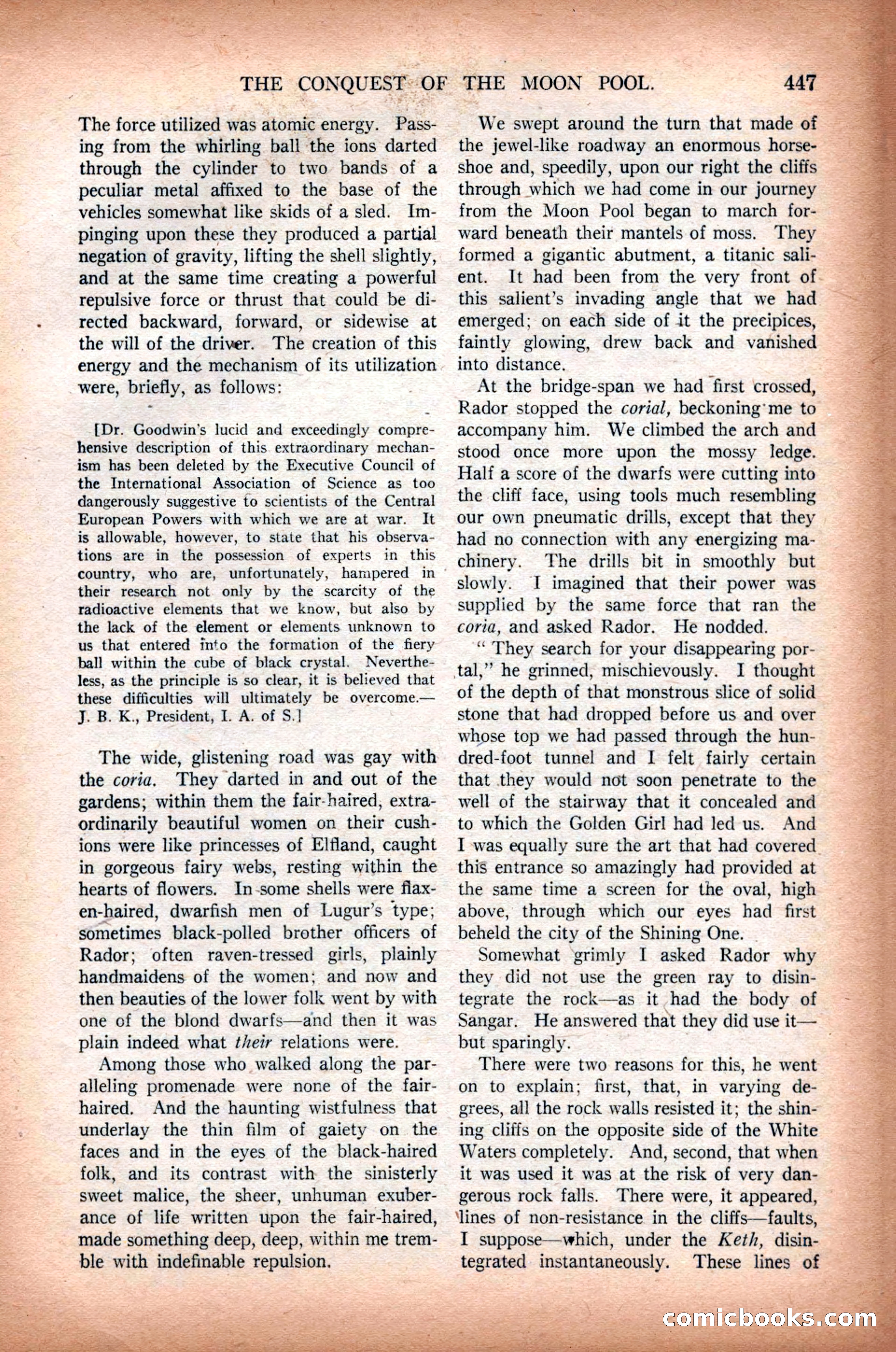
A restored page from Pulp Fiction, 1919. Page through the whole issue in the reader above.
📄 Transcribed text from this page (OCR, searchable)
Machine-transcribed from the original scan — historical spelling and the odd misread are preserved.
The force utilized was ik energy. Face: ing from the whirling ball the ions darted through the cylinder to two bands of a peculiar metal affixed to the base of the vehicles somewhat like skids of a sled. Im- pinging upon these they produced a partial negation of gravity, lifting the shell slightly, and at the same time creating a powerful repulsive force or thrust that could be di- rected backward, forward, or sidewise at the will of the driver. The creation of this energy and the mechanism of its utilization were, briefly, as follows: - {Dr. Goodwin's lucid and exceedingly compre- hensive description of this extraordinary mechan- ism has been deleted by the Executive Council of the International Association of Science as too dangerously suggestive to scientists of the Central European Powers with which we are at war. It is allowable, however, to state that his observa- tions are in the possession of experts in this country, who are, unfortunately, hampered in their research not only by the scarcity of the radioactive elements that we know, but also by the lack of the element or elements unknown to us that entered into the formation of the fiery ball within the cube of black crystal. Neverthe- less, as the principle is so clear, it is believed that these difficulties will ultimately be overcome.— J. B. K., President, I. A. of S.] The wide, glistening road was gay with the coria. They darted in and out of the gardens; within them the fair-haired, extra- ordinarily beautiful women on their cush- ions were like princesses of Elfland, caught in gorgeous fairy webs, resting within the hearts of flowers. In-some shells were flax- en-haired, dwarfish men of Lugur’s type; sometimes black-polled brother officers of Rador; often raven-tressed girls, plainly handmaidens of the women; and now and then beauties of the lower folk went by with one of the blond dwarfs—and then it was plain indeed what their relations were. Among those who walked along the par- alleling promenade were none of the fair- haired. And the haunting wistfulness that underlay the thin film of gaiety on the faces and in the eyes of the black-haired folk, and its contrast with the sinisterly sweet malice, the sheer, unhuman exuber- ance of life written upon the fair-haired, : - made something deep, deep, within me trem- ble with indefinable repulsion. ‘THE - CONQUEST. OF ‘THE MOON POOL. _ chinery. We swept ae the turn that made f= the jewel-like roadway an enormous horse-— ee shoe and, speedily, upon our right the cliffs — through which we had come in our journey — from the Moon Pool began to march for- — ward beneath their mantels of moss. They = — . a on ~~ =e a formed a gigantic abutment, a titanic sali- ent. It had been from the very front of- this salient’s invading angle that we had emerged; on each side of it the precipices, faintly glowing, drew back and vanished — into distance. At the bridge-span we had first crossed, Rador stopped the corial, beckoning’me to | * accompany him. We climbed the arch and stood once more upon the mossy ledge. Half a score of the dwarfs were cutting into the cliff face, using tools much resembling our own pneumatic drills, except that they — had no connection with any energizing ma- slowly. I imagined that their power was supplied by the same force that ran the coria, and asked Rador. He nodded. ‘They search for your disappearing por- : tal,’ he grinned, mischievously. I thought The drills bit in smoothly but. = of the depth of that monstrous slice of solid _ = stone that had dropped before us and over whose top we had passed through the hun- dred-foot tunnel and I felt fairly certain : that they would not soon penetrate to the well of the stairway that it concealed and to which the Golden Girl had led us. And I was equally sure the art that had covered. this entrance so amazingly had provided at the same time a screen for the oval, high above, through which our eyes had first beheld the city of the Shining One. - Somewhat grimly I asked Rador why they did not use the green ray to disin- tegrate the rock—as it had the body of Sangar. but sparingly. There were two reasons for this, he went on to explain; first, that, in varying de- grees, all the rock walls resisted it; the shin- ing cliffs on the opposite side of the White Waters completely. And, second, that when it was used it was at the risk of very dan- gerous rock falls. There were, it appeared, — ‘lines of non-resistance in the clifis—faults, I suppose—which, under the Keth, disin- wa AS —— = : *F ae et ert eee ee te Far AS, SY eI ee . ; He answered that they did use it— — tegrated see sore lines of = ae a = = ae, ebooks com