
Pulp Fiction, 1919 · page 104 of 192
All-Story Weekly, March 1, 1919 — page 104: what you’re looking at
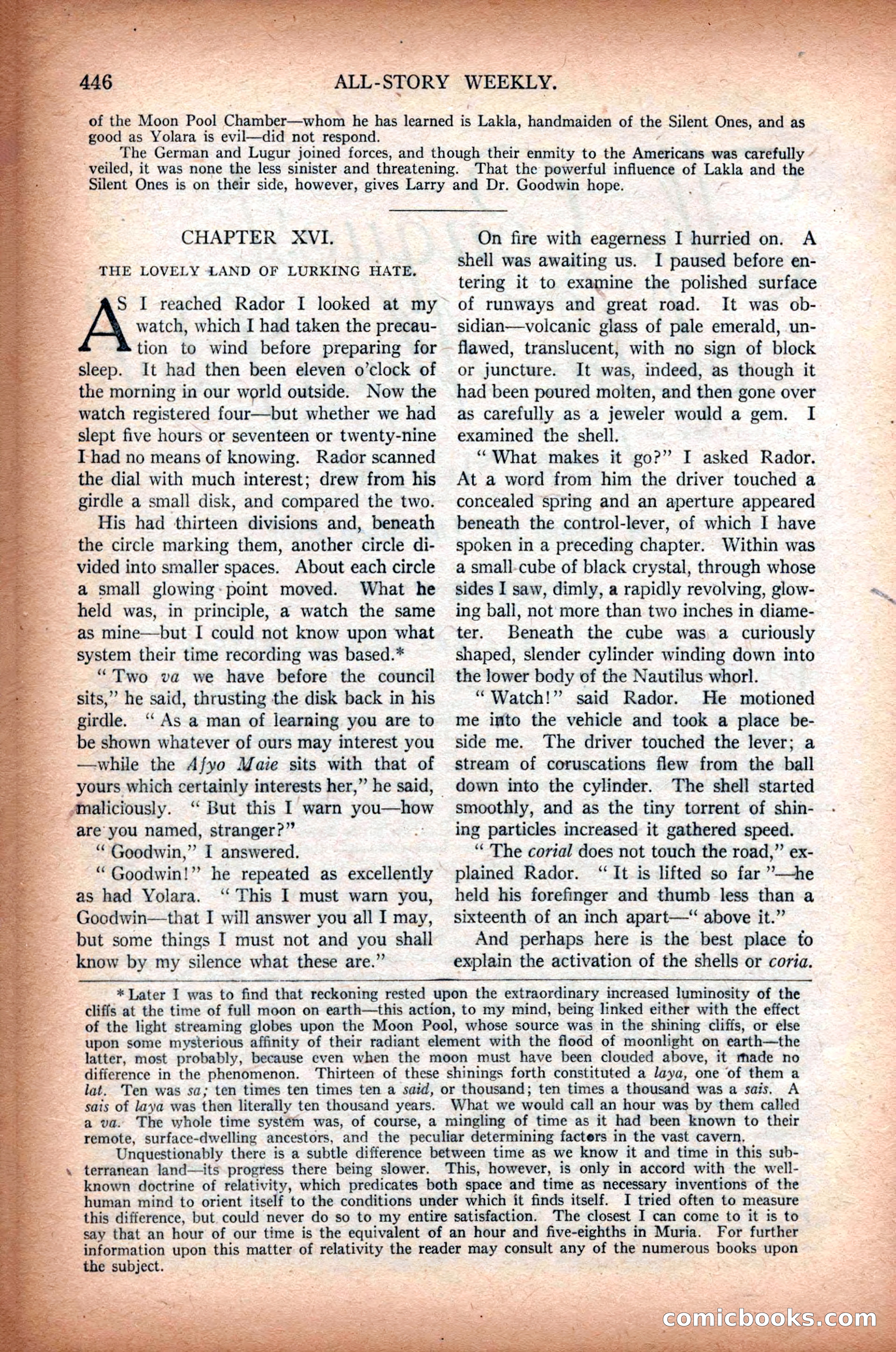
A restored page from Pulp Fiction, 1919. Page through the whole issue in the reader above.
📄 Transcribed text from this page (OCR, searchable)
Machine-transcribed from the original scan — historical spelling and the odd misread are preserved.
good as Yolara is evil—did not respond. ALL-STORY WEEKLY. 3 : of the Moon Pool Chamber--twhant he has learned is Tabla: handmaiden of the Silent Ones, and as ae The German and Lugur joined forces, and though their enmity to the Ameéticans was carefully - ____ veiled, it was none the less sinister and threatening. That the powerful influence of Lakla and the : Silent Ones is on their side, however, gives Larry and Dr. Goodwin hope. CHAPTER XVI. THE LOVELY LAND OF LURKING HATE. S I reached Rador I looked at my watch, which I had taken the precau- tion to wind before preparing for sleep. It had then been eleven o’clock of the morning in our world outside. Now the watch registered four—but whether we had slept five hours or seventeen or twenty-nine Thad no means of knowing. Rador scanned the dial with much interest; drew from his girdle a small disk, and compared the two. His had thirteen divisions and, beneath the circle marking them, another circle di- vided into smaller spaces. About each circle a small glowing: point moved. What he held was, in principle, a watch the same as mine—but I could not know upon what system their time recording was based.* “Two va we have before the council sits,” he said, thrusting the disk back in his girdle. “ As a man of learning you are to be shown whatever of ours may interest you —while the Afyo Maie sits with that of ___ yours which certainly interests her,” he said, ee maliciously. “ But this I warn you—how are you named, stranger?” “Goodwin,” I answered. “ Goodwin!” he repeated as excellently as had Yolara. ‘‘ This I must warn you, Goodwin—that I will answer you all I may, but some things I must not and you shall ‘know by my silence what these are.” ~~ _ down into the cylinder. On fire with eagerness I hurried on. A shell was awaiting us. I paused before en- tering it to examine the polished surface of runways and great road. It was ob- sidian—volcanic glass of pale emerald, un- flawed, translucent, with no sign of block or juncture. It was, indeed, as though it had been poured molten, and then gone over as carefully as a jeweler would a gem. I examined the shell. “What makes it go?” I asked Rador. At a word from him the driver touched a concealed spring and an aperture appeared beneath the control-lever, of which I have spoken in a preceding chapter. Within was a small-cube of black crystal, through whose sides I saw, dimly, a rapidly revolving, glow- ing ball, not more than two inches in diame- ter. Beneath the cube was a curiously shaped, slender cylinder winding down into the lower body of the Nautilus whorl. “Watch!” said Rador. He motioned me into the vehicle and took a place be- side me. ‘The driver touched the lever; a stream of coruscations flew from the ball The shell started smoothly, and as the tiny torrent of shin- ing particles increased it gathered speed. “The corial does not touch the road,” ex- plained Rador. “It is lifted so far ’’—he held his forefinger and thumb less than a sixteenth of an inch apart—“ above it.” And perhaps here is the best place to explain the activation of the shells or coria. * Later I was to find that reckoning rested upon the extraordinary increased luminosity of the cliffs at the time of full moon on earth—this action, to my mind, being linked either with the effect of the light streaming globes upon the Moon Pool, whose source was in the shining cliffs, or else upon some mysterious affinity of their radiant element with the flood of moonlight on earth—the latter, most probably, because even when the moon must have been clouded above, it made no difference in the phenomenon. Thirteen of these shinings forth constituted a laya, one of them a lat. Ten was sa; ten times ten times ten a said, or thousand; ten times a thousand was a sais. A sats of laya was then literally ten thousand years. What we would call an hour was by them called a va. The whole time systém was, of course, a a mingling of time as it had been known to their remote, surface-dwelling ancestors, and the peculiar determining facters in the vast cavern, Unquestionably there is a subtle difference between time as we know it and time in this sub- terranean land—its progress there being slower. This, however, is only in accord with the well- known doctrine of relativity, which predicates both space and time as necessary inventions of the human mind to orient itself to the conditions under which it finds itself. I tried often to measure this difference, but. could never do so to my entire satisfaction. The closest I can come to it is to say that an hour of our time is the equivalent of an hour and five-eighths in Muria. For further information upon this matter of relativity the reader may consult any of the numerous books upon _ the subject.