
Pulp Fiction, 1914 · page 154 of 247
The All-Story, March 1914 — page 154: what you’re looking at
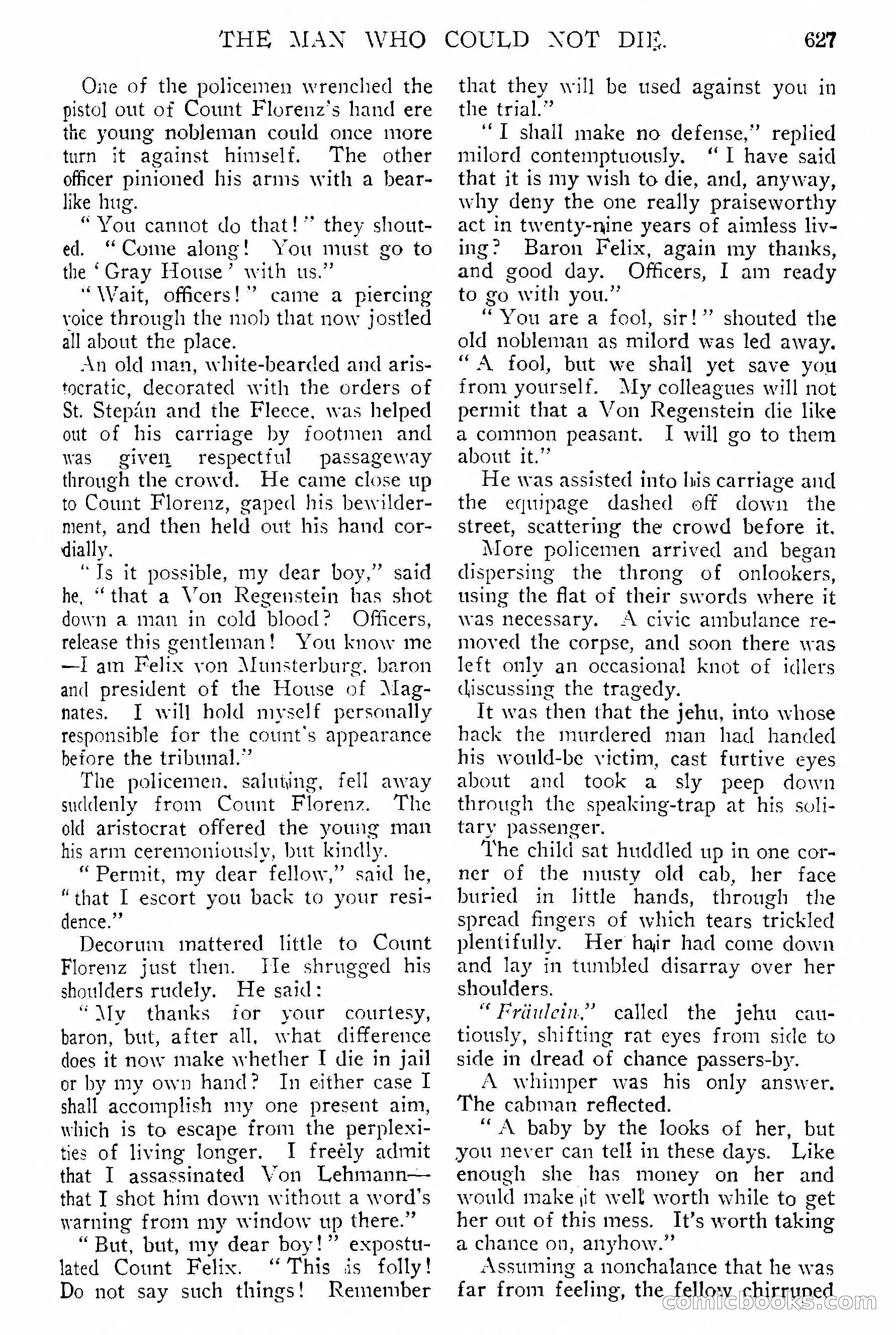
A restored page from Pulp Fiction, 1914. Page through the whole issue in the reader above.
📄 Transcribed text from this page (OCR, searchable)
Machine-transcribed from the original scan — historical spelling and the odd misread are preserved.
THE MAN WHO COULD NOT DIE. One of the policemen wrenched the pistol out of Count Florenz’s hand ere tie young nobleman could once more turn it against himself. The other officer pinioned his arms with a bear- like hug. “You cannot do that!” they shout- ed. “Come along! You must go to the ‘Gray House’ with us.” “Wait, officers!” came a piercing voice through the moh that now jostled all about the place. An old man, white-bearded and aris- tocratic, decorated with the orders of St. Stepan and the Fleece, was helped out of his carriage by footmen and was given respectful passageway through the crowd. He came close up to Count Florenz, gaped his bewilder- ment, and then held out his hand cor- dially. “Js it possible, my dear boy,” said he, “that a Von Regenstein has shot down a man in cold blood? Officers, release this gentleman! You know me —l am Felix yon Munsterburg, baron and president of the House of Alag- nates. I will hold myself personally responsible for the count’s appearance before the tribunal.” The policemen, saluting, fell away suddenly from Count Florenz. The old aristocrat offered the young man his arm ceremoniously, but kindly. “Permit, my dear fellow,” said he, “that I escort you back to your resi- dence.” Decorum mattered little to Count Florenz just then. He shrugged his shoulders rudely. He said: “AMIvy thanks for your courtesy, baron, but, after all, what difference does it now make whether I die in jail or by my own hand? In either case I shall accomplish my one present aim, which is to escape from the perplexi- ties of living longer. I freely admit that I assassinated Von Lehmann— that I shot him down without a word’s warning from my window up there.” “ But, but, my dear boy!” expostu- lated Count Felix. ‘“‘ This is folly! Do not say such things! Remember 627 that they will be used against you in the trial.” “I shall make no defense,” replied milord contemptuously. “I have said that it is my wish to die, and, anyway, why deny the one really praiseworthy act in twenty-nine years of aimless liv- ing? Baron Felix, again my thanks, and good day. Officers, I am ready to go with you.” “You are a fool, sir!’’ shouted the old nobleman as milord was led away. “A fool, but we shall yet save you from yourselt. My colleagues will not permit that a Von Regenstein die like a common peasant. I will go to them about it.” He was assisted into Ins carriage and the equipage dashed off down the street, scattering the crowd before it. More policemen arrived and began dispersing the throng of onlookers, using the flat of their swords where it was necessary. A civic ambulance re- moved the corpse, and soon there was left only an occasional knot of idlers (discussing the tragedy. It was then that the jehu, into whose hack the murdered man had handed his would-be victim, cast furtive eyes about and took a sly peep down through the speaking-trap at his soli- tary passenger. The child sat huddled up in one cor- ner of the musty old cab, her face buried in little hands, through the spread fingers of which tears trickled plentifully. Her hair had come down and lay in tumbled disarray over her shoulders. “Friulein,’ called the jehu cau- tiously, shifting rat eyes from side to side in dread of chance passers-by. A whimper was his only answer. The cabman reflected. “A baby by the looks of her, but you never can tell in these days. Like enough she has money on her and would make jit well worth while to get her out of this mess. It’s worth taking a chance on, anyhow.” Assuming a nonchalance that he was far from feeling, the _fellory. chirruned,