
Pulp Fiction, 1914 · page 15 of 247
The All-Story, March 1914 — page 15: what you’re looking at
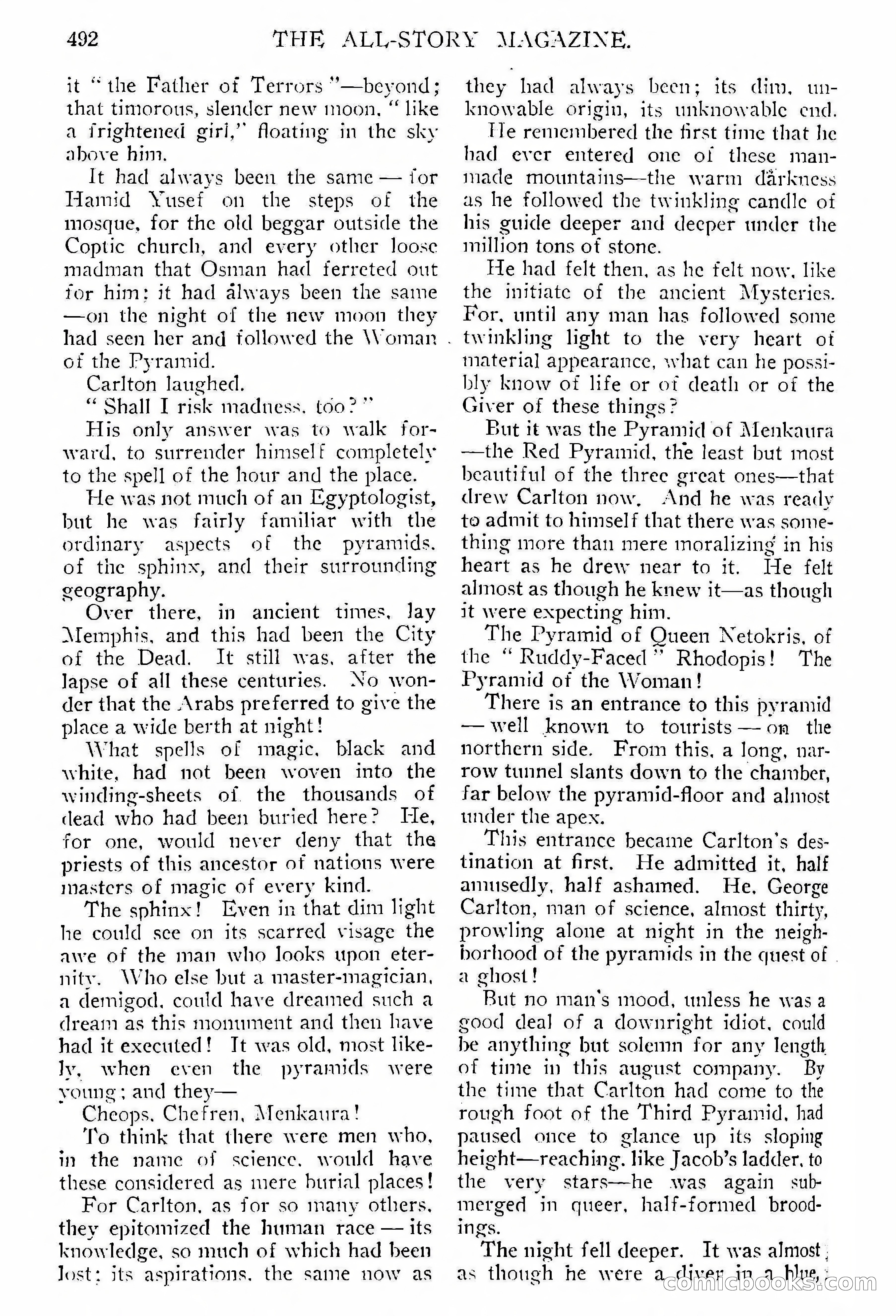
A restored page from Pulp Fiction, 1914. Page through the whole issue in the reader above.
📄 Transcribed text from this page (OCR, searchable)
Machine-transcribed from the original scan — historical spelling and the odd misread are preserved.
A492 THE ALL-STORY MAGAZINE. it “the Father of Terrors “’—beyond; that timorous, slender new tnoon, “ like a frightened giri,” floating in the sky above hin. It had always been the same — for Hamid Yusef on the steps of the mosque, for the old beggar outside the Coptic church, and every other loose madman that Osman had ferreted out tor him: it had always been the samme —on the night of the new moon they had seen her and followed the Woman . of the Pyramid. Carlton laughed. “ Shall I risk madness. too?” His only answer was to walk for- ward, to surrender himself completely to the spell of the hour and the place. He was not much of an E-gyptologtst, but he was fairly familar with the ordinary aspects of the pyramids. of the sphinx, and their surrounding ceography. Over there, in ancient times, Jay Memphis, and this had been the City of the Dead. It still was, after the lapse of all these centuries. No won- der that the .\rabs preferred to give the place a wide berth at night! What spells of magic. black and white, had not been woven into the winding-sheets of the thousands of dead who had been buried here? He, for one, would never deny that the priests of this ancestor of nations were masters of magic of every kind. The sphinx! Even in that dim light he could sce on its scarred visage the awe of the man who looks upon eter- nitv. Who else but a master-magician, a demigod. could have dreamed such a dream as this monument and then have had it executed! It was old, most like- Iv, when even the pyramids were young: Cheops. Chefren. Menkaura! To think that there were men who, in the name of science, would have these considered as mere burial places! For Carlton, as for so inany others, they epitomized the human race — its knowledge, so much of which had been Jost: its aspirations. the same now as they had always been; its dim, un- knowable origin, its unknowable end. Tle remembered the first time that he had ever entered one of these man- made mountains—the warm darkness as he followed the twinkling candle of his guide deeper and decper under the million tons of stone. He had felt then, as he felt now, like the initiate of the ancient Mysteries. For, until any man has followed some twinkling light to the very heart of material appearance, what can he possi- bly know of hfe or of death or of the Giver of these things? But it was the Pyramid of Menkaura —the Red Pyramid, the least but most beautiful of the three great ones—that drew Carlton now, And he was ready to admit to himself that there was some- thing more than mere moralizing in his heart as he drew near to it. He felt almost as though he knew it—as though it were expecting him. The Pyramid of Queen Netokris, of the “ Ruddy-Faced ” Rhodopis! The Pyramid of the Woman! There is an entrance to this pyramid —well known to tourists —on_ the northern side. From this, a long, nar- row tunnel slants down to the chamber, far below the pyramid-floor and aliost under the apex. This entrance became Carlton's des- tination at first. He admitted it, half amusedly, half ashamed. He, George Carlton, man of science, almost thirty, prowling alone at night in the neigh- borhood of the pyr amids in the quest Pot. a ghost! But no man’s mood, tunless he was a good deal of a downright idiot. could he anything but solemn for any length, of time mw this august company. ‘By the time that Carlton had come to the rough foot of the Third Pyramid, had paused once to glance up its sloping height—reaching. like Jacob’s ladder, to the very stars—he was again sub merged in queer, half-formed brood- ings. "The night fell deeper. It was almost, as though he were a Sliver in ables,