
Pulp Fiction, 1914 · page 148 of 247
The All-Story, March 1914 — page 148: what you’re looking at
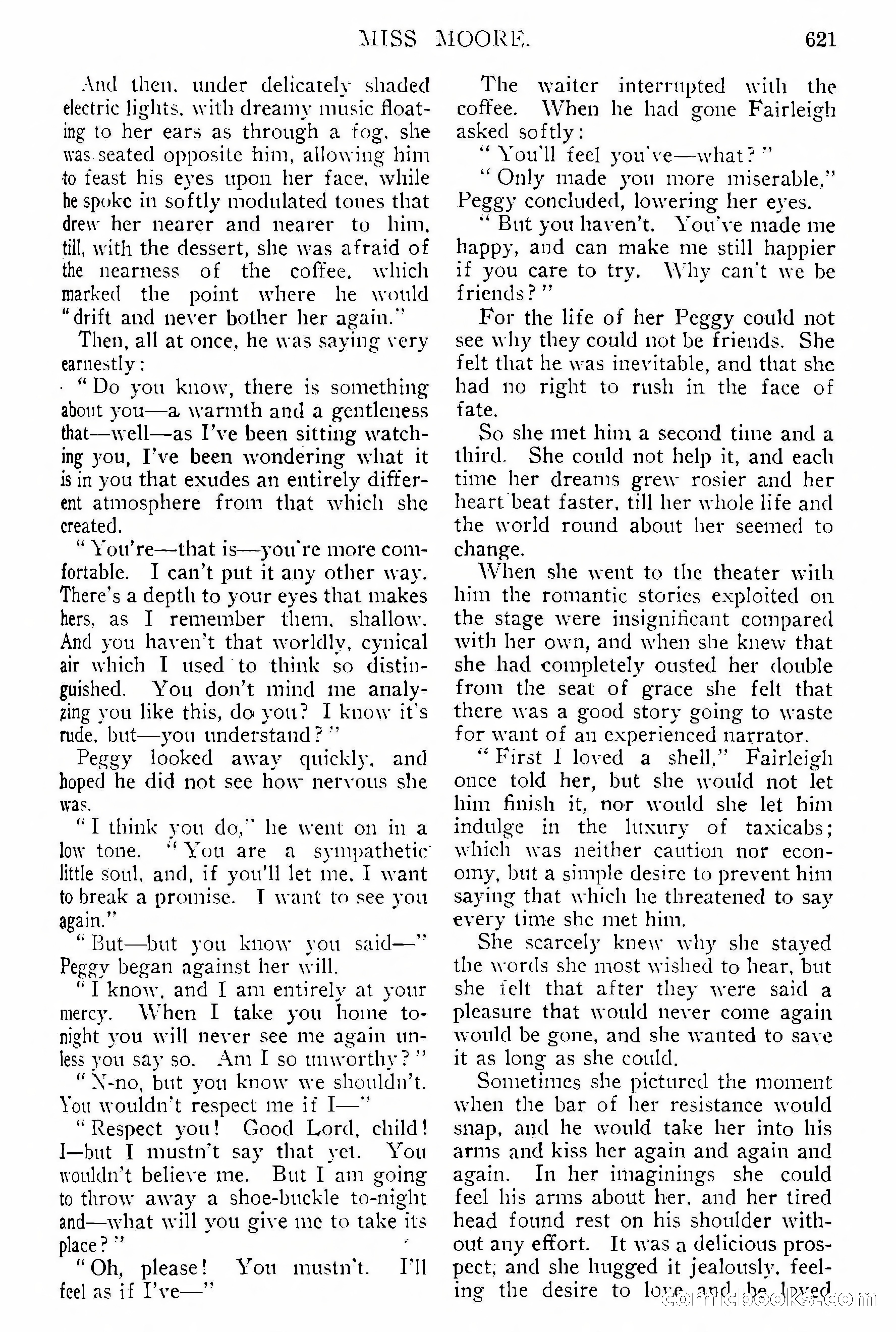
A restored page from Pulp Fiction, 1914. Page through the whole issue in the reader above.
📄 Transcribed text from this page (OCR, searchable)
Machine-transcribed from the original scan — historical spelling and the odd misread are preserved.
MISS MOORE. And then. under delicately shaded electric lights, with dreamy music float- ing to her ears as through a tog, she vas.seated opposite him, allowing him to teast his eyes upon her face, while he spoke in softly modulated tones that drew her nearer and nearer to him, till, with the dessert, she was afraid of the nearness of the coffee, which marked the point where he would “drift and never bother her again.” Then, all at once, he was saying very earnestly : “Do you know, there 1s something about you—a warmth and a gentleness that—well—as I’ve been sitting watch- ing you, I’ve been wondering what it isin you that exudes an entirely differ- ent atmosphere from that which she created. “ You’re—that is—you're more com- fortable. I can’t put it any other way. There's a depth to your eyes that makes hers, as I remember them, shallow. And you haven’t that worldly, cynical air which I used to think so distin- guished. You don’t mind me analy- zing vou like this, do you? I know it’s tude, but—you understand? ” Peggy looked away quickly, and hoped he did not see how nervous she was. “T think you do,” low tone. little soul, and, if you'll let me. I want to break a promise. I want to see you again.” *But—but you know you Pegg y began against her will. “T know, and I am entirely at your mercy. When I take you home to- night you will never see me again un- less you say so. Am I so unworthy? “N-no, but you know we shouldn’t. You wouldn’t respect me if I—" “Respect you! Good Lord, child! I—but I mustn’t say that vet. You wouldn’t believe me. But I am going to throw away a shoe-buckle to-night and—what will vou give me to take. its place? ”’ “Oh, please! feel as if ’ve—” he went on ina said—"* You mustn't. I'll “You are a sympathetic 621 The waiter interrupted with the coffee. When he had gone Fairleigh asked softly: “You'll feel you ve—what?” “Only made you more miserable,” Peggy concluded, low ering her eyes. ‘But you haven’t. You've made me happy, and can make me still happier if you care to try. Why can’t we be friends?” For the lite of her Peggy could not see Why they could not be friends. She felt that he was inevitable, and that she had no right to rush in the face of tate. yo she met him a second time and a third. She could not help it, and each time her dreams grew rosier and her heart beat faster, till her whole life and the world round about her seemed to change. When she went to the theater with him the romantic stories exploited on the stage were insignificant compared with her own, and when she knew that she had completely ousted her double from the seat of grace she felt that there was a good story going to waste for want of an experienced narrator, “First I loved a shell,” Fairleigh once told her, but she would not let hint finish it, nor would she let him indulge in the luxury of taxicabs; which was neither caution nor econ- omy, but a simple desire to prevent him saying that which he threatened to say every time she met him. She scarcely knew why she stayed the words she most wished to hear, but she ielt that after they were said a pleasure that would never come again would be gone, and she wanted to save it as long as she could. Sometimes she pictured the moment when the bar of her resistance would snap, and he would take her into his arms and kiss her again and again and again. In her imaginings she could feel lis arms about her, and her tired head found rest on his shoulder with- out any effort. It was a delicious pros- pect; and she hugged it jealously, feel- ing the desire to lose anh phe doveds