
Pulp Fiction, 1914 · page 146 of 247
The All-Story, March 1914 — page 146: what you’re looking at
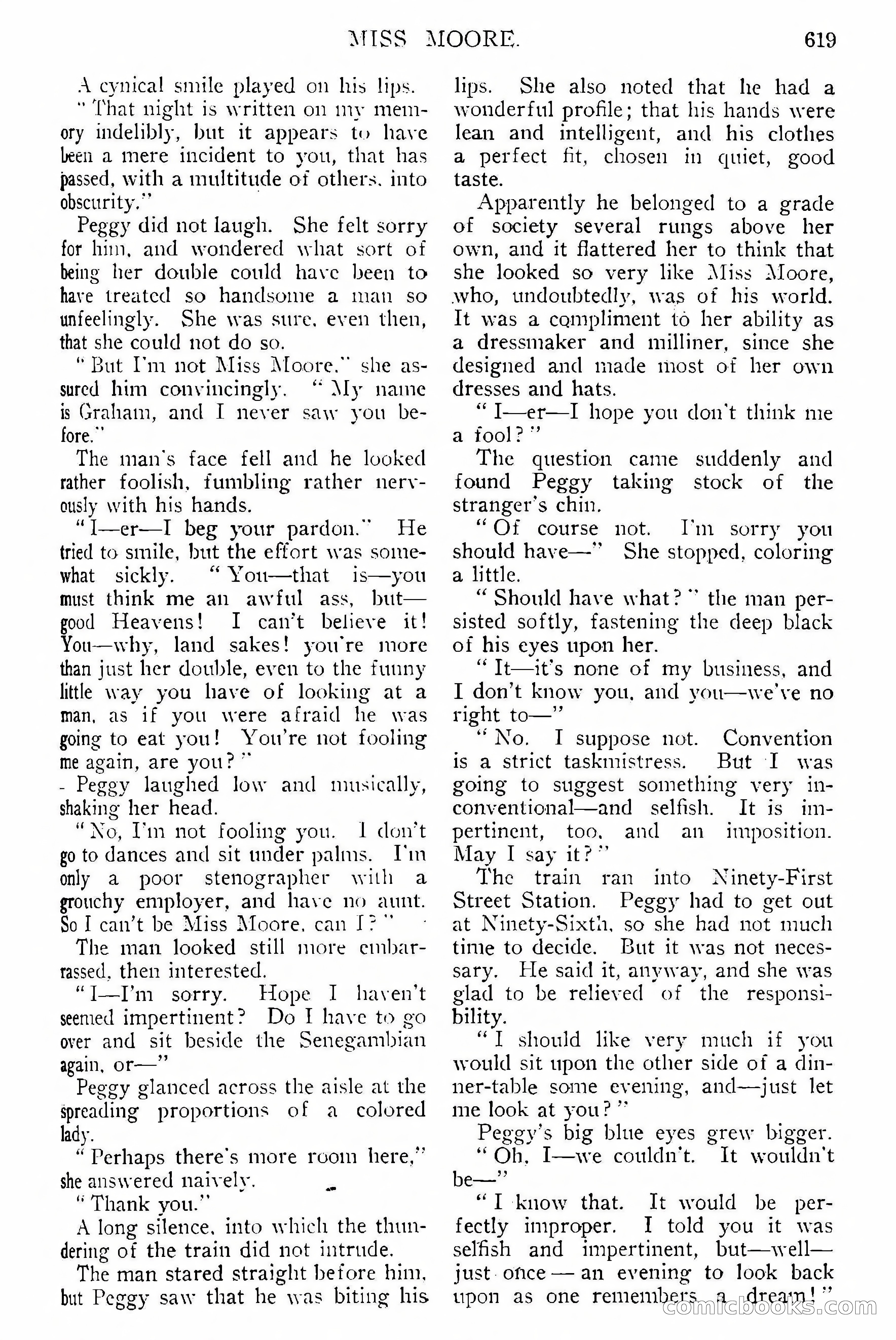
A restored page from Pulp Fiction, 1914. Page through the whole issue in the reader above.
📄 Transcribed text from this page (OCR, searchable)
Machine-transcribed from the original scan — historical spelling and the odd misread are preserved.
ATISS A cynical snile played on his lips. * That night is written on my mem- ory indehbly, but it appears to have been a mere incident to you, that has passed, with a multitude of others. into obscurity.” Peggy did not laugh. She felt sorry for him, and wondered what sort of beng her double could have been to have treated so handsome a man so wnfeelingly. She was sure, even then, that she could not do so. “But I'm not Miss Moore.” she as- sured him convincingly. “ \ly name is Graham, and I never saw you be- fore.” The man’s face fell and he looked rather foolish, fumbling rather nerv- ously with his hands. “J—er—I beg your pardon.” He tried to smile, but the effort was some- what sickly. “ You—that is—you must think me an awful ass, but— good Heavens! I can’t believe it! You—why, land sakes! yowre more than just her double, even to the funny little way you have of looking at a man, as 1f you were afraid he was going to eat you! You're not fooling me again, are you?” - Peggy laughed low and musically, shaking her head. “No, ('m not fooling you. I don’t go to dances and sit under palms. [im only a poor stenographer with a grouchy employer, and have no aunt. Sol can’t be Miss Moore. can I?" - The man looked still more embar- rassed, then interested. “T—T’m sorry. Hope I haven't seerned impertinent? Do [ have to go over and sit beside the Senegambian again, or—””’ Peggy glanced across the aisle at the spreading proportions of a colored lady. “Perhaps there’s more room here,” she answered naively. “Thank you.” A long silence, into which the thun- dering of the train did not intrude. The man stared straight before him, but Peggy saw that he was biting his ae MOORE. 619 lips. She also noted that he had a wonderful profile; that his hands were lean and intelligent, and his clothes a perfect fit, chosen in quiet, good taste. Apparently he belonged to a grade of society several rungs above her own, and it flattered her to think that she looked so very like Miss Moore, who, undoubtedly, was of his world. It was a campliment to her ability as a dressmaker and milliner, since she designed and made most of her own dresses and hats. “ I—er—I hope you don’t think me a tool?” The question came suddenly and found Peggy taking stock of the stranger's chin. “Of course not. should have—” a little. “Should have what? * the man per- sisted softly, fastening the deep black of his eyes upon her. “ Tt—it’s none of my business, and I don’t know you, and you—we've no In sorry you She stopped, coloring right to—”’ “No. I suppose not. Convention is a strict taskmuistress. But I was going to suggest something very in- conventional—and selfish. It is im- pertinent, too, and an imposition. May I say itr” The train ran into Ninety-First Street Station. Peggy had to get out at Ninety-Sixtn, so she had not much time to decide. But it was not neces- sary. He said it, anyway, and she was glad to be relieved of the responsi- bility. “YT should like very much if you would sit upon the other side of a din- ner-table some evening, and—just let me look at you? ” Peggy's big blue eyes grew bigger. “Oh, I—we couldn't. It wouldn't be—’’ “T know that. It would be per- fectly improper. I told you it was selfish and impertinent, but—well— just. once — an evening to look back upon as one remembers _a_.dreasn J CO