
Pulp Fiction, 1914 · page 136 of 247
The All-Story, March 1914 — page 136: what you’re looking at
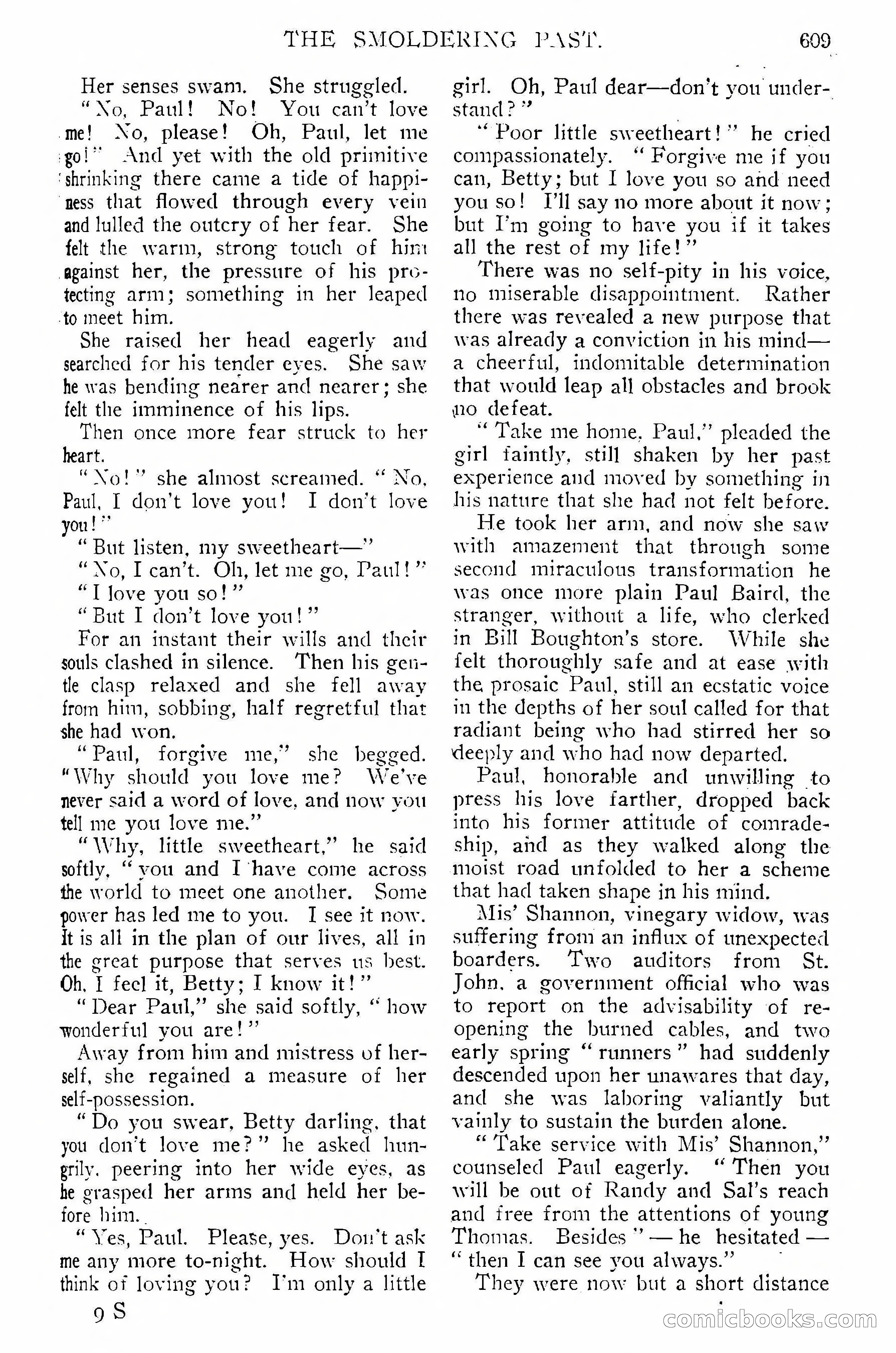
A restored page from Pulp Fiction, 1914. Page through the whole issue in the reader above.
📄 Transcribed text from this page (OCR, searchable)
Machine-transcribed from the original scan — historical spelling and the odd misread are preserved.
THE SMOLDERING Her senses swam. She struggled. “No, Paul! No! You can’t love me! No, please! Oh, Paul, let me gol” And yet with the old primitive ‘shrinking there came a tide of happi- ‘ness that flowed through every vein and lulled the outcry of her fear. She felt the warm, strong touch of hint against her, the pressure of his pro- tecting arm; something in her leaped -to meet him. She raised her head eagerly and searched for his tender eyes. She saw he was bending nearer and nearer; she felt the imminence of his lips. Then once more fear struck to her heart. “Nol” she almost screamed. “ No, Paul, I don’t love you! I don’t love you!” “But listen, my sweetheart—” “No, I can’t. Oh, let me go, Paul!” “T love you so!” “But I don’t love you!” For an instant their wills and their souls clashed in silence. Then his geu- tle clasp relaxed and she fell away from hit, sobbing, half regretful that she had won. “Paul, forgive me,” she begged. “Why should you love me? We've never said a word of love, and now you tell me you love me.” “Why, little sweetheart,” he said softly, “vou and I have come across the world to meet one another. Some power has led me to you. I see it now. It is all in the plan of our lives, all in the great purpose that serves us best. Oh, I fecl it, Betty; I know it!” “Dear Paul,’ she said softly, “ how wonderful you are!”’ Away from him and mistress of her- self, she regained a measure of her self-possession. “Do you swear, Betty darling, that you don’t love me?” he asked hun- erily. peering into her wide eyes, as he grasped her arms and held her be- fore him... “Ves, Paul. me any more to-night. think of loving you? 98 Please, yes. Don't ask How should I I’m only a little Fis. girl. Oh, Paul dear—don’t you under- stand? ” | “Poor little sweetheart!” he cried coimpassionately. “‘ Forgive me if you can, Betty; but I love you so and need you so! Tl say no more about it now; but I’m going to have you if it takes all the rest of my life!” There was no self-pity in his voice, no miserable disappointment. Rather there was revealed a new purpose that was already a conviction in his mind— a cheerful, indomitable determination that would leap all obstacles and brook no defeat. “Take me home, Paul,” pleaded the girl faintly, still shaken by her past experience aud moved by something in his nature that she had not felt before. He took her arm, and now she saw with amazement that through some second miraculous transformation he Was once more plain Paul Baird, the stranger, without a life, who clerked in Bill Boughton’s store. While she felt thoroughly safe and at ease with the prosaic Paul, still an ecstatic voice in the depths of her soul called for that radiant being who had stirred her so deeply and who had now departed. Paul, honorable and unwilling to press his love farther, dropped back into his former attitude of comrade- ship, and as they walked along the moist road unfolded to her a scheme that had taken shape in his mind. Mis’ Shannon, vinegary widow, was suffering from an influx of unexpected boarders. Two auditors from St. John, a government official who was to report on the advisability of re- opening the burned cables, and two early spring “runners” had suddenly descended upon her unawares that day, and she was laboring valiantly but vainly to sustain the burden alone. “Take service with Mis’ Shannon,” counseled Paul eagerly. “ Then you will be out of Randy and Sal’s reach and free from the attentions of young Thomas. Besides *’— he hesitated — “then I can see you always.” They were now but a short distance CoOMmicdooks.€© 609