
Pulp Fiction, 1914 · page 133 of 247
The All-Story, March 1914 — page 133: what you’re looking at
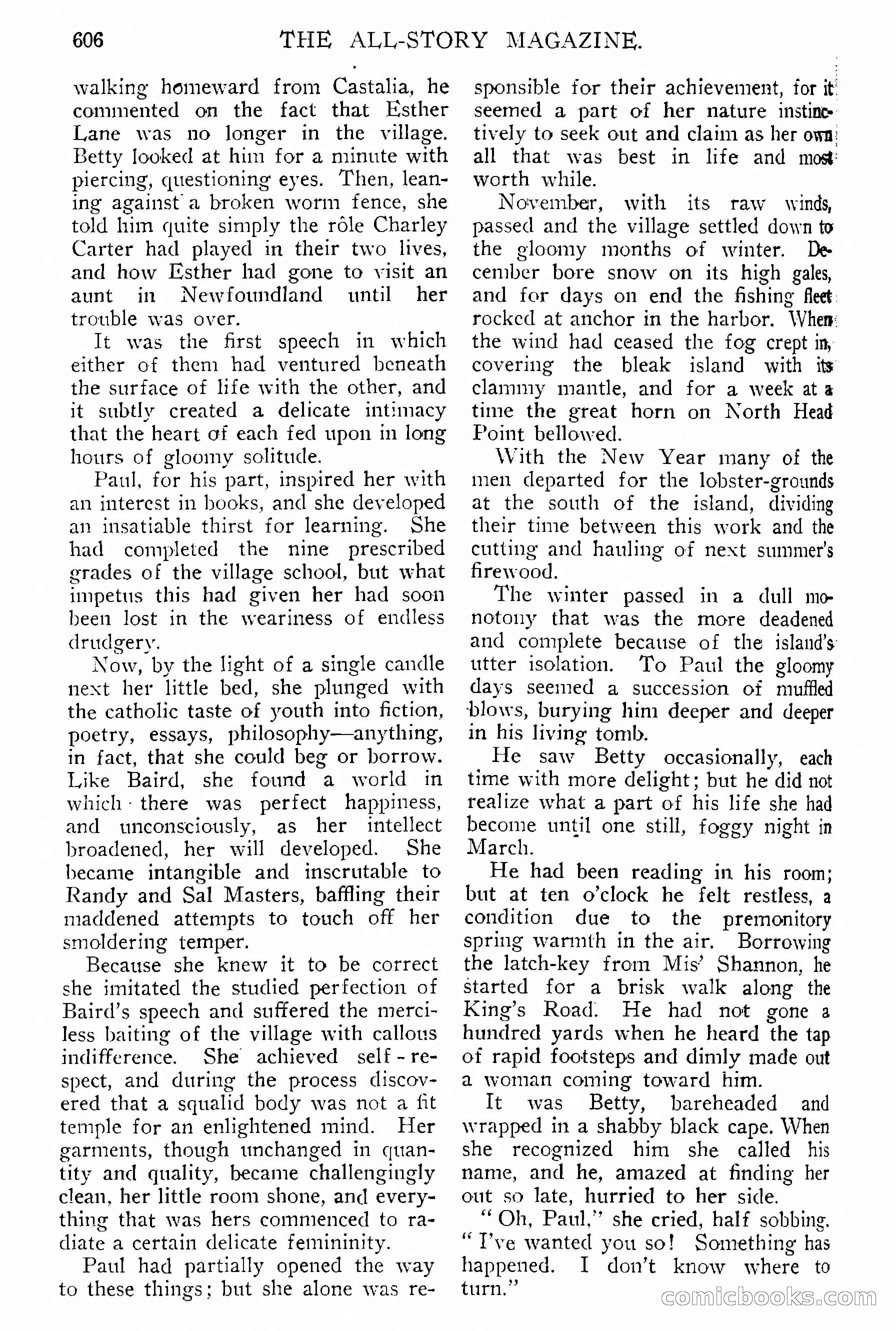
A restored page from Pulp Fiction, 1914. Page through the whole issue in the reader above.
📄 Transcribed text from this page (OCR, searchable)
Machine-transcribed from the original scan — historical spelling and the odd misread are preserved.
606 walking homeward from Castalia, he commented on the fact that Esther Lane was no longer in the village. Betty looked at him for a minute with piercing, questioning eyes. Then, lean- ing against a broken worm fence, she told him quite simply the role Charley Carter had played in their two lives, and how [tsther had gone to visit an aunt in Newfoundland until her trouble was over. It was the first speech in which either of them had ventured beneath the surface of life with the other, and it subtly created a delicate intimacy that the heart of each fed upon in long hours of gloomy solitude. Paul, for his part, inspired her with an interest in books, and she developed an insatiable thirst for learning. She had completed the nine prescribed erades of the village school, but what impetus this had given her had soon been lost in the weariness of endless drudgery. Now, by the light of a single candle next her little bed, she plunged with the catholic taste of youth into fiction, poetry, essays, philosophy—anything, in fact, that she could beg or borrow. Like Baird, she found a world in which: there was perfect happiness, and unconsciously, as her intellect broadened, her will developed. She became intangible and inscrutable to Randy and Sal Masters, baffling their maddened attempts to touch off her smoldering temper. Because she knew it to be correct she imitated the studied perfection of Baird’s speech and suffered the merci- less baiting of the village with callous indifference. She achieved self -re- spect, and during the process discov- ered that a squalid body was not a fit temple for an enlightened mind. Her garments, though unchanged in quan- tity and quality, became challengingly clean, her little room shone, and every- thing that was hers commenced to ra- diate a certain delicate femininity. Paul had partially opened the way to these things; but she alone was re- THE ALL-STORY MAGAZINE. sponsible for their achievement, jor it’ seemed a part of her nature instine tively to seek out and claim as her own: all that was best in life and most worth while. November, with its raw winds, passed and the village settled down to the gloomy months of winter. De cember bore snow on its high gales, and for days on end the fishing fleet. rocked at anchor in the harbor. When the wind had ceased the fog crept in, covering the bleak island with its clammy mantle, and for a week ata time the great horn on North Head Point bellowed. With the New Year many of the nen departed for the lobster-grounds at the south of the island, dividing their time between this work and the cutting and hauling of next summer’s firewood. The winter passed in a dull mo notony that was the more deadened and complete because of the island’s utter isolation. To Paul the gloomy days seemed a succession of muffled blows, burying him deeper and deeper in his living tomb. He saw Betty occasionally, each time with more delight; but he did not realize what a part of his life she had become until one still, foggy night in March. He had been reading in his room; but at ten o’clock he felt restless, a condition due to the premonitory spring warmth in the air. Borrowing the latch-key from Mis’ Shannon, he started for a brisk walk along the King’s Road. He had not gone a hundred yards when he heard the tap of rapid footsteps and dimly made out a woman coming toward him. It was Betty, bareheaded and wrapped in a shabby black cape. When she recognized him she called his name, and he, amazed at finding her out so late, hurried to her side. “Oh, Paul,” she cried, half sobbing. “T’ve wanted you so! Something has happened. I don’t know where to turn.” inn comiclbooks.€c©