
Pulp Fiction, 1914 · page 12 of 247
The All-Story, March 1914 — page 12: what you’re looking at
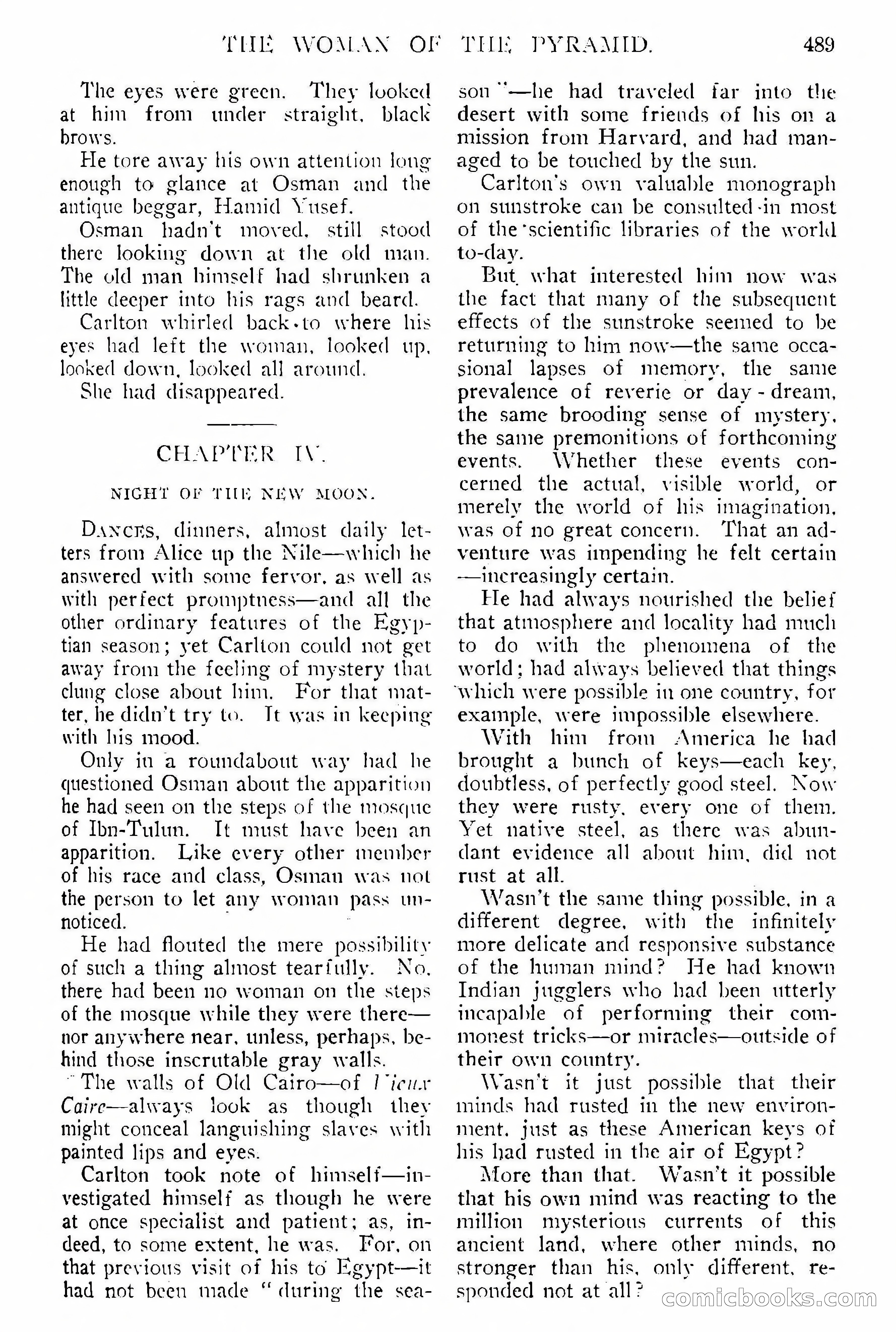
A restored page from Pulp Fiction, 1914. Page through the whole issue in the reader above.
📄 Transcribed text from this page (OCR, searchable)
Machine-transcribed from the original scan — historical spelling and the odd misread are preserved.
LO: They looked straight, black The eyes were green. at him from under brows. He tore away his own attention long enough to glance at Osman and the antique beggar, Hamid Yusef. Osman hadn't moved. still stood there looking down at the old man. The old man himself had shrunken a little deeper into his rags and beard. Carlton whirled back-to where his eyes had left the woman, looked up. looked down, looked all around. She had disappeared. CHAPTER TV. NIGHT OF TILE NEW MOON. Dancrs, dinners, almost daily let- ters from Alice up the Nile—which he answered with some fervor, as well as with perfect promptness—and all the other ordinary features of the Egyp- tian season; yet Carlton could not get away from the feeling of mystery that clung close about him. For that mat- ter, he didn’t try to. Tt was in keeping with lis mood. Only in a roundabout way had he questioned Osinan about the apparition he had seen on the steps of the mosque of Ibn-Tulun. It must have been an apparition. Like every other member of his race and class, Osman was not the person to let any woman pass un- noticed. He had flouted the mere possibility of such a thing almost tearfully. No. there had been no woman on the steps of the mosque while they were there— nor anywhere near, unless, perhaps, be- hind those inscrutable gray walls. “The walls of Old Cairo—of Iter Caire—always look as though they might conceal languishing slaves with painted lips and eyes. Carlton took note of himself—in- vestigated himself as though he were at once specialist and patient; as, in- deed, to some extent, he was. For, on that previous visit of his to Egypt—it had not been made “ during the sea- WOMAN OF TITS PYRAAITD. 489 son “—he had traveled far into the desert with some friends of his on a mission from Harvard, and had man- aged to be touched by the sun. Carlton’s own valuable monograph on stinstroke can be consulted -in most of the ‘scientific libraries of the world to-day. But. what interested him now was the fact that many of the subsequent effects of the sunstroke seemed to be returning to him now—the same occa- sional lapses of memory, the same prevalence of reverie or day - dream, the same brooding sense of mystery, the sane premonitions of forthcoming events. Whether these events con- cerned the actual, visible world, or merely the world of lis imagination, was of no great concern. That an ad- venture was impending he felt certain ——inereasingly certain. Fe had always nourished the belief that atmosphere and locality had mucli to do with the phenomena of the world; had always believed that things ‘which were possible in one country, for example, were impossible elsewhere. With him from America he had brought a bunch of keys—each key, doubtless, of perfectly good steel. Now they were rusty. every one of them. Yet native steel, as there was abun- dant evidence all about him, did not rust at all. Wasn't the same thing possible, in a different degree, with the infinitely more delicate and responsive substance of the human mind? He had known Indian jugglers who had been utterly incapable of performing their com- monest tricks—or mtracles—outside of their own country. Wasn't it just possible that their minds had rusted im the new environ- ment. just as these American keys of his had rusted in the air of Egypt? More than that. Wasn't it possible that his own mind was reacting to the million mysterious currents of this ancient land, where other minds, stronger than his, only different, re- sponded not at all? compichooks CO