
Pulp Fiction, 1913 · page 42 of 268
All Story Magazine, December 1913 — page 42: what you’re looking at
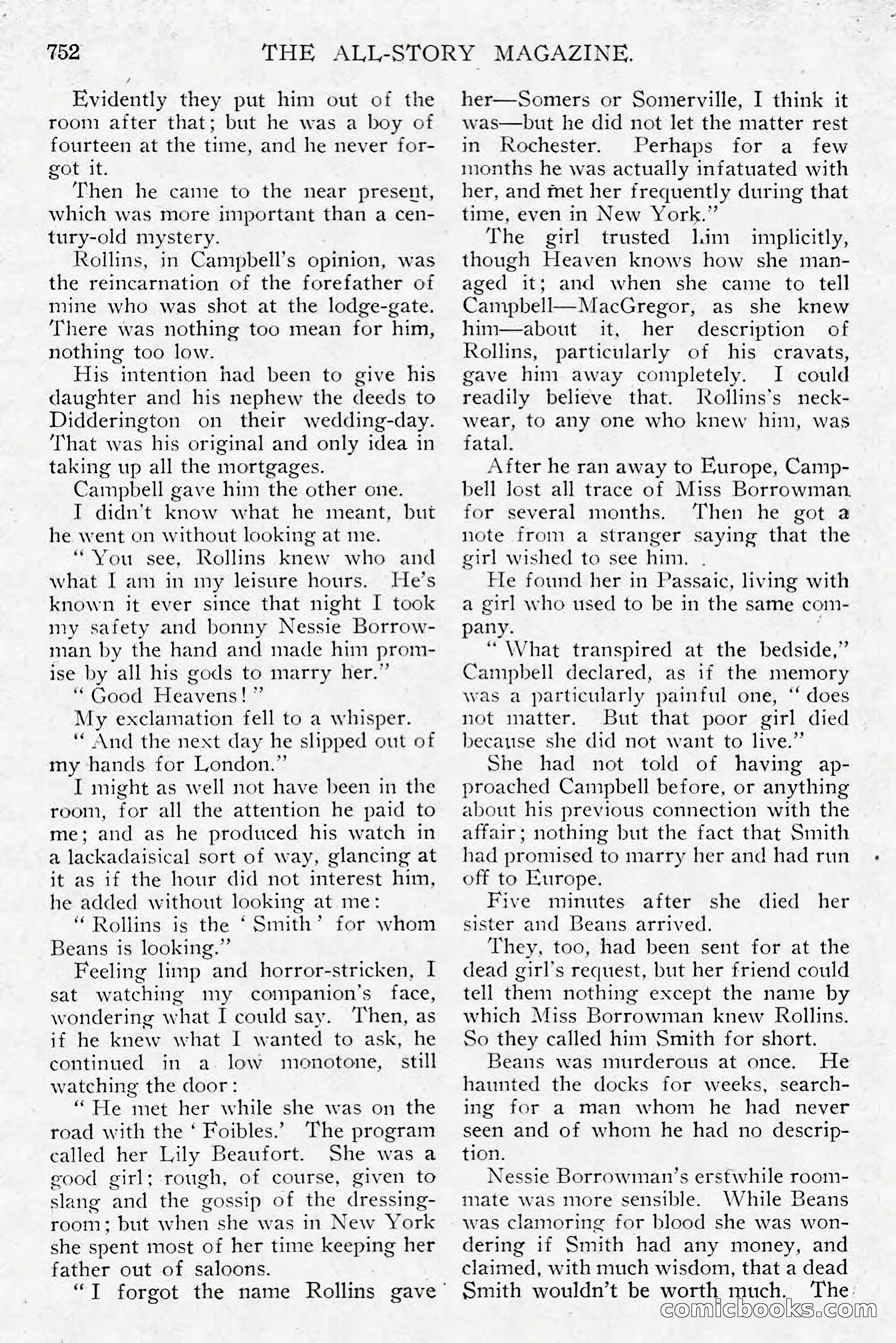
A restored page from Pulp Fiction, 1913. Page through the whole issue in the reader above.
📄 Transcribed text from this page (OCR, searchable)
Machine-transcribed from the original scan — historical spelling and the odd misread are preserved.
752 Evidently they put him out of the room after that; but he was a boy of fourteen at the time, and he never for- got it. Then he came to the near present, which was more important than a cen- tury-old mystery. Rollins, in Campbell’s opinion, was the reincarnation of the forefather of mine who was shot at the lodge-gate. There was nothing too mean for him, nothing too low. His intention had been to give his daughter and his nephew the deeds to Didderington on their wedding-day. That was his original and only idea in taking up all the mortgages. Campbell gave him the other one. I didn't know what he meant, but he went on without looking at me. * You see, Rollins knew who and what I am in my leisure hours. He's known it ever since that night I took my safety and bonny Nessie Borrow- man by the hand and made him prom- ise by all his gods to marry her.” ‘Good Heavens!” My exclamation fell to a whisper. “And the next day he slipped out of my hands for London.” I might as well not have been in the room, for all the attention he paid to me; and as he produced his watch in a lackadaisical sort of way, glancing at it as if the hour did not interest him, he added without looking at me: * Rollins is the ‘Smith’ for whom Beans is looking.” Feeling limp and horror-stricken, I sat watching my companion’s face, wondering what I could say. Then, as if he knew what I wanted to ask, he continued in a low monotone, still watching the door : “He met her while she was on the road with the ‘ Foibles.’ The program called her Lily Beaufort. She was a good girl; rough, of course, given to slang and the gossip of the dressing- room; but when she was in New York she spent most of her time keeping her father out of saloons. “T forgot the name Rollins gave’ THE ALL-STORY MAGAZINE, her—Somers or Somerville, I think it was—but he did not let the matter rest in Rochester. Perhaps for a few months he was actually infatuated with her, and met her frequently during that time, even in New York.” The girl trusted lim implicitly, though Heaven knows how she man- aged it; and when she came to tell Campbell—MacGregor, as she knew him—about it, her description of Rollins, particularly of his cravats, gave him away completely. I could readily believe that. Lollins’s neck- wear, to any one who knew him, was fatal. After he ran away to Europe, Camp- bell lost all trace of Miss Borrowman. for several months. Then he got a note from a stranger saying that the girl wished to see him. He found her in Passaic, living with a girl who used to be in the same com- pany. . “What transpired at the bedside,” Campbell declared, as if the memory was a particularly painful one, “‘ does not matter. But that poor girl died because she did not want to live.”’ She had not told of having ap- proached Campbell before, or anything about his previous connection with the affair; nothing but the fact that Smith had pronused to marry her and had run off to Europe. Five minutes after she sister and Beans arrived. They, too, had been sent for at the dead girl’s request, but her friend could tell them nothing except the name by which Miss Borrowman knew Rollins. So they called him Smith for short. Beans was murderous at once. He haunted the docks for weeks, search- ing for a man whom he had never seen and of whom he had no descrip- tion. Nessie Borrowman’s erstwhile room- mate was more sensible. While Beans was clamoring for blood she was won- dering if Smith had any money, and claimed, with much wisdom, that a dead Smith wouldn’t be worth much. The: died her comiclbooks.conmn