
Pulp Fiction, 1913 · page 41 of 268
All Story Magazine, December 1913 — page 41: what you’re looking at
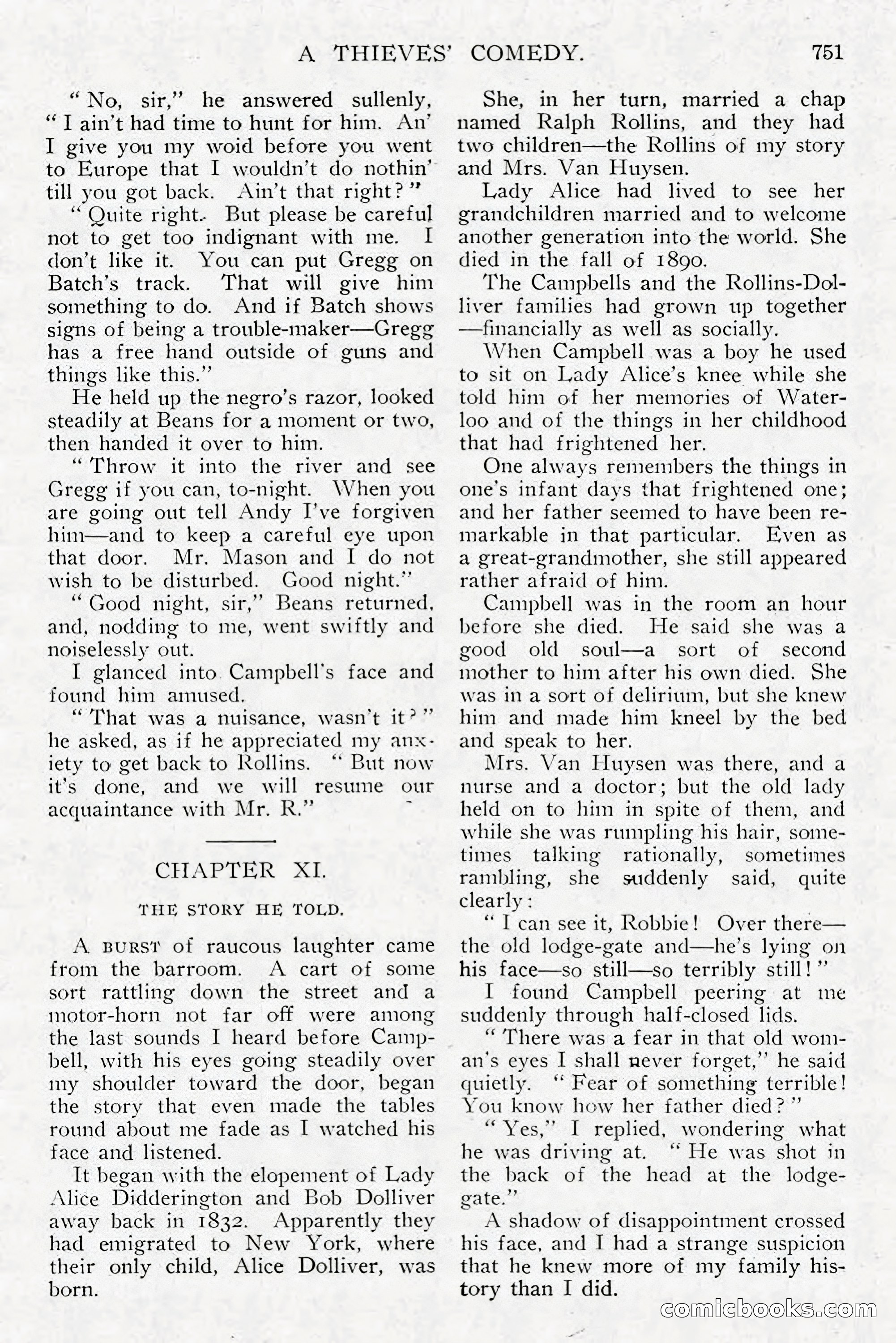
A restored page from Pulp Fiction, 1913. Page through the whole issue in the reader above.
📄 Transcribed text from this page (OCR, searchable)
Machine-transcribed from the original scan — historical spelling and the odd misread are preserved.
A “HIE VES’ COMEDY. “No, sir,” he answered sullenly, “ T ain't had time to hunt for him. An’ I give you my woid before you went to Europe that I wouldn’t do nothin’ till you got back. Ain’t that right?” “Quite right. But please be careful not to get too indignant with me. I don’t like it. You can put Gregg on Batch’s track. That will give him something to do. And if Batch shows signs of being a trouble-maker—Gregg has a free hand outside of guns and things like this.” He held up the negro’s razor, looked steadily at Beans for a moment or two, then handed it over to him. “Throw it into the river and see Gregg if you can, to-night. \When you are going out tell Andy I’ve forgiven him—and to keep a careful eye upon that door. Mr. Mason and I do not wish to be disturbed. Good night.”’ “ Good night, sir,” Beans returned, and, nodding to me, went swiftly and noiselessly out. I glanced into. Campbell's face and found him amused, “That was a nuisance, wasn’t it?” he asked, as if he appreciated my anx- iety to get back to Rollins. ‘ But now it’s done, and we will resume our acquaintance with Mr. R.” 7 CHAPTER XI. THE STORY HE TOLD, A Burst of raucous laughter came from the barroom. A cart of some sort rattling down the street and a motor-horn not far off were among the last sounds I heard before Camp- bell, with his eyes going steadily over my shoulder toward the door, began the story that even made the tables round about me fade as I watched his face and listened. It began with the elopement of Lady Alice Didderington and Bob Dolliver away back in 1832. Apparently they had emigrated to New York, where their only child, Alice Dolliver, was born. 751 She, in her turn, married a chap named Ralph Rollins, and they had two children—the Rollins of my story and Mrs. Van Huysen. Lady Alice had lived to see her grandchildren married and to welcome another generation into the world. She died in the fall of 1890. The Campbells and the Rollins-Dol- liver families had grown up together —financially as well as socially. When Campbell was a boy he used to sit on Lady Alice’s knee while she told him of her memories of Water- loo and of the things in her childhood that had frightened her. One always remembers the things in one’s infant days that frightened one; and her father seemed to have been re- markable in that particular. Even as a great-grandmother, she still appeared rather afraid of him. Campbell was in the room an hour before she died. He said she was a good old soul—a sort of second mother to him after his own died. She was ina sort of delirium, but she knew him and made him kneel by the bed and speak to her. Mrs. Van Huysen was there, and a nurse and a doctor; but the old lady held on to him in spite of them, and while she was rumpling his hair, some- times talking rationally, sometimes rambling, she suddenly said, quite clearly : “ Tcan see it, Robbie! Over there the old lodge-gate and—he’s lying on his face—so still—so terribly still!” I found Campbell peering at me suddenly through half-closed lids. “There was a fear in that old wom- an’s eyes I shall never forget,”’ he said quietly. ‘ Fear of something terrible! You know how her father died?” “Yes,” I replied, wondering what he was driving at. “ He was shot in the back of the head at the lodge- gate.” A shadow of disappointment crossed his face, and I had a strange suspicion that he knew more of my family his- tory than I did. comnlicloooks.com