
Pulp Fiction, 1913 · page 23 of 268
All Story Magazine, December 1913 — page 23: what you’re looking at
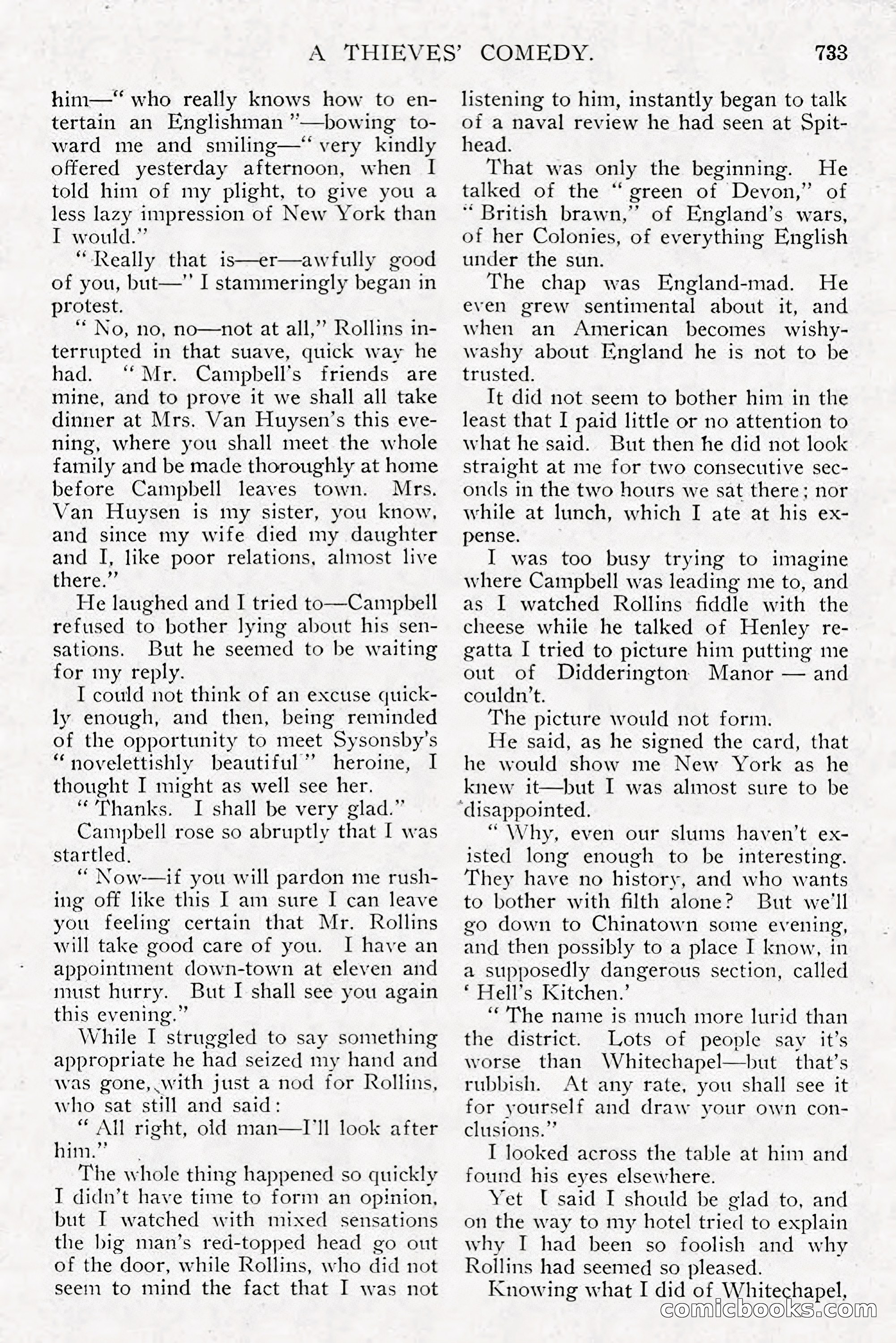
A restored page from Pulp Fiction, 1913. Page through the whole issue in the reader above.
📄 Transcribed text from this page (OCR, searchable)
Machine-transcribed from the original scan — historical spelling and the odd misread are preserved.
A THIEVES’ him—*“ who really knows how to en- tertain an Englishman ”—hbowing to- ward me and smiling—‘ very kindly offered yesterday afternoon, when I told him of my plight, to give you a less lazy impression of New York than I would.” “Really that is—er—awfully good of you, but—"’ I stammeringly began in protest. “No, no, no—not at all,’ Rollins in- terrupted in that suave, quick way he had. ‘‘Mr. Campbell’s friends are mine, and to prove it we shall all take dinner at Mrs. Van Huysen’s this eve- ning, where you shall meet the whole family and be made thoroughly at home before Campbell leaves town. Mrs. Van Huysen is my sister, you know, and since my wife died my daughter and I, like poor relations, almost live there.” He laughed and I tried to—Campbell refused to bother lying about his sen- sations. But he seemed to be waiting for my reply. I could not think of an excuse quick- ly enough, and then, being reminded of the opportunity to meet Sysonsby’s “novelettishly beautiful’? heroine, I thought I might as well see her. ‘Thanks. I shall be very glad.” Campbell rose so abruptly that I was startled. “ Now—if you will pardon me rush- ing off like this I am sure I can leave you feeling certain that Mr. Rollins will take good care of you. I have an appointment down-town at eleven and must hurry. But I shall see you again this evening.” While I struggled to say something appropriate he had seized my hand and was gone, with just a nod for Rollins, who sat still and said: “ All right, old man—I'll look after ham The whole thing happened so quickly I didn’t have time to form an opinion, but I watched with mixed sensations the big man’s red-topped head go out of the door, while Rollins, who did not seein to mind the fact that I was not COMEDY. 733 listening to him, instantly began to talk of a naval review he had seen at Spit- head. That was only the beginning. He talked of the “ green of Devon,” of “ British brawn,’ of England’s wars, of her Colonies, of everything English under the sun. The chap was England-mad. He even grew sentimental about it, and when an American becomes wishy- washy about England he is not to be trusted. It did not seem to bother him in the least that I paid little or no attention to what he said. But then he did not look straight at me for two consecutive sec- onds in the two hours we sat there; nor while at lunch, which I ate at his ex- pense. I was too busy trying to imagine where Campbell was leading me to, and as I watched Rollins fiddle with the cheese while he talked of Henley re- gatta I tried to picture him putting me out of Didderington Manor — and couldn’t. The picture would not form. He said, as he signed the card, that he would show me New York as he knew it—but I was almost sure to be ‘disappointed. “Why, even our slums haven’t ex- isted long enough to be interesting. They have no history, and who wants to bother with filth alone? But we'll go down to Chinatown some evening, and then possibly to a place I know, in a supposedly dangerous section, called * Hell’s Kitchen.’ “The naine is much more lurid than the district. Lots of people sav it’s worse than Whitechapel—but that’s rubbish. At any rate, you shall see it for yourself and draw your own con- clusions.” I looked across the table at him and found his eyes elsewhere. Yet Usaid I should be glad to, and on the way to my hotel tried to explain why I had been so foolish and why Rollins had seemed so pleased. Knowing what I did of Whitechapel, comnliclooolkks.com