
Pulp Fiction, 1913 · page 22 of 268
All Story Magazine, December 1913 — page 22: what you’re looking at
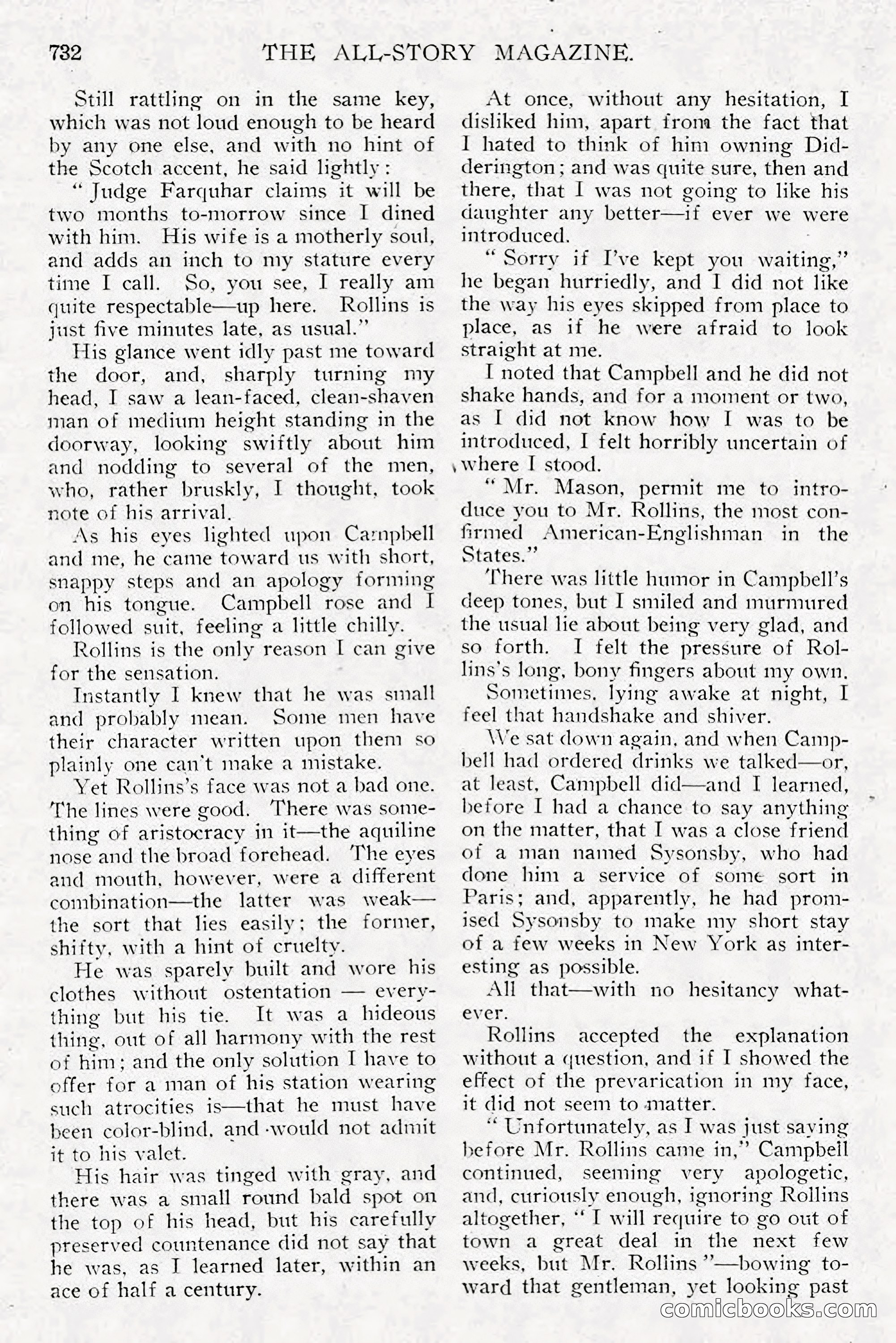
A restored page from Pulp Fiction, 1913. Page through the whole issue in the reader above.
📄 Transcribed text from this page (OCR, searchable)
Machine-transcribed from the original scan — historical spelling and the odd misread are preserved.
732 Still rattling on in the same key, which was not loud enough to be heard by any one else, and with no hint of the Scotch accent, he said lightly : “Judge Farquhar claims it will be two months to-morrow since I dined with him. His wife is a motherly soul, and adds an inch to my stature every time I call. So, you see, I really am quite respectable—up here. Rollins is just five minutes late, as usual.” His glance went idly past me toward the door, and, sharply turning my head, I saw a lean-faced, clean-shaven man of medium height standing in the doorway, looking swiftly about him and nodding to several of the men, who, rather bruskly, I thought, took note of his arrival. As his eyes lighted upon Carpbell and me, he came toward us with short, snappy steps and an apology forming on his tongue. Campbell rose and T followed suit, feeling a little chilly. Rollins is the only reason I can give for the sensation. Instantly I knew that he was small and probably mean. Some men have their character written upon them so plainly one can’t make a mistake. Yet Rollins’s face was not a bad one. The lines were good. There was some- thing of aristocracy in it—the aquiline nose >and the broad forehead. The eyes and mouth, however, were a different combination—the latter was weak— the sort that lies easily; the former, shifty, with a hint of cruelty. He was sparely built and wore his clothes without ostentation — every- thing but his tie. It was a hideous thing, out of all harmony with the rest of him: and the only solution I have to offer for a man of his station wearing such atrocities is—that he must have been color-blind, and -~would not admit it to his valet. His hair was tinged with gray, and there was a small round bald spot on the top of his head, but his carefully preserved countenance did not say that he was, as I learned later, within an ace of half a century. - THE ALL-STORY MAGAZINE. At once, without any hesitation, I disliked him, apart from the fact that I hated to think of him owning Did- derington ; and was quite sure, then and there, that I was not going to like his daughter any better—if ever we were introduced, “Sorry if I’ve kept you faitine: he began hurriedly, and I did not like the way his eyes skipped from place to place, as if he were afraid to look straight at me. I noted that Campbell and he did not shake hands, and for a moment or two, as I did not know how I was to be introduced, I felt horribly uncertain of where I stood, “Mr. Mason, permit me to intro- duce you to Mr. Rollins, the most con- firmed American-Englishman in the States.” ‘There was little humor in Campbell’s deep tones, but I smiled and murmured the usual lie about being very glad, and so forth. I felt the pressure of Rol- lins’s long, bony fingers about my own. Sometimes, lying awake at night, I feel that handshake and shiver. We sat down again, and when Camp- bell had ordered drinks we talked—or, at least, Campbell did—and I learned, betore I had a chance to say anything on the matter, that I was a close friend of a man named Sysonsby, who had done him a service of some sort in Paris; and, apparently, he had prom- ised Sysonsby to make my short stay of a few weeks in New York as inter- esting as possible. 39 ever. Rollins accepted the explanation without a question, and if I showed the effect of the prevarication in my face, it did not seem to matter. “ Unfortunately, as I was just saving before Mr. Rollins came in,’’ Campbeil continued, seeming very apologetic, and, curiously enough, ignoring Rollins altogether, ‘‘ [ will require to go out of town a great deal in the next few weeks, but Mr. Rollins ”’—hbowing to- ward that gentleman, yet looking past comiclooolkks.com