
Pulp Fiction, 1913 · page 13 of 268
All Story Magazine, December 1913 — page 13: what you’re looking at
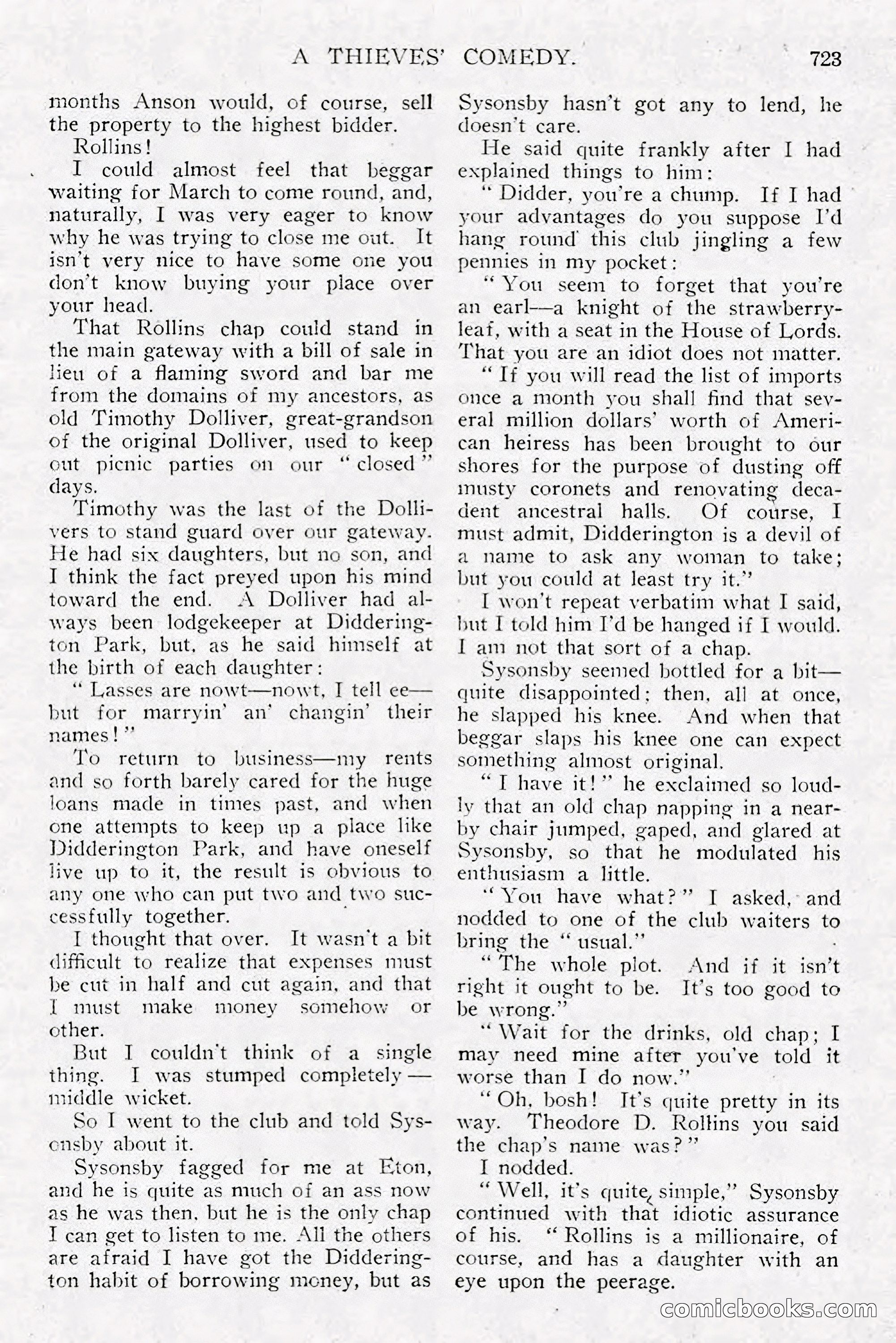
A restored page from Pulp Fiction, 1913. Page through the whole issue in the reader above.
📄 Transcribed text from this page (OCR, searchable)
Machine-transcribed from the original scan — historical spelling and the odd misread are preserved.
A THIEVES’ COMEDY. months Anson would, of course, sell the property to the highest bidder. Rollins! I could almost feel that beggar waiting for March to come round, and, naturally, I was very eager to know why he was trying to close me out. It isn’t very nice to have some one you don’t know buying your place over your head. That Rollins chap could stand in the main gateway with a bill of sale in hieu of a flaming sword and bar me from the domains of my ancestors, as old Timothy Dolliver, great-grandson of the original Dolliver, used to keep out picnic parties on our “ closed” days. Timothy was the last of the Dolli- vers to stand guard over our gateway. He had six daughters, but no son, and I think the fact preyed upon his mind toward the end. A Dolliver had al- ways been lodgekeeper at Diddering- ton Park, but, as he said himself at the birth of each daughter: “ Lasses are nowt—nowt, I tell ee— but for marryin’ an’ changin’ their names! ”’ To return to business—my _ rents and so forth barely cared for the huge loans made in times past, and when one attempts to keep up a place like Didderington Park, and have oneself live up to it, the result is obvious to any one who can put two and two suc- cessfully together. ' I thought that over. It wasn't a bit difficult to realize that expenses must be cut in half and cut again, and that { must make money somehow or other. But I couldn't think of a single thing. I was stumped completely — middle wicket. So I went to the club and told Sys- ensby about it. Sysonsby fagged for me at Eton, and he is quite as much of an ass now as he was then, but he is the only chap I can get to listen to me. Ali the others are afraid I have got the Diddering- ton habit of borrowing meney, but as 723 Sysonsby hasn’t got any to lend, he doesn't care. He said quite frankly after I had explained things to him: ‘* Didder, you’re a chump. If I had your advantages do you suppose I'd hang round this club jingling a few pennies in my pocket: “You seem to forget that you're an earl—a knight of the strawberry- leaf, with a seat in the House of Lords. That you are an idiot does not matter. “Tf you will read the list of imports once a month you shall find that sey- eral million dollars’ worth of Ameri- can heiress has been brought to our shores for the purpose of dusting off musty coronets and renovating deca- dent ancestral halls. Of course, I must admit, Didderington is a devil of a name to ask any woman to take; but you could at least try it.” I won't repeat verbatim what I said, but I told him I'd be hanged if I would. I am not that sort of a chap. Sysonsby seemed bottled for a bit— quite disappointed; then, all at once, he slapped his knee. And when that beggar slaps his knee one can expect something almost original. “T have it!’’ he exclaimed so loud- ly that an old chap napping in a near- by chair jumped, gaped, and glared at Sysonsby, so that he modulated his enthusiasm a little. “You have what?” I asked, and nodded to one of the club waiters to bring the ‘ usual.” “The whole plot. right it ought to be. be wrong.” “ Wait for the drinks, old chap; I may need mine after you've told it worse than I do now.” “Oh, bosh! It’s quite pretty in its way. Theodore D. Rollins you said the chap’s name was?” I nodded. “Well, it’s quite, simple,’ Sysonsby continued with that idiotic assurance of his. ‘ Rollins is a millionaire, of course, and has a daughter with an eye upon the peerage. And if it isn’t It’s too good to comiicloooks.com