
Pulp Fiction, 1913 · page 12 of 268
All Story Magazine, December 1913 — page 12: what you’re looking at
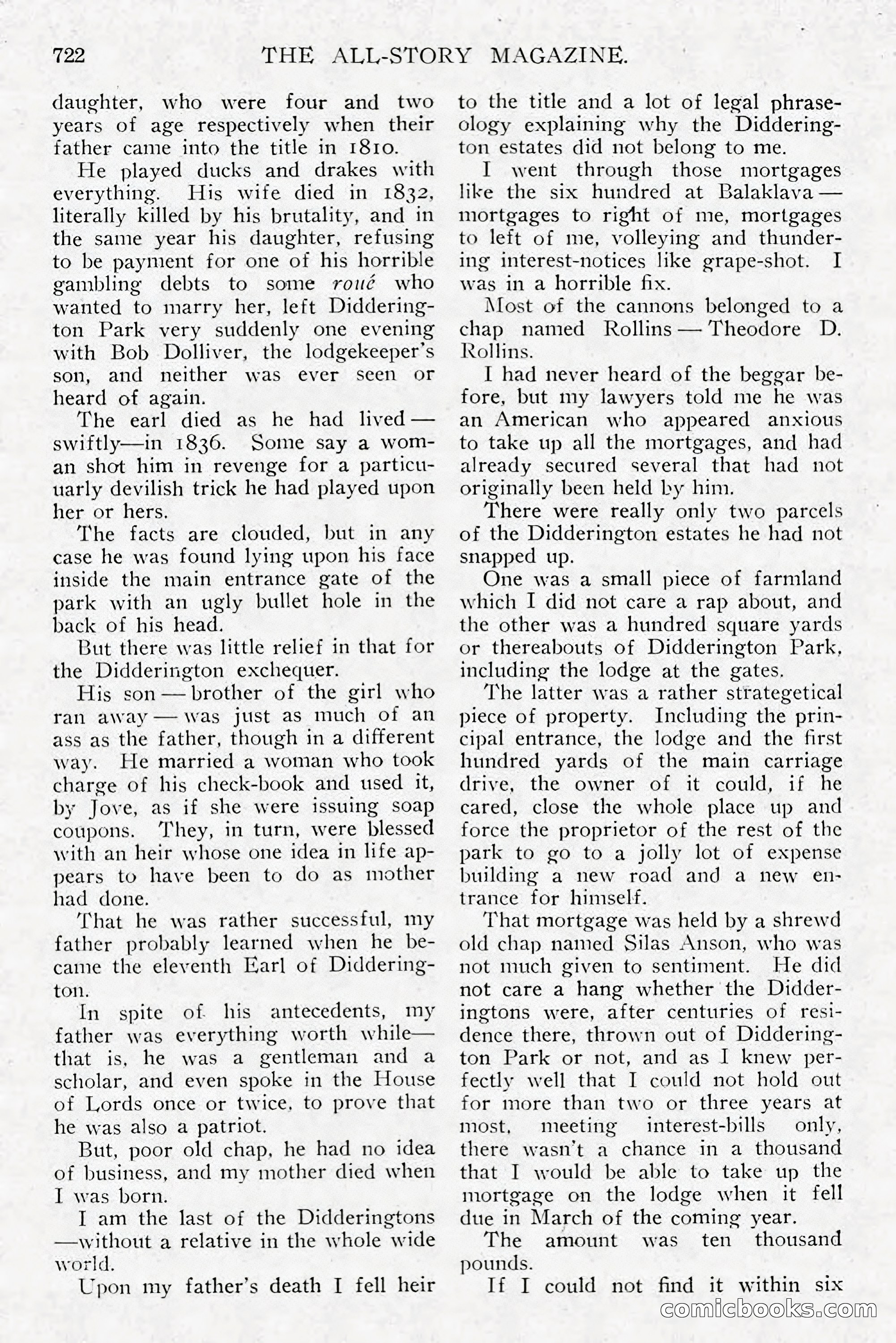
A restored page from Pulp Fiction, 1913. Page through the whole issue in the reader above.
📄 Transcribed text from this page (OCR, searchable)
Machine-transcribed from the original scan — historical spelling and the odd misread are preserved.
722 daughter, who were four and two years of age respectively when their father came into the title in 1810. He played ducks and drakes with everything. His wife died in 1832, literally killed by his brutality, and in the same year his daughter, refusing to be payment for one of his horrible gambling debts to some roué who wanted to marry her, left Diddering- ton Park very suddenly one evening with Bob Dolliver, the lodgekeeper’s son, and neither was ever seen or heard of again. The earl died as he had lived — swiftly—in 1836. Some say a wom- an shot him in revenge for a particu- uarly devilish trick he had played upon her or hers. The facts are clouded, but in any case he was found lying upon his face inside the main entrance gate of the park with an ugly bullet hole in the back of his head. But there was little relief in that for the Didderington exchequer. His son— brother of the girl who ran away — was just as much of an ass as the father, though in a different way. He married a woman who took charge of his check-book and used it, by Jove, as if she were issuing soap coupons. They, in turn, were blessed with an heir whose one idea in life ap- pears to have been to do as mother had done. That he was rather successful, my father probably learned when he be- came the eleventh Earl of Diddering- ton. In spite of his antecedents, my father was everything worth while— that is, he was a gentleman and a scholar, and even spoke in the House of Lords once or twice, to prove that he was also a patriot. But, poor old chap, he had no idea of business, and my mother died when I was born. I am the last of the Didderingtons —without a relative in the whole wide world, Upon my father’s death I fell heir THE ALL-STORY MAGAZINE. to the title and a lot of legal phrase- ology explaining why the Diddering- ton estates did not belong to me. I went through those mortgages like the six hundred at Balaklava — mortgages to right of me, mortgages to left of me, volleying and thunder- ing interest-notices like grape-shot. I was in a horrible fix. Most of the cannons belonged to a chap named Rollins — Theodore D. Rollins. I had never heard of the beggar be- fore, but my lawyers told me he was an American who appeared anxious to take up all the mortgages, and had already secured several that had not originally been held by him. There were really only two parcels of the Didderington estates he had not snapped up. One was a small piece of farmland which I did not care a rap about, and the other was a hundred square yards or thereabouts of Didderington Park, including the lodge at the gates, The latter was a rather strategetical piece of property. Including the prin- cipal entrance, the lodge and the first hundred yards of the main carriage drive, the owner of it could, if he cared, close the whole place up and force the proprietor of the rest of the park to go to a jolly lot of expense building a new road and a new en- trance for himself. That mortgage was held by a shrewd old chap named Silas Anson, who was not much given to sentiment. He did not care a hang whether the Didder- ingtons were, after centuries of resi- dence there, thrown out of Diddering- ton Park or not, and as I knew per- fectly well that I could not hold out for more than two or three years at most, meeting interest-bills only, there wasn’t a chance in a thousand that I would be able to take up the mortgage on the lodge when it fell due in March of the coming year. The amount was ten thousand pounds. If I could not find it within six comlicloooks.com