
Pulp Fiction, 1938 · page 87 of 100
Air Stories — page 87: what you’re looking at
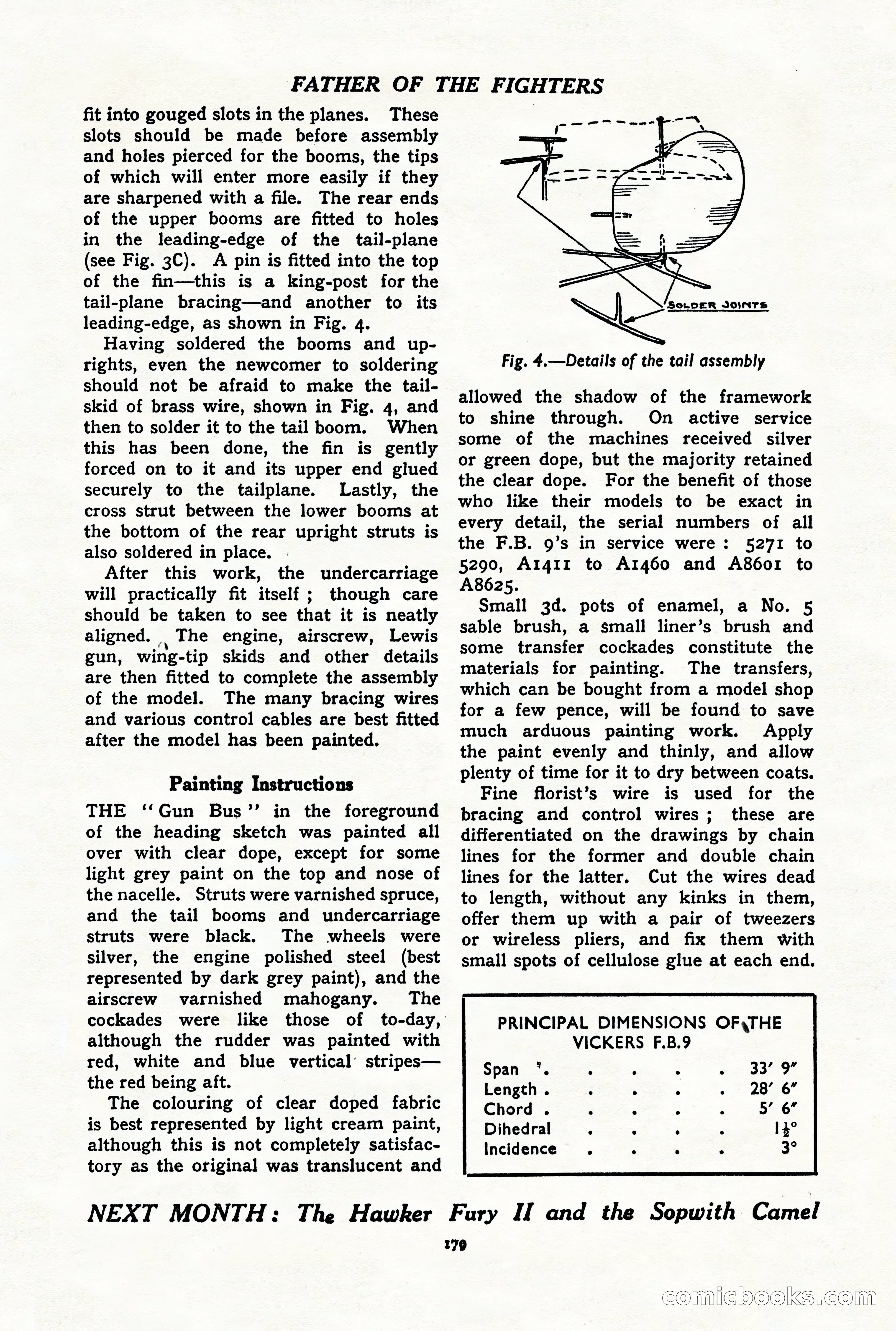
A restored page from Pulp Fiction, 1938. Page through the whole issue in the reader above.
📄 Transcribed text from this page (OCR, searchable)
Machine-transcribed from the original scan — historical spelling and the odd misread are preserved.
FATHER OF THE FIGHTERS fit into gouged slots in the planes. These slots should be made before assembly and holes pierced for the booms, the tips of which will enter more easily if they are sharpened with a file. The rear ends of the upper booms are fitted to holes in the leading-edge of the tail-plane (see Fig. 3C). A pin is fitted into the top of the fin—this is a king-post for the tail-plane bracing—and another to its leading-edge, as shown in Fig. 4. Having soldered the booms and up- rights, even the newcomer to soldering should not be afraid to make the tail- skid of brass wire, shown in Fig. 4, and then to solder it to the tail boom. When this has been done, the fin is gently forced on to it and its upper end glued securely to the tailplane. Lastly, the cross strut between the lower booms at the bottom of the rear upright struts is also soldered in place. After this work, the undercarriage will practically fit itself ; though care should be taken to see that it is neatly aligned. i The engine, airscrew, Lewis gun, wing-tip skids and other details are then fitted to complete the assembly of the model. The many bracing wires and various control cables are best fitted after the model has been painted. Painting Instructions THE ‘‘Gun Bus’’ in the foreground of the heading sketch was painted all over with clear dope, except for some light grey paint on the top and nose of the nacelle. Struts were varnished spruce, and the tail booms and undercarriage struts were black. The wheels were silver, the engine polished steel (best represented by dark grey paint), and the airscrew varnished mahogany. The cockades were like those of to-day,’ although the rudder was painted with red, white and blue vertical’ stripes— the red being aft. The colouring of clear doped fabric is best represented by light cream paint, although this is not completely satisfac- tory as the original was translucent and aan = = was Fig. 4.—Details of the tail assembly allowed the shadow of the framework to shine through. On active service some of the machines received silver or green dope, but the majority retained the clear dope. For the benefit of those who like their models to be exact in every detail, the serial numbers of all the F.B. 9’s in service were: 5271 to 5290, Ar4giz1 to A1460 and A86o01 to A8625. Small 3d. pots of enamel, a No. 5 sable brush, a small liner’s brush and some transfer cockades constitute the materials for painting. The transfers, which can be bought from a model shop for a few pence, will be found to save much arduous painting work. Apply the paint evenly and thinly, and allow plenty of time for it to dry between coats. Fine florist’s wire is used for the bracing and control wires; these are differentiated on the drawings by chain lines for the former and double chain lines for the latter. Cut the wires dead to length, without any kinks in them, offer them up with a pair of tweezers or wireless pliers, and fix them with small spots of cellulose glue at each end. PRINCIPAL DIMENSIONS OF THE VICKERS F.B.9 33’ 9” 28’ 6” 5’ 6” 14° 3° Span *. Length . Chord . F Dihedral ‘ Incidence ‘ NEXT MONTH: The Hawker Fury Il and the Sopwith Camel 179 EO DOO) ©