
Pulp Fiction, 1938 · page 76 of 100
Air Stories — page 76: what you’re looking at
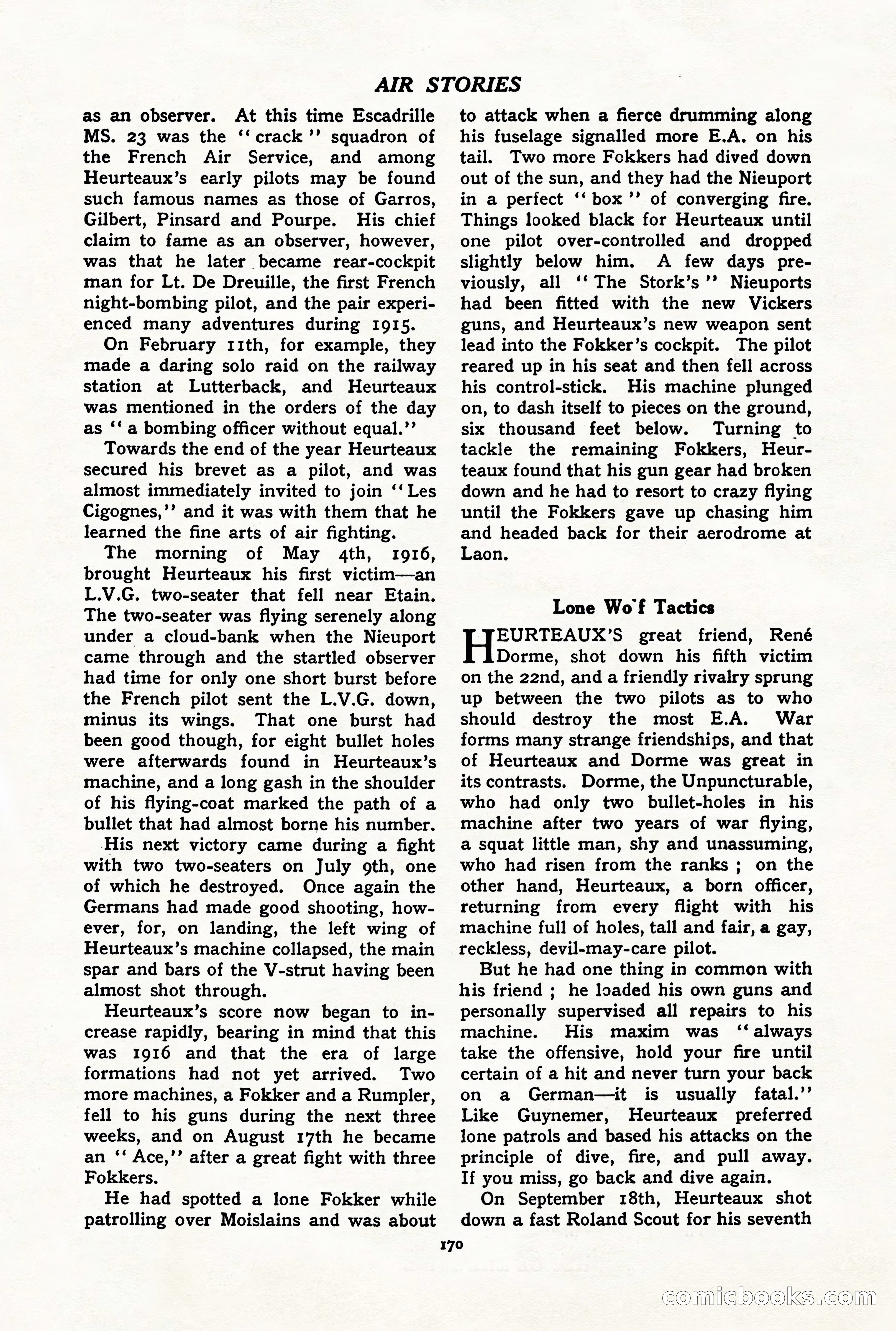
A restored page from Pulp Fiction, 1938. Page through the whole issue in the reader above.
📄 Transcribed text from this page (OCR, searchable)
Machine-transcribed from the original scan — historical spelling and the odd misread are preserved.
AIR STORIES as an observer. At this time Escadrille MS. 23 was the ‘‘ crack ’’ squadron of the French Air Service, and among Heurteaux’s early pilots may be found such famous names as those of Garros, Gilbert, Pinsard and Pourpe. His chief claim to fame as an observer, however, was that he later became rear-cockpit man for Lt. De Dreuille, the first French night-bombing pilot, and the pair experi- enced many adventures during I9I15. On February 11th, for example, they made a daring solo raid on the railway station at Lutterback, and Heurteaux was mentioned in the orders of the day as ‘‘a bombing officer without equal.’’ Towards the end of the year Heurteaux secured his brevet as a pilot, and was almost immediately invited to join ‘‘Les Cigognes,’’ and it was with them that he learned the fine arts of air fighting. The morning of May 4th, 1916, brought Heurteaux his first victim—an L.V.G. two-seater that fell near Etain. The two-seater was flying serenely along under a cloud-bank when the Nieuport came through and the startled observer had time for only one short burst before the French pilot sent the L.V.G. down, minus its wings. That one burst had been good though, for eight bullet holes were afterwards found in Heurteaux’s machine, and a long gash in the shoulder of his flying-coat marked the path of a bullet that had almost borne his number. -His next victory came during a fight with two two-seaters on July goth, one of which he destroyed. Once again the Germans had made good shooting, how- ever, for, on landing, the left wing of Heurteaux’s machine collapsed, the main spar and bars of the V-strut having been almost shot through. Heurteaux’s score now began to in- crease rapidly, bearing in mind that this was 1916 and that the era of large formations had not yet arrived. Two more machines, a Fokker and a Rumpler, fell to his guns during the next three weeks, and on August 17th he became an ‘‘ Ace,’’ after a great fight with three Fokkers. He had spotted a lone Fokker while patrolling over Moislains and was about to attack when a fierce drumming along his fuselage signalled more E.A. on his tail. Two more Fokkers had dived down out of the sun, and they had the Nieuport in a perfect ‘‘ box ’’ of converging fire. Things looked black for Heurteaux until one pilot over-controlled and dropped slightly below him. A few days pre- viously, all ‘‘ The Stork’s’’ Nieuports had been fitted with the new Vickers guns, and Heurteaux’s new weapon sent lead into the Fokker’s cockpit. The pilot reared up in his seat and then fell across his control-stick. His machine plunged on, to dash itself to pieces on the ground, six thousand feet below. Turning to tackle the remaining Fokkers, Heur- teaux found that his gun gear had broken down and he had to resort to crazy flying until the Fokkers gave up chasing him and headed back for their aerodrome at Laon. Lone Wo f Tactics EURTEAUX’S great friend, René Dorme, shot down his fifth victim on the 22nd, and a friendly rivalry sprung up between the two pilots as to who should destroy the most E.A. War forms many strange friendships, and that of Heurteaux and Dorme was great in its contrasts. Dorme, the Unpuncturable, who had only two bullet-holes in his machine after two years of war flying, a squat little man, shy and unassuming, who had risen from the ranks ; on the other hand, Heurteaux, a born officer, returning from every flight with his machine full of holes, tall and fair, a gay, reckless, devil-may-care pilot. But he had one thing in common with his friend ; he loaded his own guns and personally supervised all repairs to his machine. His maxim was ‘‘ always take the offensive, hold your fire until certain of a hit and never turn your back on a German—it is usually fatal.’’ Like Guynemer, Heurteaux preferred lone patrols and based his attacks on the principle of dive, fire, and pull away. If you miss, go back and dive again. On September 18th, Heurteaux shot down a fast Roland Scout for his seventh 170 Ccommclboolk (©