
Pulp Fiction, 1938 · page 75 of 100
Air Stories — page 75: what you’re looking at
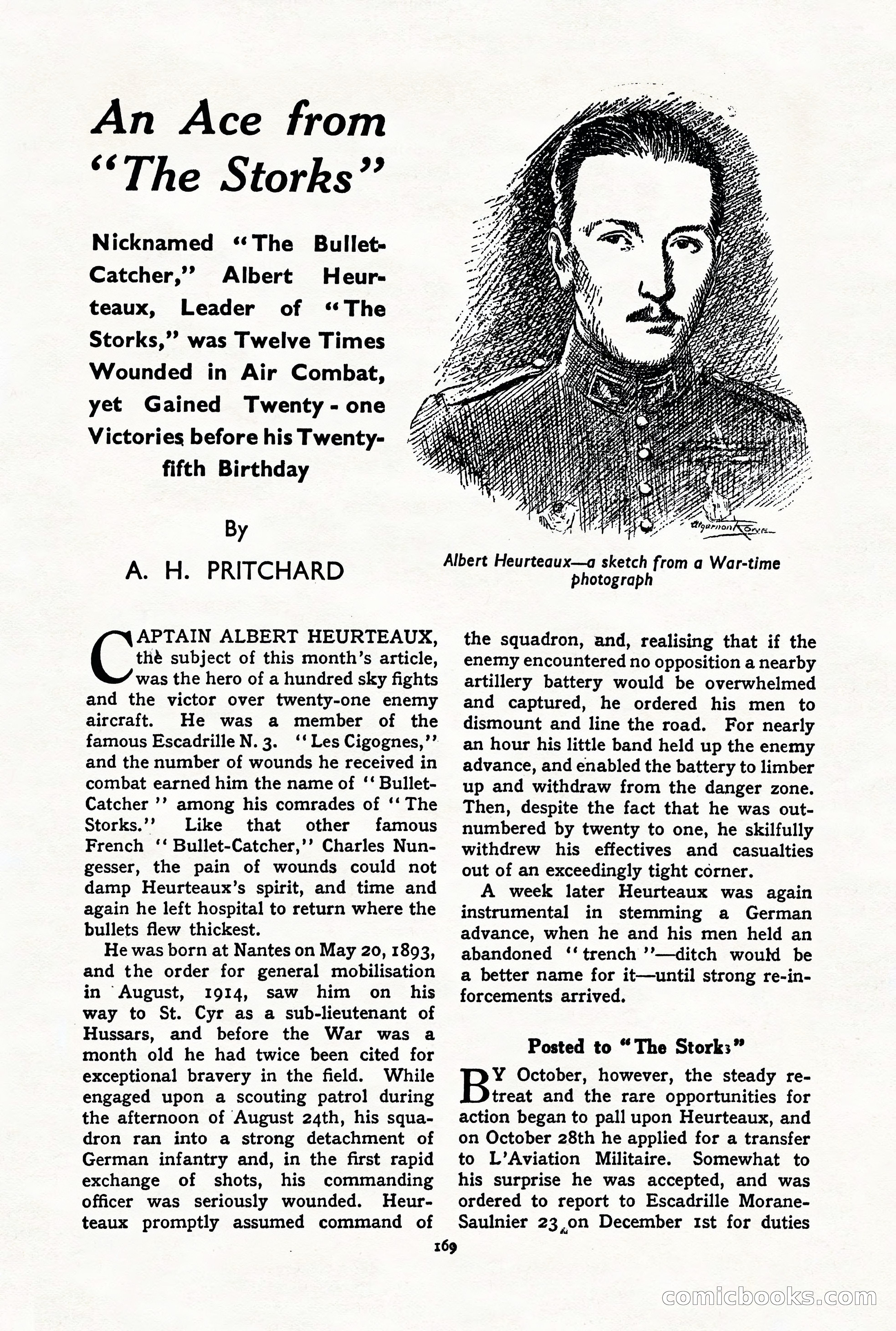
A restored page from Pulp Fiction, 1938. Page through the whole issue in the reader above.
📄 Transcribed text from this page (OCR, searchable)
Machine-transcribed from the original scan — historical spelling and the odd misread are preserved.
An Ace from ‘The Storks’’ A os Nicknamed ‘The Bullet- TG: Catcher,” Albert H ie atcher, er eur= Wie y f teaux, Leader of ‘* The Yee ‘ Mog Storks,”? was Twelve Times on We hi set Nore iG): OgA hpe: "1 SAE le eee e yj ’ 5 Wounded in Air Combat, ZI OE EM OH MELE et Gained Twenty-one 4o*2440 G3 Se eee es & a Y 7 A “16% yg ¥ Py 23° , ry Wes 5 a Neo 7° / Victories before his Twenty- 2,GRaA A eaten apie te sou YI fifth Birthda ERICH OE Ha Teen Pee EER EE 2 es 1] 1G Gs get-a%, eA Aidt CA aA ; BLO NS ye 7. ‘ IZ, $0450: 4'5 Ca t's a 59 09 eee eee 1 OIE AY Sa Ne RH game Me oo 1 eM ight o(42 Ne SILO 8 AR any BEANO Ee 2 By Dr dl ee ald yet * WhhernonP Saves A. H. PRITCHARD APTAIN ALBERT HEURTEAUX, thé subject of this month’s article, was the hero of a hundred sky fights and the victor over twenty-one enemy aircraft. He was a member of the famous Escadrille N. 3. and the number of wounds he received in combat earned him the name of ‘‘ Bullet- Catcher ’’ among his comrades of ‘‘ The Storks.’? Like that other famous French ‘‘ Bullet-Catcher,’’ Charles Nun- gesser, the pain of wounds could not damp Heurteaux’s spirit, and time and again he left hospital to return where the bullets flew thickest. He was born at Nantes on May 20, 1893, and the order for general mobilisation in August, 1914, saw him on_ his way to St. Cyr as a sub-lieutenant of Hussars, and before the War was a month old he had twice been cited for exceptional bravery in the field. While engaged upon a scouting patrol during the afternoon of August 24th, his squa- dron ran into a strong detachment of German infantry and, in the first rapid exchange of shots, his commanding officer was seriously wounded. Heur- teaux promptly assumed command of Albert Heurteaux—a sketch from a War-time ‘* Les Cigognes,’’ 169 photograph the squadron, and, realising that if the enemy encountered no opposition a nearby artillery battery would be overwhelmed and captured, he ordered his men to dismount and line the road. For nearly an hour his little band held up the enemy advance, and enabled the battery to limber up and withdraw from the danger zone. Then, despite the fact that he was out- numbered by twenty to one, he skilfully withdrew his effectives and casualties out of an exceedingly tight corner. A week later Heurteaux was again instrumental in stemming a German advance, when he and his men held an abandoned ‘‘ trench ’’—ditch would be a better name for it—until strong re-in- forcements arrived. Posted to “ The Stork;” Y October, however, the steady re- treat and the rare opportunities for action began to pall upon Heurteaux, and on October 28th he applied for a transfer to L’Aviation Militaire. Somewhat to his surprise he was accepted, and was ordered to report to Escadrille Morane- Saulnier 23,0n December Ist for duties COMIECLOO© (©