
Pulp Fiction, 1938 · page 75 of 100
Air Stories — page 75: what you’re looking at
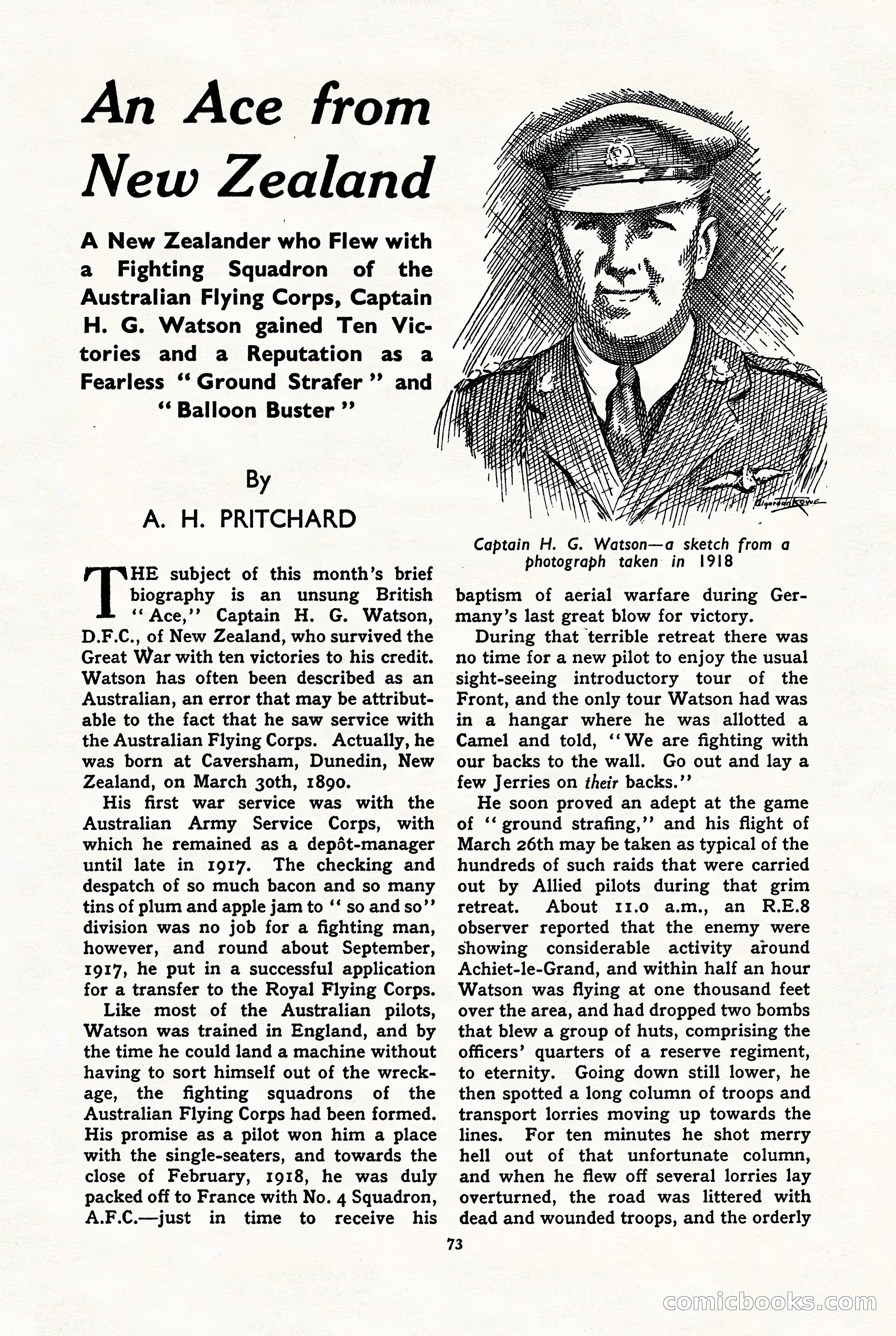
A restored page from Pulp Fiction, 1938. Page through the whole issue in the reader above.
📄 Transcribed text from this page (OCR, searchable)
Machine-transcribed from the original scan — historical spelling and the odd misread are preserved.
An Ace from New Zealand A New Zealander who Flew with a Fighting Squadron of the Australian Flying Corps, Captain H. G. Watson gained Ten Vic- tories and a Reputation as a Fearless ‘‘ Ground Strafer ’’ and ‘* Balloon Buster ”’ By A. H. PRITCHARD HE subject of this month’s brief biography is an unsung British ‘“Ace,’’ Captain H. G. Watson, D.F.C., of New Zealand, who survived the Great War with ten victories to his credit. Watson has often been described as an Australian, an error that may be attribut- able to the fact that he saw service with the Australian Flying Corps. Actually, he was born at Caversham, Dunedin, New Zealand, on March 3oth, 1890. His first war service was with the Australian Army Service Corps, with which he remained as a depdt-manager until late in 1917. The checking and despatch of so much bacon and so many tins of plum and apple jam to ‘‘ so and so’’ division was no job for a fighting man, however, and round about September, 1917, he put in a successful application for a transfer to the Royal Flying Corps. Like most of the Australian pilots, Watson was trained in England, and by the time he could land a machine without having to sort himself out of the wreck- age, the fighting squadrons of the Australian Flying Corps had been formed. His promise as a pilot won him a place with the single-seaters, and towards the close of February, 1918, he was duly packed off to France with No. 4 Squadron, A.F.C.—just in time to _ receive his . gS S 4 ed QSL VED é LEE LE IP Oaee?, Captain H. G. Watson—a sketch from a photograph taken in 1918 baptism of aerial warfare during Ger- many’s last great blow for victory. During that terrible retreat there was no time for a new pilot to enjoy the usual sight-seeing introductory tour of the Front, and the only tour Watson had was in a hangar where he was allotted a Camel and told, ‘‘ We are fighting with our backs to the wall. Go out and lay a few Jerries on their backs.’’ He soon proved an adept at the game of ‘‘ ground strafing,’’ and his flight of March 26th may be taken as typical of the hundreds of such raids that were carried out by Allied pilots during that grim retreat. About I1.0 a.m., an R.E.8 observer reported that the enemy were showing considerable activity around Achiet-le-Grand, and within half an hour Watson was flying at one thousand feet over the area, and had dropped two bombs that blew a group of huts, comprising the officers’ quarters of a reserve regiment, to eternity. Going down still lower, he then spotted a long column of troops and transport lorries moving up towards the lines. For ten minutes he shot merry hell out of that unfortunate column, and when he flew off several lorries lay overturned, the road was littered with dead and wounded troops, and the orderly 73 CO OO (C ”, 5 pent lols x x x Gt SY KD ~ see?, 0 om ; S PRK i De . \ Fille f . ~ Ahn HH] > b < CZ Y) Hh Kk} i toresaee TTT PN LK _ Fi it Zee. >. LP * HT EE } LU ey Ze If REA oO CU PZLEHB LE, ibestete ite | : HGALII pibelesraceelies BA Cezeese\ens TA hoes YEH VA 42595 1eg 5448 gi EBs 448% 2058 4 nn 7 f Ay ‘30g LACAN ee OS WS WLLL gh: CTH A OK a AI AEE) RE HARA ASA ROS WA ADELE TA EE ALS 1:5 69 the coe GENO ee OM I A EEE HANSA NO RAE LAT AHH e \ ‘ t MALL ~~ eat wi ¥ Giger an iy, A Nt AAA AWG N Lf) HE far, Migs Be