
Pulp Fiction, 1938 · page 74 of 100
Air Stories — page 74: what you’re looking at
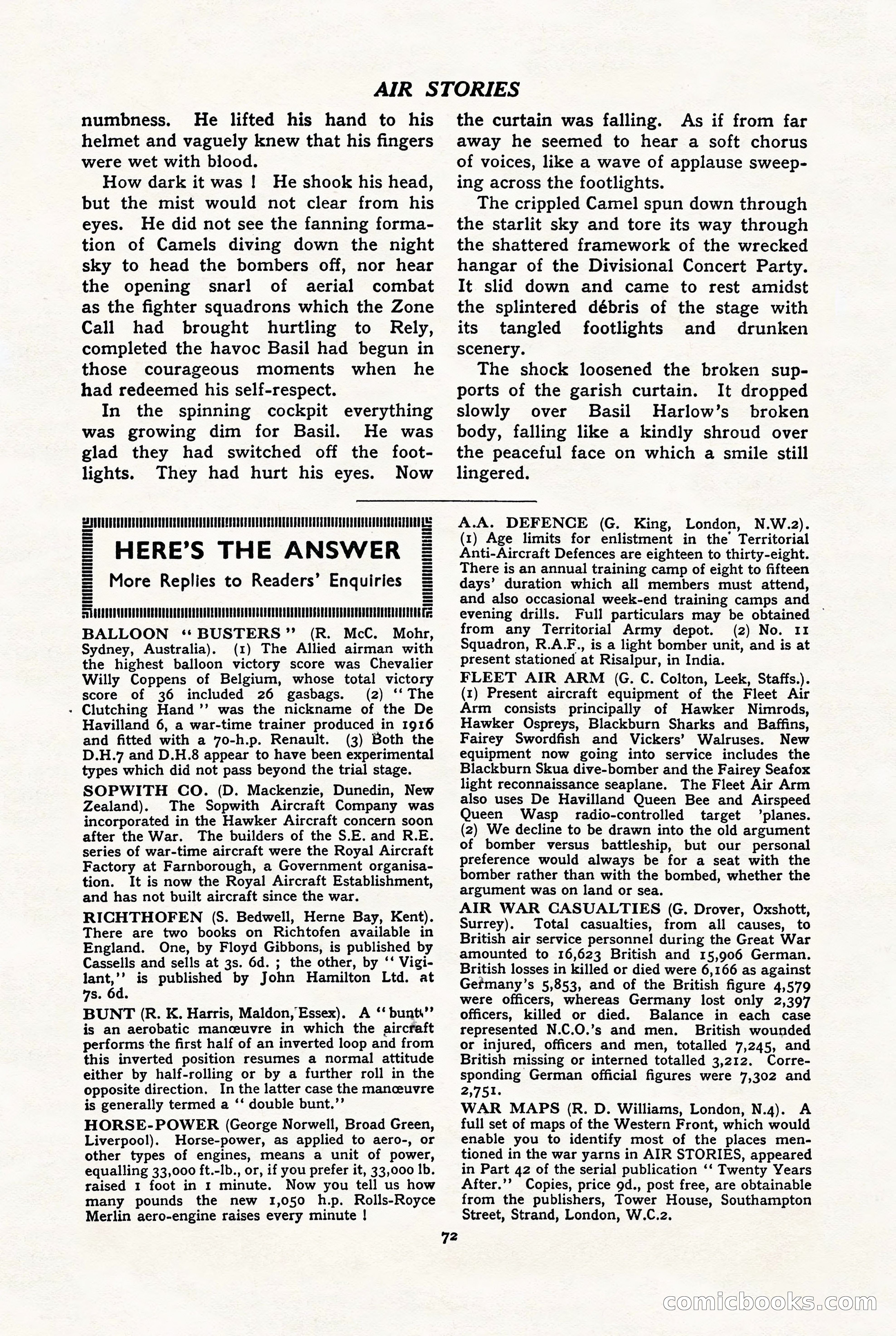
A restored page from Pulp Fiction, 1938. Page through the whole issue in the reader above.
📄 Transcribed text from this page (OCR, searchable)
Machine-transcribed from the original scan — historical spelling and the odd misread are preserved.
AIR STORIES numbness. He lifted his hand to his helmet and vaguely knew that his fingers were wet with blood. How dark it was | He shook his head, but the mist would not clear from his eyes. He did not see the fanning forma- tion of Camels diving down the night sky to head the bombers off, nor hear the opening snarl of aerial combat as the fighter squadrons which the Zone Call had brought hurtling to Rely, completed the havoc Basil had begun in those courageous moments when he had redeemed his self-respect. In the spinning cockpit everything was growing dim for Basil. He was glad they had switched off the foot- lights. They had hurt his eyes. Now HERE’S THE ANSWER More Replies to Readers’ Enquiries DUUOUSARENUEUSTUAUTENLE ks ETIUIUUQUQUUDUNUOGUONULQUCHOQUEQUUEUNOEDOBUODUQUOVEQUAHOQUNDGODEONOSUONUONSEDQQUEROUSUUOG re BALLOON ‘* BUSTERS” (R. McC. Mohr, Sydney, Australia). (1) The Allied airman with the highest balloon victory score was Chevalier Willy Coppens of Belgium, whose total victory score of 36 included 26 gasbags. (2) ‘‘ The - Clutching Hand ’’ was the nickname of the De Havilland 6, a war-time trainer produced in 1916 and fitted with a 70-h.p. Renault. (3) Both the D.H.7 and D.H.8 appear to have been experimental types which did not pass beyond the trial stage. SOPWITH CoO. (D. Mackenzie, Dunedin, New Zealand). The Sopwith Aircraft Company was incorporated in the Hawker Aircraft concern soon after the War. The builders of the S.E. and R.E. series of war-time aircraft were the Royal Aircraft Factory at Farnborough, a Government organisa- tion. It is now the Royal Aircraft Establishment, and has not built aircraft since the war. RICHTHOFEN (S. Bedwell, Herne Bay, Kent). There are two books on Richtofen available in England. One, by Floyd Gibbons, is published by Cassells and sells at 3s. 6d. ; the other, by ‘‘ Vigi- lant,’’ is published by John Hamilton Ltd. at 7s. 6d. BUNT (R. K. Harris, Maldon, Essex). A ‘‘ buntt’’ is an aerobatic manceuvre in which the aircraft performs the first half of an inverted loop and from this inverted position resumes a normal attitude either by half-rolling or by a further roll in the opposite direction. In the latter case the manceuvre is generally termed a ‘‘ double bunt.’’ HORSE-POWER (George Norwell, Broad Green, Liverpool). Horse-power, as applied to aero-, or other types of engines, means a unit of power, equalling 33,000 ft.-lb., or, if you prefer it, 33,000 Ib. raised 1 foot in I minute. Now you tell us how many pounds the new 1,050 h.p. Rolls-Royce Merlin aero-engine raises every minute ! 72 the curtain was falling. As if from far away he seemed to hear a soft chorus of voices, like a wave of applause sweep- ing across the footlights. The crippled Camel spun down through the starlit sky and tore its way through the shattered framework of the wrecked hangar of the Divisional Concert Party. It slid down and came to rest amidst the splintered débris of the stage with its tangled footlights and drunken scenery. The shock loosened the broken sup- ports of the garish curtain. It dropped slowly over Basil Harlow’s broken body, falling like a kindly shroud over the peaceful face on which a smile still lingered. A.A. DEFENCE (G. King, London, N.W.2). (1) Age limits for enlistment in the’ Territorial Anti-Aircraft Defences are eighteen to thirty-eight. There is an annual training camp of eight to fifteen days’ duration which all members must attend, and also occasional week-end training camps and evening drills. from any Territorial Army depot. (2) No. 11 Squadron, R.A.F., is a light bomber unit, and is at present stationed at Risalpur, in India. FLEET AIR ARM (G. C. Colton, Leek, Staffs.). (1) Present aircraft equipment of the Fleet Air Arm consists principally of Hawker Nimrods, Hawker Ospreys, Blackburn Sharks and Baffins, Fairey Swordfish and Vickers’ Walruses. New equipment now going into service includes the Blackburn Skua dive-bomber and the Fairey Seafox light reconnaissance seaplane. The Fleet Air Arm also uses De Havilland Queen Bee and Airspeed Queen Wasp radio-controlled target ’planes. (2) We decline to be drawn into the old argument of bomber versus battleship, but our personal preference would always be for a seat with the bomber rather than with the bombed, whether the argument was on land or sea. AIR WAR CASUALTIES (G. Drover, Oxshott, Surrey). Total casualties, from all causes, to British air service personnel during the Great War amounted to 16,623 British and 15,906 German. British losses in killed or died were 6,166 as against Gefmany’s 5,853, and of the British figure 4,579 were officers, whereas Germany lost only 2,397 officers, killed or died. Balance in each case represented N.C.O.’s and men. British wounded or injured, officers and men, totalled 7,245, and British missing or interned totalled 3,212. Corre- sponding German official figures were 7,302 and 2,751. WAR MAPS (R. D. Williams, London, N.4). A full set of maps of the Western Front, which would enable you to identify most of the places men- tioned in the war yarns in AIR STORIES, appeared in Part 42 of the serial publication ‘‘ Twenty Years After.’’ Copies, price 9d., post free, are obtainable from the publishers, Tower House, Southampton Street, Strand, London, W.C.z2. COMICLO@O Full particulars may be obtained ~ (©